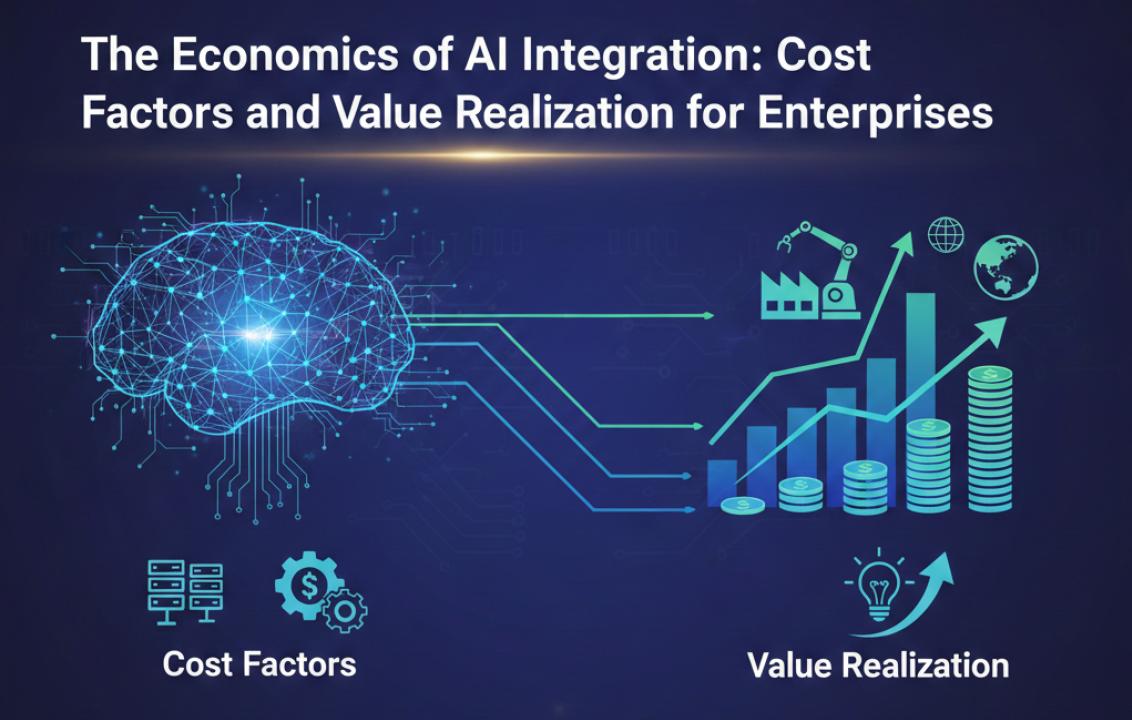
In today's competitive business landscape, enterprises and well-funded startups increasingly turn to Artificial Intelligence (AI) to drive efficiency, innovation, and strategic advantage. Understanding the economics of AI integration is critical for decision-makers evaluating technology investments. AI Integration Services offer a structured approach to incorporating AI capabilities into existing operations, enabling organizations to optimize resources, reduce operational costs, and generate measurable business value. From predictive analytics to automated decision-making, enterprises are recognizing that a well-planned AI strategy is not merely a technological upgrade but a significant investment that impacts long-term ROI. This article explores the cost factors and value realization associated with AI integration, offering insights for leaders seeking practical guidance.
How do AI integration services improve enterprise efficiency?
AI integration services are designed to embed intelligence into core business processes, transforming how enterprises operate. By leveraging advanced algorithms and data-driven insights, these services enable companies to reduce manual workloads, enhance decision accuracy, and improve overall operational efficiency.
Key ways AI integration services drive efficiency include:
- Automating repetitive tasks such as invoice processing and customer support.
- Enhancing supply chain forecasting using predictive analytics.
- Identifying patterns in large datasets for strategic decision-making.
- Reducing operational bottlenecks through real-time monitoring.
- Optimizing resource allocation and workforce management.
Organizations partnering with a reliable AI integration company gain access to expertise in integrating AI into legacy systems while ensuring minimal disruption. Furthermore, advanced tools like Generative AI can support content creation, data synthesis, and customer engagement strategies, which can dramatically reduce time-to-market for products and services.
What are the main cost factors in AI integration?
Implementing AI solutions involves several cost components that enterprises must consider during planning. While initial investment may seem high, understanding these factors helps justify expenditure through long-term value creation.
Key cost factors include:
- Software and platform licensing: Fees for AI platforms, analytics tools, or cloud services.
- Data preparation and management: Collecting, cleaning, and organizing data for AI models.
- Talent and consulting: Hiring skilled data scientists, engineers, or outsourcing through AI Integration Consulting.
- Integration with existing systems: Customization and middleware to ensure AI functions smoothly with legacy infrastructure.
- Maintenance and updates: Continuous improvement of AI models and software.
While cost structures vary, enterprises typically find that the ROI justifies the initial investment, particularly when AI enables faster decision-making and reduces operational inefficiencies.
How can enterprises maximize value from AI integration solutions?
Maximizing value from AI integration requires a strategic approach that aligns technology with business objectives. Enterprises often struggle when AI initiatives are implemented in isolation rather than as part of a broader operational strategy.
Effective strategies include:
- Defining clear KPIs to measure the impact of AI on business outcomes.
- Prioritizing use cases where AI offers immediate operational or revenue benefits.
- Investing in scalable solutions that grow with organizational needs.
- Fostering internal AI literacy to ensure teams understand and adopt AI tools effectively.
- Partnering with an experienced AI integration company to access specialized knowledge.
Generative AI and other AI integration solutions offer additional advantages, such as improved customer engagement, personalized experiences, and advanced analytics. Enterprises that integrate AI thoughtfully realize both cost savings and revenue growth, ensuring technology investments contribute to competitive advantage.
Which AI integration approaches offer the best ROI for startups?
For well-funded startups, AI adoption must balance innovation with resource efficiency. Unlike established enterprises, startups often operate under tight timelines, making the choice of AI integration strategy critical.
High-ROI approaches include:
- Cloud-based AI solutions: Reduce infrastructure costs and accelerate deployment.
- AI Integration Consulting partnerships: Provide expert guidance without the overhead of hiring large internal teams.
- Modular AI applications: Enable startups to scale AI adoption incrementally.
- Data-focused AI initiatives: Prioritize projects that leverage existing data for predictive insights and market analysis.
- Process automation for operational efficiency: Frees up teams to focus on innovation and growth.
A structured approach to AI integration ensures that startups minimize unnecessary costs while capitalizing on technology to gain early market advantages. Leveraging Artificial Intelligence Integration Services from specialized providers also helps startups implement AI with industry best practices, reducing risk and enhancing outcomes.
What role does AI integration consulting play in enterprise transformation?
AI integration consulting serves as a bridge between strategy and execution, helping enterprises navigate the complexities of AI adoption. Consulting services typically focus on:
- Evaluating existing workflows and identifying AI opportunities.
- Selecting appropriate AI models and technology stacks.
- Designing implementation roadmaps that align with business objectives.
- Ensuring data security, compliance, and ethical considerations.
- Providing ongoing support to refine AI systems post-deployment.
AI Integration Consulting is particularly valuable for enterprises with complex operations, as consultants provide actionable insights that reduce implementation risks and accelerate value realization. External data shows that organizations that invest in expert AI guidance are 40 percent more likely to achieve measurable ROI within the first year of integration.
By leveraging AI integration consulting alongside AI integration solutions, enterprises can unlock new revenue streams, improve operational efficiency, and gain actionable insights for strategic planning.
FAQ
1. What are AI integration services?
AI integration services involve embedding artificial intelligence into enterprise systems to optimize operations, enhance decision-making, and improve efficiency. These services include workflow automation, predictive analytics, and system integration for measurable business impact.
2. Why should enterprises partner with an AI integration company?
Partnering with a specialized AI integration company provides access to technical expertise, industry knowledge, and proven methodologies, helping enterprises implement AI effectively without disrupting existing workflows.
3. How do AI integration solutions reduce operational costs?
AI solutions automate repetitive tasks, improve process efficiency, and deliver actionable insights. These capabilities help organizations lower labor costs, reduce errors, and optimize resource allocation across departments.
4. What is the role of AI integration consulting?
AI integration consulting guides enterprises through strategy, implementation, and post-deployment optimization. Consultants help identify use cases, select suitable technologies, and ensure AI projects align with business objectives.
5. How can startups benefit from Artificial Intelligence Integration Services?
Startups can accelerate growth by leveraging scalable AI solutions, cloud-based tools, and consulting expertise. This approach allows startups to gain insights, streamline operations, and improve customer engagement with minimal overhead.
6. What types of AI integration solutions are most effective?
Effective solutions include predictive analytics, workflow automation, generative AI applications, and AI-powered decision support systems. Selection depends on business objectives, data availability, and scalability needs.
Conclusion
Integrating AI into enterprise operations is a strategic investment that combines technology with measurable business outcomes. AI Integration Services help enterprises and startups reduce operational inefficiencies, leverage data for decision-making, and create new revenue opportunities. By understanding cost factors, prioritizing high-impact initiatives, and partnering with an experienced AI integration company, organizations can maximize the value of AI while controlling expenditure. Enterprises and strong startups seeking to enhance performance and ROI should explore AI Integration Services to achieve a sustainable competitive advantage.