As Bangalore continues to expand as India’s largest technology and cloud
infrastructure hub, enterprises are rapidly adopting VXLAN EVPN fabrics to
modernize their data center networks. VXLAN EVPN enables scalable,
multi-tenant, and highly flexible data center architectures—perfect for supporting
the massive growth of SaaS, fintech, AI workloads, and enterprise applications
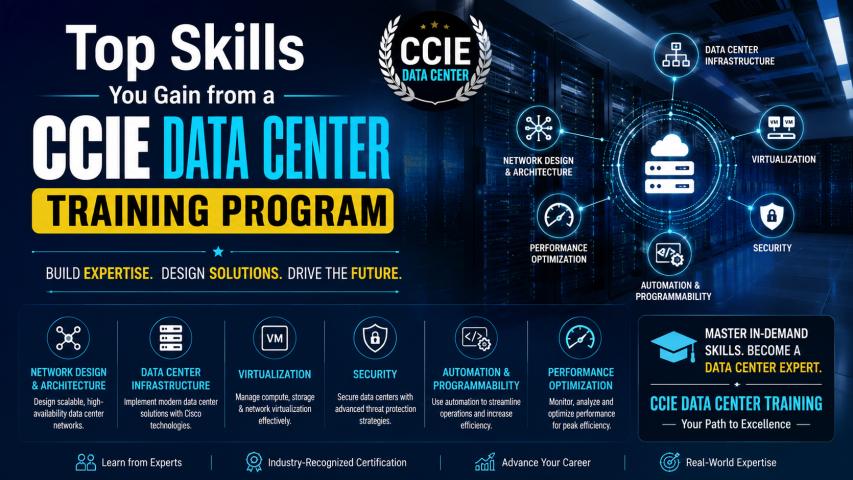
across Bangalore’s digital ecosystem. Many professionals exploring CCIE Data Center Bangalore are now prioritizing VXLAN EVPN expertise since
it is one of the most in-demand skills for modern DC engineers.
This blog provides an 800-word, SEO-optimized, neutral overview of the best
practices for building and optimizing VXLAN EVPN fabrics in Bangalore’s
next-generation data centers.
1. Start with a Leaf-Spine Architecture
A fundamental principle of VXLAN EVPN design is the leaf-spine
topology, which ensures predictable latency and high bandwidth. Best
practices include:
·
Deploying equal-cost leaf-to-spine connections
·
Avoiding daisy-chain designs
·
Ensuring all leaf switches connect to all spine
switches
·
Keeping spine switches Layer 3 only (no VLAN
stitching)
This architecture provides non-blocking traffic paths suitable for
Bangalore’s high-performance workloads.
2. Use BGP EVPN for Control Plane Signaling
VXLAN EVPN fabrics rely on BGP EVPN to distribute MAC, IP,
and VRF information. To ensure effective implementation:
·
Use MP-BGP for EVPN Route Types (2, 3, 5)
·
Enable address-family l2vpn evpn on all leaf and
spine switches
·
Maintain consistent ASN placement across the
fabric
·
Use Route Reflectors (RRs) for scalable control
plane operations
BGP EVPN brings stability and scalability, making it ideal for large
Bangalore data centers.
3. Prefer Distributed Anycast Gateways
Anycast Gateway allows hosts to use the same default gateway across all leaf
switches. Best practices include:
·
Consistent SVI configurations across leaf
switches
·
Using the same virtual MAC address
·
Maintaining identical IP gateway addresses
Distributed gateways reduce east-west traffic and minimize latency within
the fabric.
4. Implement Redundancy with vPC or vPC+
To ensure host-level redundancy:
·
Use vPC or vPC+ on leaf switches connecting to
servers
·
Avoid spanning tree designs
·
Maintain FHRP-free operation through Anycast
Gateway
·
Ensure consistent port-channel configurations
Redundancy mechanisms help maintain uptime in Bangalore’s mission-critical
applications.
5. Use Separate VRFs for Multi-Tenancy
For Bangalore companies hosting multiple departments, applications, or
customer environments:
·
Use VRFs to isolate traffic
·
Leverage Route Targets (RT) for export/import
control
·
Use BD/EPG segmentation to maintain isolation
Multi-tenancy is a core requirement in large enterprises and SaaS-focused
data centers.
6. Optimize Underlay Network Design
A strong underlay ensures a stable overlay. Best practices include:
·
Use OSPF or IS-IS for underlay routing
·
Maintain consistent MTU across the fabric
(usually > 1550)
·
Enable ECMP to optimize bandwidth
·
Use loopback interfaces for VTEP endpoints
A well-designed underlay ensures VXLAN encapsulation works smoothly.
7. Properly Assign and Manage VNIs
VXLAN Network Identifiers (VNIs) segment tenant traffic within the fabric.
For efficient VNI allocation:
·
Assign dedicated VNIs for Layer 2 and Layer 3
·
Avoid overlapping VNI ranges
·
Use templated numbering for easy identification
·
Maintain documentation for global VNI allocation
This ensures scalability and minimizes misconfigurations.
8. Enable Multicast or Head-End Replication (HER)
VXLAN supports two replication methods:
Multicast Replication Best
Practices:
·
Use PIM-SM
·
Properly prune multicast trees
·
Ensure multicast is supported in the underlay
Head-End Replication (HER):
·
Preferred in many Bangalore DCs due to
simplicity
·
Reduces dependency on multicast
·
Works efficiently for moderate-sized fabrics
HER is more common in modern EVPN deployments due to its simplicity.
9. Follow Security Best Practices for Modern DC Environments
Security is critical in Bangalore’s fintech, healthcare, and enterprise
sectors. Ensure:
·
Control-plane policing (CoPP)
·
Proper filtering of EVPN routes
·
TACACS/RADIUS for device access
·
MAC/IP binding validations
·
Segmentation using VRF-aware ACLs
Security must be integrated into the fabric design, not added as an
afterthought.
10. Optimize for Automation and Programmability
Modern data centers in Bangalore rely heavily on automation. VXLAN EVPN
fabrics should be designed to support:
·
Ansible-based deployments
·
Python scripting for configuration
·
API-driven operations
·
Infrastructure-as-Code (IaC) through Terraform
·
Version-controlled configurations via Git
Automation reduces operational errors and improves scalability.
11. Use Telemetry and Real-Time Monitoring
To ensure consistent performance:
·
Enable streaming telemetry
·
Use tools like Cisco Nexus Dashboard, Grafana,
Intersight
·
Monitor VTEP performance and flow patterns
·
Track EVPN routes and adjacency stability
Visibility is essential for troubleshooting and optimizing the fabric.
12. Plan for Scale-out and Future Growth
Bangalore’s rapidly expanding enterprises require designs that:
·
Add new leaf/spine switches easily
·
Scale VNI ranges
·
Support additional tenants
·
Integrate cloud on-ramp connectivity
Planning for future requirements ensures long-term fabric stability.
Conclusion
VXLAN EVPN has become the backbone of modern Bangalore data centers due to
its scalability, flexibility, and multi-tenancy support. By applying the right
design principles—such as optimized underlay routing, BGP EVPN best practices,
Anycast Gateways, redundancy, automation, and security—enterprises can deploy robust
and future-ready network fabrics. In conclusion, mastering VXLAN EVPN design
enables professionals to thrive in Bangalore’s evolving digital landscape,
especially when supported through structured CCIE Data Center Training.