As Bangalore continues to grow as India’s most dynamic technology hub,
enterprises are rapidly modernizing their data center environments. Automation
has become an essential capability for reducing operational overhead,
minimizing human errors, and accelerating infrastructure deployments. Many
networking professionals searching for CCIE Data Center Bangalore
now recognize that mastering automation tools such as Ansible and Python is
critical for future-proofing their careers in the city’s evolving IT landscape.
This 800-word blog provides a neutral, SEO-optimized deep dive into how
Ansible and Python are transforming data center operations for CCIE engineers
in Bangalore—and how these skills contribute to career progression and
operational excellence.
Why Automation Matters in Bangalore’s Modern Data Centers
With large enterprises, cloud service providers, fintech companies, and
global system integrators concentrated in Bangalore, the volume and complexity
of data center infrastructure have grown significantly.
Key challenges automation helps solve include:
·
Time-consuming manual configurations
·
High risk of human error
·
Growing multi-cloud and hybrid environments
·
Need for consistent and repeatable deployments
·
Pressure to reduce downtime and improve SLAs
Ansible and Python have emerged as the preferred automation tools thanks to
their simplicity, flexibility, and strong integration with Cisco data center
platforms.
How Python Helps CCIE Engineers Become More Efficient
Python is now considered a mandatory skill for advanced data center roles.
Here’s how CCIE engineers in Bangalore use it in daily operations:
1. Automating CLI-Based
Tasks
Python scripts help automate repetitive tasks such as:
·
Interface configuration
·
VLAN provisioning
·
Device health checks
·
Log parsing
This eliminates manual effort and speeds up network changes.
2. API-Driven Automation
Cisco ACI and Nexus devices support REST APIs, enabling Python-based
automation for:
·
Tenant creation
·
Policy deployment
·
Contract updates
·
ACI object modifications
This API-driven approach is essential for managing large-scale fabrics in
Bangalore’s enterprise data centers.
3. Troubleshooting
Automation
Python scripts can quickly:
·
Identify configuration mismatches
·
Analyze routing tables
·
Filter EVPN route leaks
·
Generate troubleshooting reports
This significantly reduces downtime and accelerates root-cause analysis.
How Ansible Simplifies Multi-Device Automation
Ansible is widely adopted across Bangalore enterprises because it allows
declarative, agentless automation.
1. Consistent Multi-Device
Configuration
Ansible playbooks automate:
·
VXLAN configurations
·
Nexus switch provisioning
·
ACI tenant deployments
·
Fabric interface consistency
Engineers can push identical configurations across dozens or hundreds of
devices in minutes.
2. Inventory Management for
Large Fabrics
With multiple data centers in Electronic City, Whitefield, Manyata Tech
Park, and beyond, Ansible’s inventory files help manage:
·
Device groups
·
Site-specific variations
·
Multi-tenancy segmentation
This is critical for distributed data center operations.
3. Integration with CI/CD
Pipelines
Modern IT teams in Bangalore are adopting DevOps->
·
Version-controlled network changes
·
Automated testing
·
Safe rollbacks
·
Peer-reviewed deployments
This ensures network changes follow software-driven best practices.
Why Bangalore Companies Prefer Python + Ansible Automation
1. Scalability for Large
Enterprises
With thousands of endpoints and dozens of fabrics, automation is the only
viable method for maintaining scale.
2. Cloud and Multi-Site
Integrations
Hybrid cloud connectivity with AWS, Azure, and Google Cloud requires
automated workflows to ensure consistent policy deployment.
3. Reduced Operational Costs
Automating repetitive tasks enables smaller teams to manage larger
environments, helping companies optimize costs.
4. Faster Rollouts and
Upgrades
Ansible playbooks help deploy new services or upgrade devices within hours,
not days.
5. Improved SLA and
Reliability
Automation ensures fewer misconfigurations, resulting in increased network
uptime—a major priority for Bangalore’s tech-driven businesses.
Common Use Cases for Automation in Bangalore Data Centers
1. ACI Tenant and
Application Profile Deployment
Automated creation of:
·
VRFs
·
Bridge domains
·
EPGs
·
Contracts
2. Bulk Nexus Switch
Configuration
Automating:
·
Interface activation
·
vPC creation
·
Routing configurations
3. Zero-Touch Provisioning
Automating the onboarding of new devices across multiple Bangalore data
center locations.
4. Infrastructure Health
Monitoring
Scripted tools to:
·
Monitor CPU/memory
·
Validate fabric health
·
Detect anomalies
These use cases demonstrate how widely automation is applied across enterprise
networks.
Skills CCIE Engineers in Bangalore Must Master
To stay competitive in Bangalore’s DC job market, engineers should develop:
·
Python scripting (loops, functions, modules)
·
REST API usage (ACI, NX-OS)
·
Jinja2 templating
·
YAML and Ansible playbooks
·
Git version control
·
Infrastructure-as-code (IaC) concepts
These skills complement the CCIE Data Center curriculum and elevate an
engineer’s profile.
Career Benefits of Automation for CCIE Engineers
Automation is opening new high-growth roles such as:
·
Network Automation Engineer
·
SDN Specialist
·
DevNet/NetDevOps Engineer
·
ACI Automation Architect
·
Infrastructure-as-Code Engineer
Professionals with CCIE-level knowledge combined with automation expertise
receive higher salaries, faster promotions, and better job stability in
Bangalore’s growing data center industry.
Conclusion
Automation using Ansible and Python has become a fundamental requirement for
modern data center engineers in Bangalore. As enterprises adopt hybrid cloud
models, large-scale fabrics, and policy-driven architectures, the ability to
automate operations is now essential—not optional. In conclusion, developing
strong automation capabilities enhances both technical performance and career
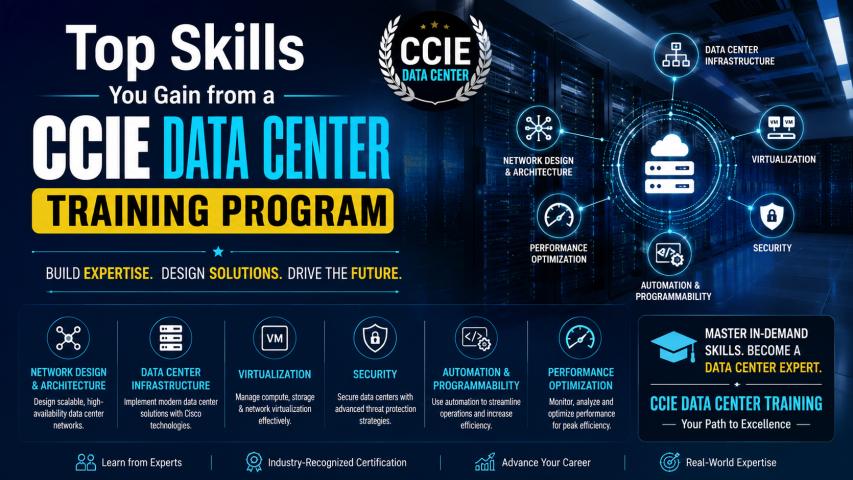
growth, especially when supported through comprehensive CCIE DataCenter Training.