As enterprises increasingly adopt multi-cloud strategies,
securing workloads across diverse cloud environments has become a critical
challenge. Without proper segmentation, applications and data can be exposed to
unauthorized access, lateral movement, and compliance risks. FortiGate
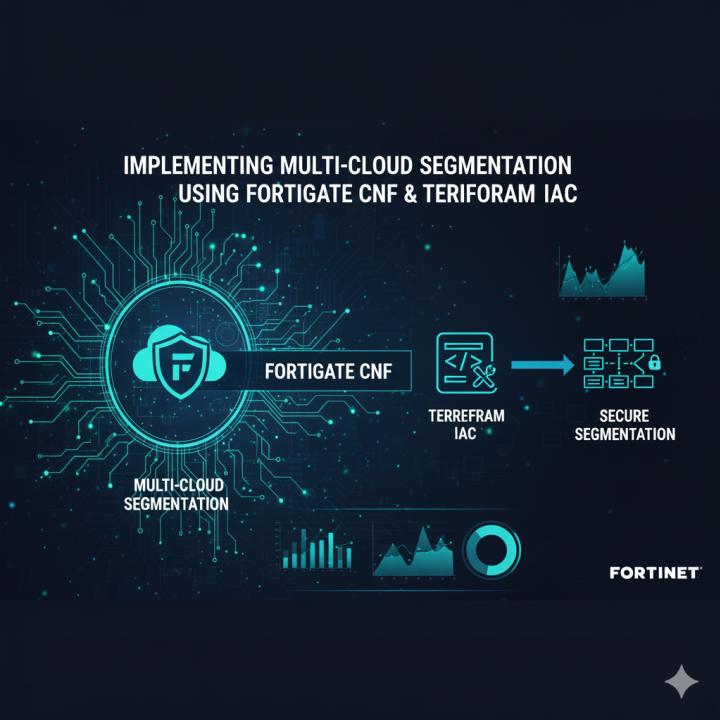
Cloud-Native Firewalls (CNF), combined with Infrastructure as Code (IaC) tools
like Terraform, provide a powerful solution for implementing automated,
scalable, and consistent multi-cloud segmentation.
For Fortinet NSE 8 Course professionals, understanding how to
deploy FortiGate CNF using Terraform is essential. This approach ensures that
security policies are consistently enforced across public and private clouds
while enabling rapid deployment, version control, and auditing capabilities.
Understanding Multi-Cloud Segmentation
Multi-cloud segmentation involves dividing cloud
environments into isolated security zones, controlling traffic between them
based on application, user, or data sensitivity. Segmentation helps
organizations:
- Reduce
the attack surface by limiting lateral movement.
- Enforce
compliance requirements, such as PCI DSS, HIPAA, or GDPR.
- Improve
operational visibility and control over network traffic.
Without segmentation, multi-cloud architectures are
vulnerable to breaches, misconfigurations, and insider threats.
FortiGate CNF Overview
FortiGate CNF is a cloud-native firewall designed to operate
seamlessly in containerized and cloud environments. It provides:
- Advanced
security features: Including intrusion prevention, application
control, and SSL/TLS inspection.
- Scalability:
Automatically scales with cloud workloads.
- Integration
with cloud-native orchestration tools: Supports Kubernetes, OpenShift,
and major cloud providers.
By deploying FortiGate CNF, enterprises can enforce security
policies directly at the workload level, ensuring protection across dynamic,
ephemeral cloud environments.
Terraform for Automated Multi-Cloud Security
Terraform, a popular Infrastructure as Code (IaC) tool,
enables organizations to define and manage cloud infrastructure
programmatically. When combined with FortiGate CNF, Terraform allows:
- Consistent
deployment: Replicate firewall policies and segmentation rules across
multiple clouds.
- Version
control: Track changes to network and security configurations.
- Automated
provisioning: Reduce human errors and speed up deployment cycles.
- Policy
testing and rollback: Quickly validate configurations and revert
changes if needed.
Terraform scripts act as a blueprint for multi-cloud
security, ensuring repeatable and auditable deployments.
Building Multi-Cloud Segmentation Pipelines
Implementing multi-cloud segmentation using FortiGate CNF
and Terraform involves several key steps:
1. Define Security Zones and Policies
Identify cloud workloads, classify them by sensitivity, and
define zones accordingly. Create segmentation policies that control traffic
between zones based on applications, ports, and user roles.
2. Deploy FortiGate CNF Instances
Provision FortiGate CNF firewalls in each cloud environment.
Use Terraform modules to automate deployment, configure interfaces, and apply
baseline security policies.
3. Integrate with Cloud Orchestration Platforms
Connect FortiGate CNF with Kubernetes or other orchestration
platforms to enforce security at the pod or workload level. Enable dynamic
scaling of firewalls as workloads are added or removed.
4. Automate Policy Enforcement
Use Terraform scripts to define segmentation rules, NAT
configurations, and logging policies. Automate deployment across multiple
clouds to maintain consistent security posture.
5. Monitor and Audit
Leverage FortiAnalyzer and FortiManager to monitor traffic,
analyze logs, and ensure compliance. Continuous monitoring helps detect policy
violations or anomalous traffic patterns in real time.
Best Practices for Multi-Cloud Segmentation
- Start
with a clear segmentation strategy: Understand workload relationships
and data sensitivity.
- Use
least-privilege policies: Only allow necessary traffic between zones.
- Automate
as much as possible: Reduce human errors and ensure repeatable
deployments.
- Maintain
version control: Track Terraform scripts and firewall configurations
for auditing and compliance.
- Regularly
review and update policies: Adapt to evolving workloads and threat
landscapes.
Following these practices ensures robust multi-cloud
security while maintaining operational agility.
Why Fortinet NSE 8 Professionals Should Focus on
Multi-Cloud Segmentation
For Fortinet NSE 8 professionals, implementing automated
multi-cloud segmentation using FortiGate CNF and Terraform is a strategic
skill. Modern enterprises rely on cloud environments for scalability and
innovation, making it critical to:
- Secure
workloads across multiple cloud providers consistently.
- Reduce
risk from lateral movement and misconfigurations.
- Maintain
compliance and visibility across complex multi-cloud infrastructures.
Mastering these capabilities allows NSE 8 engineers to
design resilient, secure, and scalable cloud security architectures.
Conclusion
Implementing multi-cloud segmentation using FortiGate CNF
and Terraform IaC is essential for securing dynamic, distributed enterprise
environments. For Fortinet NSE 8 Certification professionals, understanding this methodology
ensures consistent policy enforcement, enhanced threat protection, and
streamlined deployment across multiple cloud platforms. By leveraging automated
pipelines and cloud-native firewalls, organizations can reduce risks, maintain
compliance, and achieve a robust, scalable multi-cloud security posture.