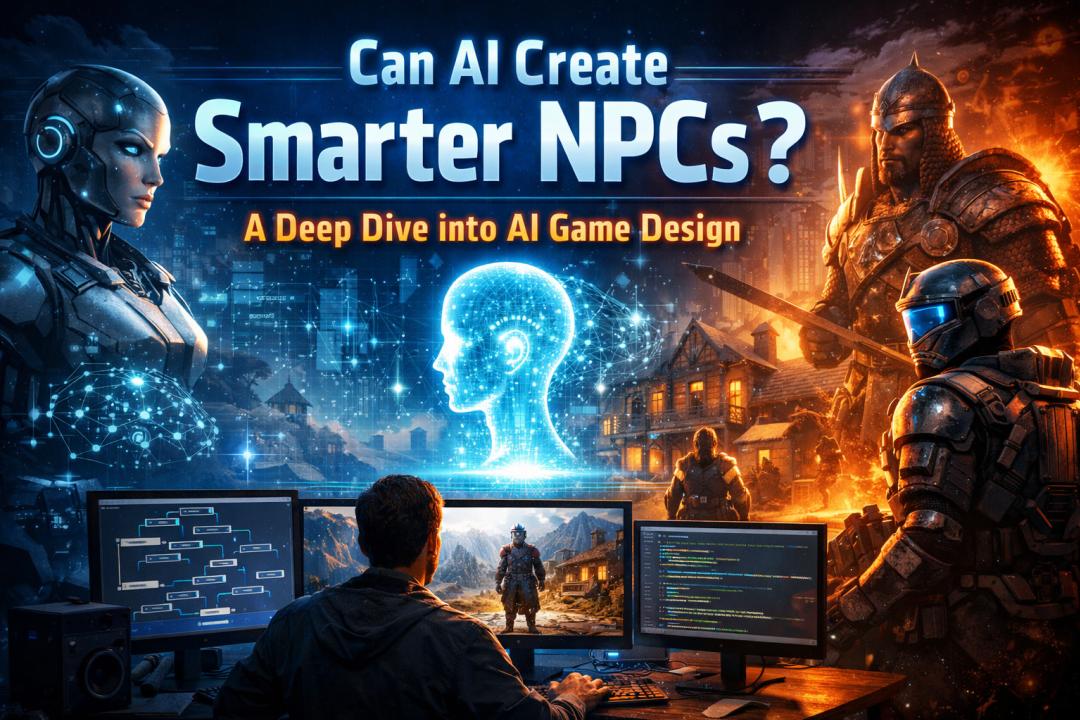
Sometimes, more than the main character in a game, we admire the NPCs (Non-Playable Characters). As the name says, they don’t play in a game but contribute to it by their expressions and gestures. And trust me, that's enough to gain massive traction among the players.
Earlier, it used to take a long time to create such attractive NPCs for a single game, but now with the emergence of AI in gaming, it has become an easy task. Many entrepreneurs look for partners who provide AI game development services.
Can AI Really Create Smarter NPCs? A Technical Perspective
The real question is not about whether AI can create smarter NPCs, but how efficiently it can be implemented within real-world game development constraints. The real intelligence in NPCs involves decision-making, learning, adaptability, and contextual understanding, areas where modern AI has made significant progress.
Defining Smart NPCs' Behavior
In AI-driven game design, an NPC is considered smart when it evaluates multiple possible actions and outcomes. Adapt its strategy based on the player's behavior, and react dynamically to changing environments. Exhibit non-deterministic, human-like behavior.
AI Decision-Making vs. Scripted Logic
In traditional games, NPCs follow fixed rules, which basically means that if the same action is repeated by the player, the NPC will react in exactly the same way every time. Though it is easy to control, it often makes gameplay feel repetitive and predictable.
AI transforms the whole format by allowing NPCs to think and choose instead of just following rules. The AI-powered NPCs can decide what to do based on things like what’s happening in the game, and also how the players usually play.
Learning and Adaptation in NPCs
As everyone knows, AI is smart and has a great ability to learn. Using techniques such as machine learning and reinforcement learning, NPCs can:
- Adjust combat tactics over time
- Learn optimal paths or strategies
- Respond differently to novice vs. experienced players
Real-Time Constraints and Optimization
AI provides advanced capabilities; it must operate within strict performance limits. NPC AI systems are designed to:
- Run efficiently on target platforms (PC, console, mobile)
- Balance intelligence with performance budgets
- Avoid excessive computational overhead
Technical Feasibility Meets Business Value
From a technical and commercial perspective, AI-driven NPCs are not just feasible; they are highly essential. Remember when it is implemented correctly, they:
- Scale across large game worlds
- Reduce repetitive content creation
- Enhance long-term player engagement
Role of AI in Game Development: From Scripts to Smart Systems
The integration of Artificial Intelligence in a game has totally changed the perspective on how games are designed, created, and scaled. The AI has changed the traditional game development to modern game design.
From Rule-Based Scripts to Intelligent Systems
Earlier NPC systems were dependent on if-else logic, predefined state transitions, and manually authored behavior trees. These techniques require a vast developer effort for even minor behavioral changes. In contrast, AI-powered systems introduce learning, adaptation, and contextual awareness.
How AI Enhances Core Game Development Processes
AI in game development extends far beyond NPC behavior. It influences multiple stages of production, including procedural content generation, player behavior analysis, dynamic difficulty adjustment, and real-time decision-making systems.
Though NPC intelligence remains one of the most visible and impactful applications. AI-driven NPCs can react differently to each player, creating bespoke gameplay experiences that increase replayability.
Why Entrepreneurs are planning to invest in AI Game Development
From the business perspective, AI-driven game systems help entrepreneurs to reduce long-term development and maintenance costs, deliver personalized player experiences at scale, and improve retention and monetization metrics.
By partnering with experienced AI game development services, startups and enterprises can implement intelligent systems without building difficult AI infrastructure in-house. You can get different benefits like:
- Low-cost development
- Personalized Player Experiences
- Higher Player Retention
- Improved Monetization
- Faster Time-to-Market
What are the Technical Advantages of AI Game Development?
Above, we have talked from a business perspective about how AI helps in game development. And here are the technical advantages of AI game development that every entrepreneur must know.
Adaptive NPC Behavior Systems
AI is an expert in replacing rigid, rule-based logic with adaptive systems that allow NPCs to change behavior based on player actions, game state, and real-time inputs. The AI makes NPCs more realistic and capable of handling unpredictable player strategies.
Real-Time Decision-Making
AI allows NPCs to evaluate multiple actions at runtime and select the most appropriate response, creating dynamic and non-repetitive gameplay. This improves immersion by ensuring NPC reactions feel more natural than pre-programmed.
Reduced Dependency on Hard-Coded Logic
Machine learning models and behavior-driven systems minimize difficult if-else scripting, making game logic clearer, more modular, and easier to maintain. Developers can iterate faster without rewriting large portions of NPC behavior code.
Scalable AI Architectures
The best part about AI-driven systems is that they can be reused and scaled to multiple levels, characters, or game modes without rewriting core logic. This approach supports rapid content expansion and long-term game scalability.
Performance Optimization
AI helps manage computational resources efficiently by prioritizing NPC actions and adjusting complexity based on platform constraints. This guarantees smooth gameplay even in large, NPC-dense environments.
Automated Testing and Balancing
AI-driven simulations and analytics assist in playtesting, bug detection, and gameplay balancing, reducing manual QA effort. Games can reach the market faster while maintaining stability and fair difficulty levels.
Cross-Platform Compatibility
AI models can be optimized to work consistently across PC, console, and mobile platforms, ensuring stable performance. This helps developers to maintain a unified codebase across different hardware environments.
AI Features and Benefits in Creating Smarter NPCs
| AI Feature/Benefit | How It Improves NPCs | Game Example |
| Adaptive Behavior | NPCs change tactics based on player actions and skill level | Middle-earth: Shadow of Mordor (Nemesis System) |
| Decision-Making AI | NPCs choose actions dynamically instead of following fixed scripts | The Last of Us Part II |
| Learning from Player Behavior | NPCs adjust difficulty and responses over time | Forza Horizon Series |
| Context-Aware NPCs | NPCs react to the environment, sound, and visibility | Metal Gear Solid V |
| Emergent Gameplay | NPCs create unscripted, unique encounters | Red Dead Redemption 2 |
| Dynamic Dialogue Systems | NPC conversations change based on player choices | Cyberpunk 2077 |
| Squad-Based AI | NPCs coordinate and communicate like real teams | Halo Series |
| Procedural NPC Interactions | NPC actions feel organic and unpredictable | Grand Theft Auto V |
Wrapping Up: What is the Future of NPCs in Games
AI is making a big contribution in game development, and it is a practical, scalable, and strategic tool for creating smarter NPCs and more immersive game worlds. From adaptive behavior and real-time decision-making to learning systems that develop with players, AI has redefined what NPCs can do and how they contribute to player engagement.