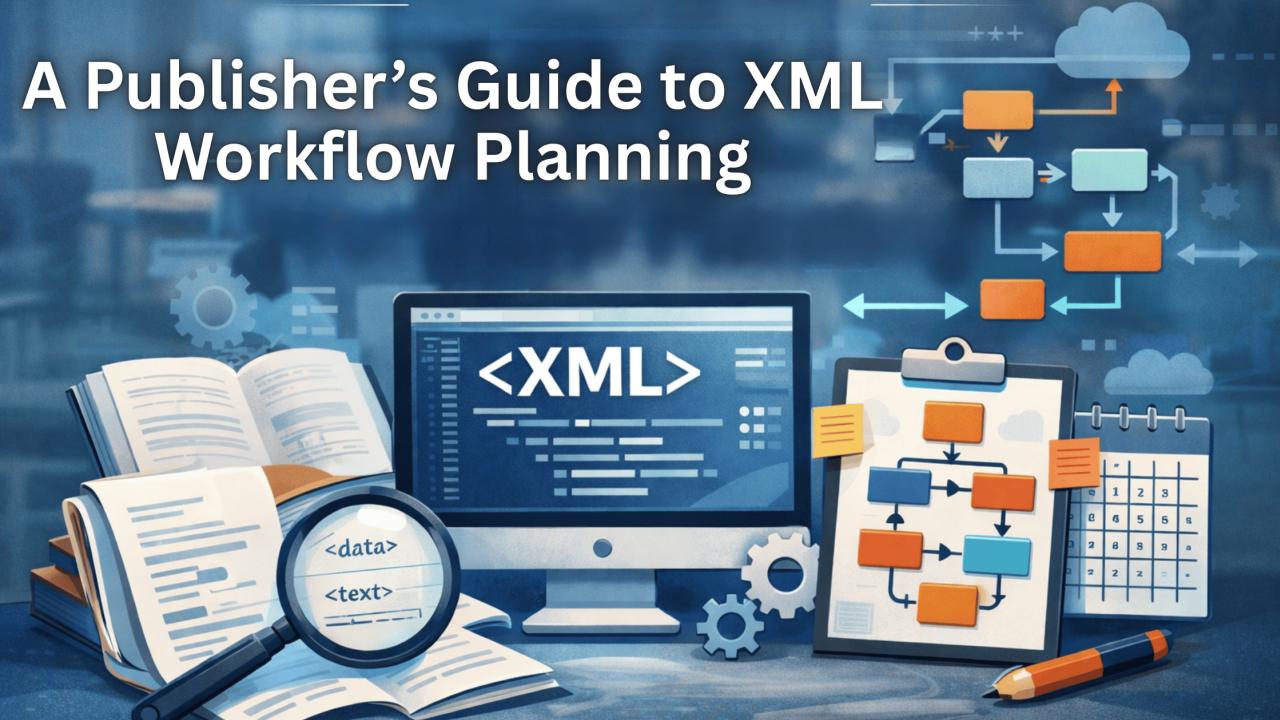
Over the years, publishing has changed significantly, and now the content is no longer created in just one format or platform, but is also used or published for print books, ebooks, websites, learning platforms, and mobile apps.
To manage efficiently, publishers are moving towards an XML-based workflow, which requires careful planning. So, before investing in a tool or XML conversion services, the publisher needs to understand how the workflow works, involves, and how it impacts daily operations.
In this post, we will explore what steps should be involved or known to the publisher before starting the XML workflow.
Understanding What an XML Workflow Means
An XML workflow is a structured way of creating, storing, and managing content using XML(eXtensible Markup Language), which allows content to be made once and reused multiple times across various platforms instead of being designed separately for each format.
Means, in XML content can get separated from design; the text, heading, tables, and metadata are stored in a structured format, while the visual layout is handled using a >
Why Planning Is Essential Before Adopting XML
Moving to an XML workflow is not something that should be rushed, so without proper planning, publishers may face challenges such as inconsistent tagging, workflow delays, staff confusion, or higher costs.
Planning helps publishers:
- Define clear goals for XML adoption
- Identify gaps in current workflows
- Choose the right level of structure
- Prepare teams for new ways of working
A well-planned XML workflow supports scalability, improves content reuse, and reduces rework over time.
Step 1: Review Current Workflow
Evaluate how content is created, edited, and prepared before publication. Identify where files exist in non-XML formats and where content must be converted into structured XML before entering XML publishing for further processing and output generation.
Step 2: Define Publishing Objectives
Clarify the purpose of adopting XML, such as enabling multi-format publishing, improving consistency, reducing production time, or supporting long-term digital growth. These objectives guide decisions throughout the workflow.
Step 3: Design XML Structure
Determine the appropriate level of XML structure based on content type and publishing requirements. At this stage, source files are mapped to defined XML schemas, allowing converted content to move smoothly into XML publishing systems for validation, transformation, and delivery.
Step 4: Build a Scalable Workflow
Design workflows that support multiple outputs, legacy content migration, and future expansion. A scalable XML workflow ensures converted content can be reused, updated, and delivered across evolving channels without rework.
Step 5: Consider Conversion Outsourcing
Assess whether outsourcing XML conversion is practical based on content volume, complexity, and internal expertise.
External conversion support can help maintain accuracy, speed up implementation, and reduce the learning curve during early XML adoption, while ensuring teams understand how structured XML flows through publishing platforms.
From Manuscript to Multi-Format Output: A Step-by-Step Breakdown
XML workflows come in several interconnected stages for designing and managing content efficiently from creation to delivery. The following stages help publishers plan structured, compliant, scalable workflows.
1. Document Creation
The workflow begins with document creation using an XML editor or structured authoring tool, and content is directly authored in XML following predefined tags that describe each element and its relationship within documents.
In an XML-first workflow, XML is the default file format, Structure is applied during authoring, not after, and Advanced XML constructs are fully supported.
2. Document Validation
Once it's created, the next step is to validate documents against an XML schema or Document Type Definition (DTD). That ensures the document follows defined structural rules, data types, and constraints.
This step is essential for maintaining compliance across publications, preventing structural errors, and ensuring downstream systems can process content reliably.
3. Document Editing
Often, XML content requires updates during editorial and production cycles. Editing may involve inserting, modifying, or deleting elements, attributes, or values.
These changes can be managed through manual editing in XML tools and automated scripts and processes. A well-planned workflow allows controlled updates without breaking document structure.
4. Document Transformation
One of XML's most significant advantages is its ability to support multiple outputs. Using tools and techniques such as XSLT, XML documents can be transformed into formats like HTML, PDF, EPUB, or other XML schemas.
Transformation enables separation of content from presentation, efficient multi-channel publishing, and faster adaptation to new formats. This stage is critical for maximising content reuse.
5. Parsing and Processing
In many workflows, XML documents must be parsed and processed by software applications. This involves extracting data, applying business rules, and generating outputs based on content structure.
Parsing and processing support automated publishing pipelines, data - driven workflows, and integration with external systems. An accurate structure ensures reliable processing at this stage.
6. Document Integration
As XML is widely used for data exchange between systems. Integration involves sending and receiving XML documents across platforms such as content management systems, publishing platforms, and indexing services.
Effective integration allows seamless data flow between tools, reduced manual handoffs, and improved collaboration across teams. Planning integration points early avoids workflow delays later.
Old vs. Modern Publishing: What’s Changed and Why It Matters
Today, many publishers are moving away from traditional methods and adopting more structured, flexible approaches. When comparing the two, it becomes clear why this shift is happening.
Challenges with Traditional Publishing
Traditional publishing often ties content closely to its design, which can create several problems, such as
- Text is fixed to a specific layout, making changes difficult.
- Multiple versions of the duplicate content must be handled separately.
- Time-consuming edits, even minor updates, require reformatting every version.
- Reusing content for other platforms takes extra effort.
- Content may not display well across different screens and devices.
How XML Workflow Improves the Process
A structured publishing approach solves many of these issues by separating content from design:
- A single structured file can produce multiple formats.
- Content automatically adjusts to different layouts.
- Faster updates and edits are reflected everywhere at once.
- Content can be reused and adapted with minimal effort.
- Works everywhere, content is compatible across devices and platforms.
Why This Shift Makes Sense
1. Easy Collaboration
Teams can edit the same document simultaneously without layout issues, making reviews and updates faster and more coordinated.
2. Single Source
One structured file is used for editing, reviewing, and sharing, eliminating the need for multiple document versions.
3. Universal Access
Content displays correctly across all devices and browsers, helping reach readers regardless of screen size or platform.
4. Higher Productivity
Standardized content removes repeated formatting work, allowing teams to focus more on content quality and speed.
5. Search Visibility
Well-structured content is easier for search engines to read, helping improve discoverability and overall search performance.
6. Flexible Scaling
Structured content can be reused, updated, and published in multiple formats without recreating documents from scratch.
Making Publishing Better with Structured XML Workflow
An XML workflow is a robust foundation for modern publishing, but its success depends heavily on planning. Understanding content needs, preparing teams, and designing flexible structures all play a critical role.
With thoughtful preparation, combining with professional data conversion services, publishers can move beyond format-specific production and build a workflow that supports both current demands and future opportunities.