Traditional industries are entering a decisive phase. Manufacturing, logistics, healthcare, energy, finance, and retail face rising cost pressure, complex supply chains, changing customer behavior, and increasing regulatory demands. Many of these sectors still rely on legacy systems and manual decision workflows. This creates an opportunity for data driven transformation, yet most enterprises struggle to convert ambition into operational progress.
This is where an AI Consulting Company plays a central role. Rather than selling technology alone, these firms guide organizations through strategy, data readiness, model development, system integration, and long term governance. The result is measurable innovation that fits business realities instead of experimental pilots that stall after launch.
This article explores how AI consulting firms drive progress in traditional industries, why enterprises rely on structured AI Consulting Services, and how decision makers evaluate ROI when investing in Custom AI and machine learning consulting services.
Traditional industries face structural innovation barriers
Legacy enterprises often carry decades of accumulated technology, fragmented data storage, and manual workflows. Innovation initiatives fail when companies attempt to deploy advanced AI tools without modernizing foundations.
Common barriers include:
- Data scattered across departments with inconsistent quality.
- Limited in house AI expertise.
- Operational teams hesitant to trust algorithm driven decisions.
- Compliance and security risks tied to automated systems.
- Difficulty connecting AI solutions to existing software infrastructure.
According to McKinsey, over 70 percent of AI transformation projects stall before full scale deployment due to data readiness and change management gaps.
AI consultants specialize in removing these barriers. Their value is not only technical execution but building structured transformation paths that align with business outcomes.
From strategy to execution: What AI consultants actually deliver
Enterprises no longer seek experimental proof of concept projects. They want repeatable impact. A mature AI consulting engagement typically moves through four core stages.
1. Business opportunity mapping
Consultants begin by identifying where AI produces direct financial or operational impact. This includes demand forecasting, predictive maintenance, fraud detection, supply chain optimization, intelligent automation, and personalized customer engagement. Each use case is evaluated through cost savings potential, revenue growth opportunity, and implementation complexity.2. Data and infrastructure readiness
Traditional organizations rarely have AI ready data environments. Consultants assess data availability, quality pipelines, storage architecture, and security frameworks. They define modernization steps required before model development begins.3. Model design and integration
This is where AI Development Services come into play. Consulting teams work with engineering groups to build machine learning models, integrate APIs, deploy automation workflows, and connect outputs to operational software used by employees.4. Governance and long term optimization
Sustained innovation requires monitoring model performance, managing bias risks, retraining pipelines, and maintaining compliance. Consultants establish governance frameworks so AI systems remain reliable after deployment.This structured delivery approach separates serious transformation from short term experimentation.
Industry specific impact examples
AI consulting impact differs by sector. Traditional industries share common transformation goals but unique operational constraints.
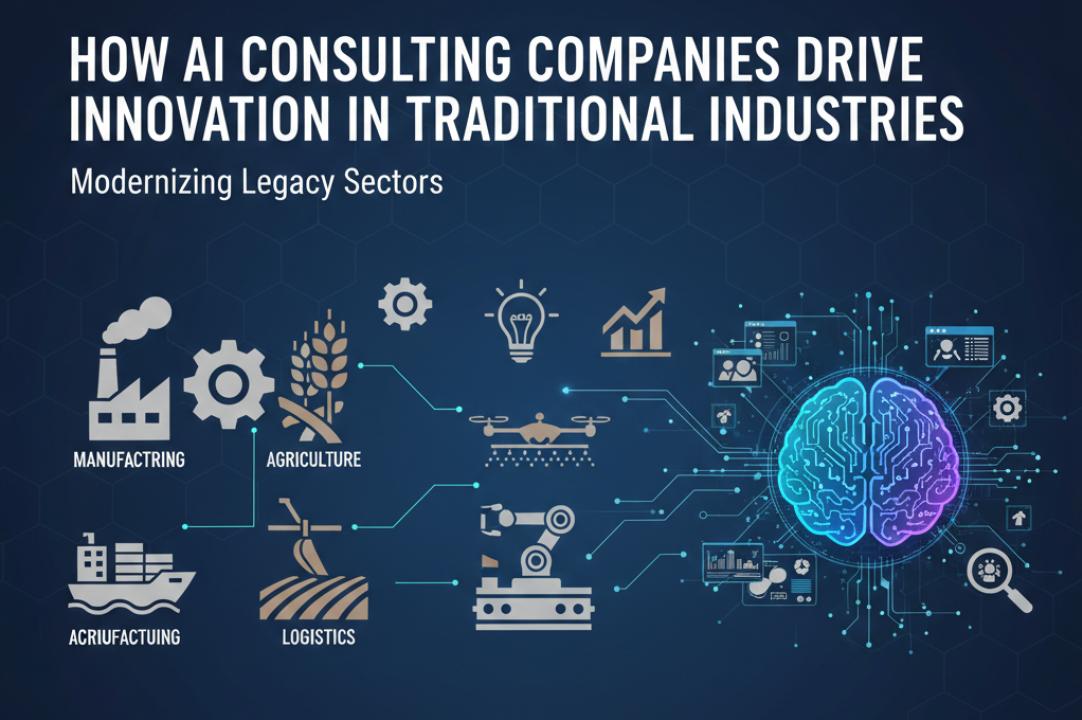
Manufacturing
Predictive maintenance reduces unplanned downtime. Computer vision detects production defects early. Inventory forecasting lowers warehouse costs. Deloitte reports AI driven predictive maintenance can reduce maintenance costs by up to 30 percent.Logistics and supply chain
AI optimizes route planning, fuel consumption, and delivery scheduling. Real time demand sensing improves inventory accuracy. AI powered planning reduces supply chain disruptions that cost enterprises millions annually.Healthcare
AI supports diagnostic imaging analysis, patient risk prediction, hospital resource planning, and clinical documentation automation. Consultants ensure compliance with data privacy regulations while introducing automation into sensitive environments.Banking and financial services
Fraud detection, credit risk scoring, customer personalization, and compliance automation are leading AI applications. According to PwC, AI adoption in financial services could add over 1 trillion USD in value globally by 2030.Energy and utilities
AI forecasting improves grid load balancing, predictive asset maintenance, and energy trading strategies. This reduces outages and operational waste.Across sectors, consulting firms adapt technical implementation to industry specific regulations, workflows, and risk tolerance.
Why enterprises choose external AI consulting partners
Building internal AI teams takes time. Hiring experienced data scientists, ML engineers, and AI architects is expensive and competitive. Enterprises also risk building isolated solutions that fail to scale across departments.
AI consulting firms bring:
- Cross industry experience from multiple transformation projects.
- Established implementation frameworks.
- Ready to deploy engineering accelerators.
- Vendor neutral technology selection.
- Change management expertise.
This reduces execution risk while accelerating time to value. It also allows leadership teams to focus on strategic direction rather than technical micromanagement.
Measuring ROI in AI transformation
Decision makers need clarity on return expectations. AI investments are justified through direct financial and operational metrics rather than innovation branding alone.
Common ROI indicators include:
- Reduction in manual processing costs.
- Lower maintenance and downtime expenses.
- Improved demand forecast accuracy.
- Reduced fraud losses.
- Faster decision cycle times.
- Increased customer retention rates.
AI consultants help build business cases, define performance baselines, and track post deployment outcomes. This accountability builds trust at board level where funding decisions are made.
Selecting the right AI consulting partner
Not all providers offer equal maturity. Enterprises evaluate consulting partners through several practical criteria.
Domain experience
Firms that understand sector specific operations reduce onboarding time and design relevant use cases.
End to end delivery
Strategy alone is insufficient. Enterprises prefer partners capable of discovery, model development, integration, deployment, and ongoing optimization.
Data security and compliance expertise
This is essential for regulated industries like healthcare, banking, and energy.
Scalability of solutions
Pilot projects must evolve into enterprise wide deployment without reengineering.
Transparent collaboration model
Clear communication, milestone tracking, and measurable outcomes are critical for executive alignment.
The rise of customized consulting engagements
Standard AI products rarely fit complex enterprise environments. This drives demand for Custom AI and machine learning consulting services that reflect internal processes, data realities, and compliance obligations.
Customized engagements include:
- Proprietary model development.
- Industry specific data pipelines.
- Integration with existing ERP and CRM systems.
- Internal AI capability training programs.
- Governance frameworks for ethical AI usage.
Customization ensures AI systems serve real operational needs rather than forcing teams to adapt to generic software.
Looking ahead: AI consulting as a long term partnership
AI transformation is not a one time initiative. Models evolve, markets change, regulations shift, and data environments grow. Consulting relationships increasingly move toward long term partnerships where firms support continuous optimization, performance monitoring, and capability expansion.
Traditional industries that adopt this mindset build competitive resilience. They transition from reactive operations to predictive decision making. They reduce waste while improving customer experience. They also create internal AI maturity that compounds over time.
Final perspective
Traditional industries hold vast operational data, complex workflows, and deep institutional knowledge. When combined with structured AI execution, these assets become drivers of sustained innovation. Enterprises that partner with experienced AI consultants reduce execution risk, accelerate transformation, and maintain governance control across growing AI ecosystems.
As AI adoption expands globally, organizations that invest in robust consulting led transformation today will shape the next decade of industry leadership.