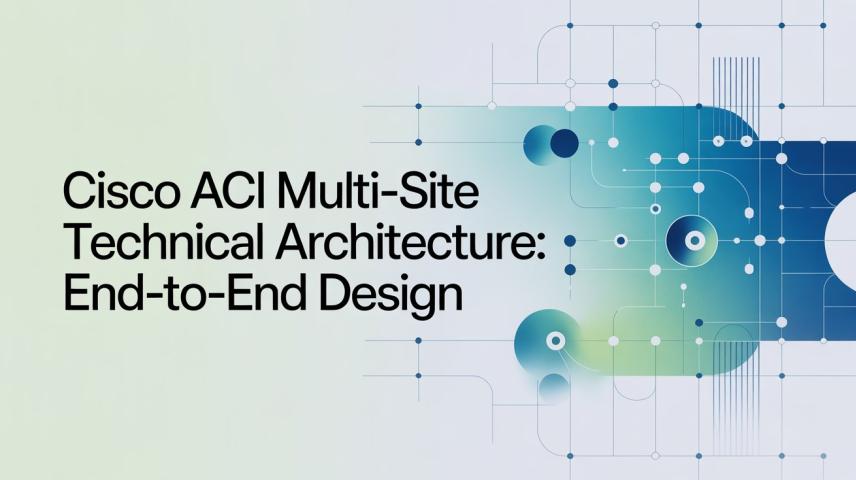
Managing multiple data centers is not just about connecting networks; it is about keeping them secure, reliable, and consistent. When organizations grow, they often expand to different locations, and this creates challenges in managing traffic, policies, and applications across sites. Cisco ACI Multi-Site architecture is designed to solve these challenges by providing a structured and scalable way to connect multiple data centers while keeping each one independent. Understanding this architecture becomes much easier when concepts are explained step by step, which is why many learners start with Cisco ACI Training to build a strong foundation.
Cisco ACI Multi-Site is not about making one big network. Instead, it focuses on connecting separate data centers in a controlled way. Each site keeps its own policies and management, while selected applications and services can communicate across sites. This balance between independence and connectivity is what makes the end-to-end design of Cisco ACI Multi-Site both powerful and practical.
Understanding Cisco ACI Multi-Site Architecture
Cisco ACI Multi-Site architecture connects multiple ACI fabrics using a routed Layer 3 network. Each site operates independently with its own controllers and switches, but policies can be shared across sites when needed. This design improves availability and reduces risk, because a problem in one site does not directly affect the others.
At the heart of each site is the APIC (Application Policy Infrastructure Controller) cluster. The APIC manages local policies, endpoint groups (EPGs), and contracts. For multi-site environments, a Multi-Site Orchestrator (MSO) is used. MSO allows administrators to define common policies and push them across multiple sites without manually configuring each one.
Key Components in an End-to-End Design
A complete Cisco ACI Multi-Site design includes several important components working together:
APIC Clusters: Each site has its own APIC cluster for local control.
Leaf and Spine Switches: These switches form the internal fabric of each data center.
Multi-Site Orchestrator: Manages shared policies across sites.
Inter-Site Network: A Layer 3 routed network that connects the sites.
EPGs and Contracts: Control how applications communicate within and across sites.
Understanding how these components interact is often a major focus area in a Cisco ACI Course, as it helps learners visualize real-world deployments.
How Traffic Flows Across Multiple Sites
Traffic flow in a multi-site environment follows clearly defined rules. When an application in one site needs to communicate with an application in another site, the communication must match predefined contracts and policies. These contracts specify which traffic is allowed and which is blocked.
The traffic first follows local ACI rules, then moves through the inter-site Layer 3 network, and finally reaches the destination site where local policies are applied again. This layered approach ensures security and consistency. Many professionals preparing for a Cisco ACI Certification focus heavily on understanding this traffic flow, as it is critical for design and troubleshooting.
Design Principles and Best Practices
A good multi-site design starts with careful planning. Only necessary applications should communicate across sites to reduce complexity and improve performance. Naming conventions should be consistent, making policies easy to understand and manage.
Another important principle is independence. Each site should continue operating even if connectivity to other sites is lost. This approach improves resilience and supports disaster recovery scenarios. These concepts are commonly reinforced in a Cisco ACI Training Course, where design decisions are linked to real operational benefits.
Benefits of Cisco ACI Multi-Site Design
Cisco ACI Multi-Site offers several advantages:
Scalability: New sites can be added without redesigning the entire network.
Consistency: Policies can be applied uniformly across locations.
High Availability: Sites operate independently, reducing downtime.
Security: Traffic is tightly controlled using contracts and policies.
These benefits make the architecture suitable for large enterprises, cloud environments, and disaster recovery setups.
Conclusion
Cisco ACI Multi-Site Technical Architecture provides a structured and reliable way to connect multiple data centers while maintaining control, security, and flexibility. By using independent fabrics, centralized policy orchestration, and controlled traffic flow, organizations can scale their networks without increasing complexity. Understanding the end-to-end design helps network engineers make informed decisions and build resilient infrastructures.
For learners who want to deepen their understanding and practice these concepts hands-on, exploring labs and resources through Cisco ACI Online Training can help reinforce real-world design scenarios and prepare them for advanced roles in data center networking.