Engineering is one of the most demanding academic disciplines, not just because of its technical depth but also due to how rapidly coursework expectations evolve over time. Many students begin their engineering degree thinking the difficulty will remain consistent throughout, only to realise that each academic year introduces new challenges, skills, and responsibilities. Understanding how engineering coursework changes from first year to final year can help students prepare better, manage stress, and approach assignments more strategically.
First Year: Building the Foundations
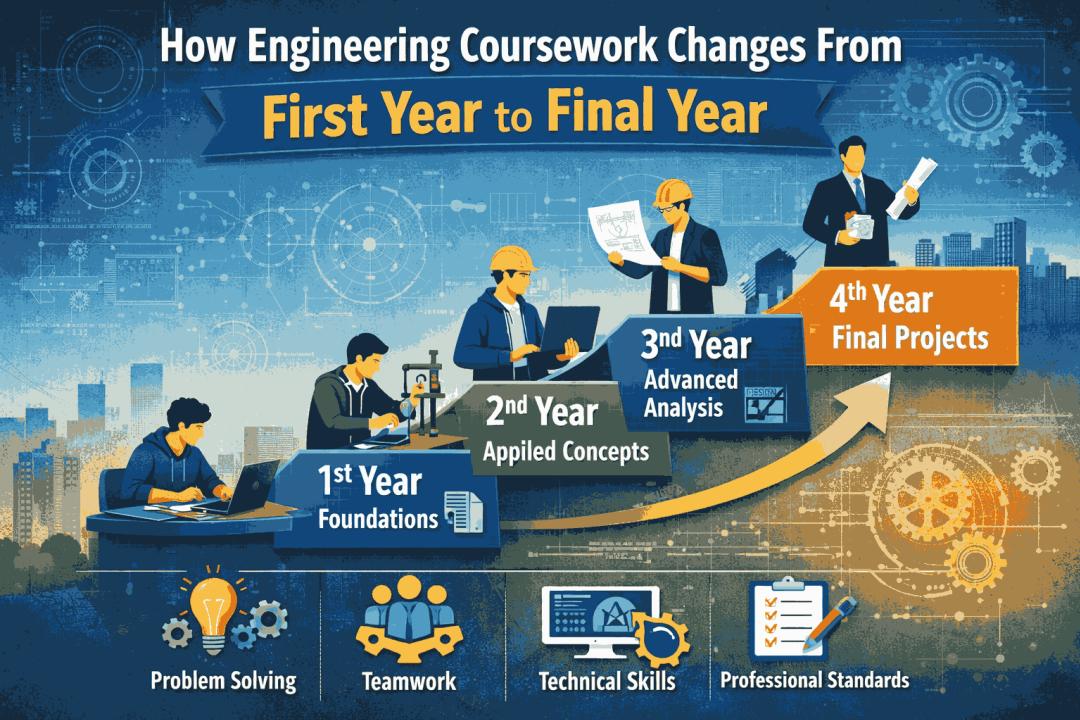
First-year engineering coursework is primarily focused on laying a strong academic foundation. Students are introduced to core subjects such as mathematics, physics, basic programming, and introductory engineering concepts. Assignments at this stage are generally structured, guided, and designed to test fundamental understanding rather than advanced application.
Most first-year tasks involve problem sets, short lab reports, quizzes, and introductory essays. Lecturers often provide detailed instructions, sample formats, and step-by-step explanations. While the workload may still feel heavy, the emphasis is on learning how to study engineering rather than mastering complex design or analysis.
Despite this support, many students struggle with the transition from school to university. Independent learning, time management, and academic writing can be challenging at first. This is often when students begin exploring academic resources or Engineering assignment help to understand expectations and improve their approach early on.
Second Year: Increasing Complexity and Application
By second year, engineering coursework shifts from basic theory to applied concepts. Subjects become more specialised, and assignments require students to apply formulas, principles, and methods to real-world scenarios. Labs become more detailed, and reports demand clearer explanations, assumptions, and technical reasoning.
Second-year students often face multiple assignments running simultaneously across different subjects. Time management becomes critical, as coursework now includes longer problem sets, mid-sized projects, and group work. Unlike first year, instructions may be less detailed, requiring students to interpret briefs more independently.
At this stage, mistakes often come from misunderstanding assignment requirements rather than lack of effort. Many students turn to Engineering assignment help services or academic guidance resources to clarify expectations, improve structure, and ensure they are applying concepts correctly.
Third Year: Advanced Analysis and Critical Thinking
Third year marks a significant turning point in an engineering degree. Coursework becomes more analytical, and students are expected to demonstrate deeper understanding rather than simply follow formulas. Assignments often involve open-ended problems with multiple possible solutions, requiring justification, evaluation, and comparison.
Design projects, case studies, and advanced lab work become more common. Reports are longer and more technical, with a stronger emphasis on clarity, logic, and professional presentation. Lecturers expect students to justify design choices, discuss limitations, and reference industry standards.
This is also the year where academic pressure increases noticeably. Balancing heavy coursework with internships, part-time work, or extracurricular commitments becomes challenging. Ethical Engineering assignment help is often used during this stage to support learning, especially when students are dealing with unfamiliar software, simulations, or advanced calculations.
Final Year: Professional-Level Expectations
Final-year engineering coursework is designed to prepare students for professional practice. Assignments closely resemble real-world engineering tasks, often requiring independent research, complex design decisions, and detailed documentation. The final-year project or capstone is typically the most demanding component of the degree.
Unlike earlier years, there is minimal guidance at this stage. Students are expected to plan timelines, manage risks, and produce work that meets professional and academic standards. Assessments may include industry->
Errors in logic, assumptions, or calculations can have a major impact on grades. Many final-year students seek Engineering assignment help not for shortcuts, but for guidance on methodology, structure, and technical clarity, ensuring their work meets both academic and professional expectations.
Changes in Assignment Structure Over Time
One of the most noticeable differences across engineering coursework is how assignment structure evolves. Early assignments are often formula-based and short, while later tasks require integration of multiple concepts, tools, and disciplines.
In first year, assignments usually test “how” to solve a problem. By final year, assignments test “why” a solution works, “whether” it is optimal, and “how” it can be improved. This shift requires students to develop stronger analytical writing and technical communication skills.
Understanding this progression helps students avoid frustration and adapt their study strategies accordingly.
Skill Development Across the Degree
Engineering coursework is not just about technical knowledge—it also develops transferable skills. Over the years, students gradually build:
-
Problem-solving and analytical thinking
-
Technical writing and documentation skills
-
Time management and project planning
-
Team collaboration and communication
-
Use of industry tools and software
Assignments become vehicles for skill development rather than just assessments. Using academic support and Engineering assignment help responsibly can help students identify gaps in these skills and improve them systematically.
Common Challenges Students Face
Across all years, engineering students face recurring challenges such as heavy workloads, overlapping deadlines, and high academic pressure. However, the nature of these challenges changes over time.
First-year students struggle with transition and independence. Mid-degree students face complexity and workload management. Final-year students deal with professional expectations and high-stakes assessments.
Recognising these challenges early allows students to seek appropriate support, whether through peer discussions, academic workshops, or structured Engineering assignment help.
How Students Can Adapt Successfully
Adapting to changing coursework requires flexibility and proactive planning. Students who succeed typically start assignments early, clarify requirements, and break tasks into manageable stages. Reviewing feedback from previous assignments is also crucial for improvement.
Seeking guidance when concepts are unclear is a strength, not a weakness. Ethical academic support helps students stay aligned with learning outcomes while reducing unnecessary stress.
Conclusion
Engineering coursework evolves significantly from first year to final year, becoming more complex, independent, and professionally oriented. Each stage builds upon the last, preparing students not only for graduation but for real-world engineering challenges.
By understanding how coursework changes, developing strong study habits, and using resources like Engineering assignment help responsibly, students can navigate their degree with greater confidence and academic success. Engineering is demanding, but with the right approach and support, it becomes a rewarding journey of growth and skill development.