Outsourcing is much more than a way of cutting costs. For many companies, it enables them to obtain specialized skills, deliver outsourcing services on time, and, more importantly, maintain focus on their core business. For those who need to scale their business, especially to address seasonal spikes in workload, or for companies that require specific expertise, the chosen outsourcing model directly impacts operational efficiency and sustainable outcomes.
The challenge with outsourcing is that it is not a one-size-fits-all model. Certain firms prefer to keep operations local, while others choose offshore outsourcing to access broader talent at lower operating costs. More and more businesses are willing to implement a hybrid approach, combining local management and offshore development.
Choosing the right outsourcing model helps businesses stay flexible while aligning with budget, communication needs, and delivery goals.
What Outsourcing Models Mean in Practice
An outsourcing model concerns the location of your external team and how they collaborate.
To put this as simply as possible:
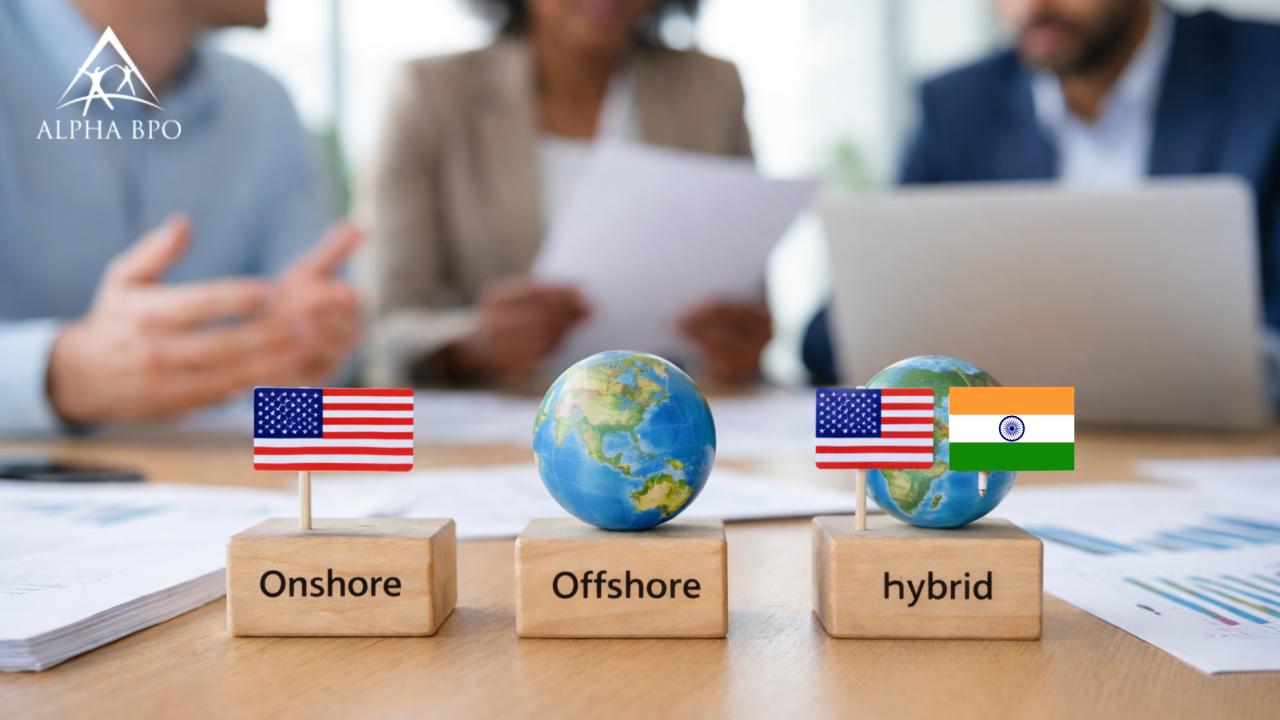
- Onshore outsourcing is talking to a service provider in your own country.
- Offshore outsourcing involves working with a service provider in a different country, with a different timezone and economic scale.
- Hybrid outsourcing is a combination of the two, in which the country retains the business functions that are more managerial and strategic. Then it shifts the more operational, administrative, and tactical work to another country.
The right model to choose depends on how much continuous supervision is required on the project, how quickly decisions need to be made, and how comfortable the organization is with the degree of control.
1. Onshore Outsourcing: Strong Communication, Higher Cost
Onshore outsourcing is the easiest option, as both teams operate within the same legal, linguistic, and cultural business environment. This model is the most suitable option for projects that require regular conversations, quick approvals, or strict compliance requirements.
Communication tends to be smoother because there are no major time-zone gaps, and in many cases, face-to-face meetings are possible. For businesses that value direct collaboration, this can reduce misunderstandings and speed up decision-making.
The main limitation is cost. For example, the labour costs may be substantially higher than those in an overseas market. For repetitive operational work, long-term onshore delivery can become expensive.
This is typically selected for:
- Work involving legal sensitivities
- Support that is client-facing
- Work where an understanding of the local market is important
- Development cycles that require a high level of collaboration
2. Offshore Outsourcing: Cost Efficiency with Global Reach
Hiring teams abroad lets businesses find great talent in countries with lower operating costs. That is why many firms use it for large projects, technical support, app development, and heavy back-office work.
The biggest advantage is flexibility. Businesses can scale faster without expanding internal headcount too quickly. It also opens access to talent that may be difficult or expensive to hire locally. In many industries, offshore teams now work as long-term operational extensions rather than temporary vendors.
Successful offshore outsourcing relies heavily on clearly defined processes. With minimal detail, there will certainly be gaps in quality and delays. Time-zone differences can create challenges, but they can also support round-the-clock productivity.
This model usually works for:
- Data management
- Software development
- Support documentation
- Admin work
- Tasks involving large-scale transactions
Businesses that handle a lot of paperwork often outsource form processing to offshore operations, where accuracy and turnaround time are critical.
Comparing Onshore, Offshore, and Hybrid Models
Since every model addresses different business challenges, comparisons are most effective when the business factors are considered first.
1. Cost
- Due to local labor rates, Onshore models are typically the most expensive.
- Offshore models are the most cost-effective,
- And hybrid models fall in between cost and control.
2. Communication
- With onshore models, communication is the simplest, as teams work similar hours and share similar cultural contexts.
- Offshore communication often requires more robust documentation and structured updates to avoid delays.
- Hybrid models will vary in ease of communication depending on how the responsibilities are divided.
3. Speed of Scaling
- Offshore teams are typically able to facilitate the quickest expansion, as there is a greater availability of external talent.
- Hybrid models also allow for quick expansion, while keeping operational management closer to business leadership.
4. Operational Control
- Onshore models allow for the most direct operational control.
- In hybrid models, there is still a fair amount of operational control locally,
- Offshore models depend more on strong systems and clear accountability than direct supervision.
5. Risk Management
- Onshore and hybrid models are often preferred in industries with strict compliance requirements because governance remains closer to internal leadership.
Choosing the Right Model for Business Needs
A business does not always need the same outsourcing model forever.
Startups often begin with offshore arrangements because cost is most important in the early growth stages. As operations become more complex, hybrid models often become more attractive.
Larger enterprises may use multiple outsourcing models simultaneously, depending on the function. For instance, customer service work might be kept local, while processing and technical support can be moved offshore.
Hybrid outsourcing often suits businesses that want local oversight while reducing execution costs through offshore support.
Before you make a decision, you might ask questions such as these:
- Is daily collaboration needed?
- Is reducing costs the primary goal, or is that just one concern?
- What is the level of sensitivity of the data?
- Can I standardize the work?
- How likely is the workload to change over time?
The more process-driven a task is, the easier offshore delivery usually becomes.
Why Businesses Are Expanding Through Offshore Outsourcing
For many businesses, offshore outsourcing is no longer limited to cost savings. It has also become a way to access specific talent, reduce turnaround times, improve operational flexibility, and lessen the workload for internal teams.
One major reason offshore models continue to grow is scalability. Businesses can easily increase capacity by diverting work to offshore teams rather than the effort of hiring and training local employees. This is especially important in project-based work or when the work involves specialized skills that are not readily available in the local market.
Offshore staffing also offers the advantage of continuous operation because workers in different time zones can keep working on tasks for longer.
This model works especially well when workflows are well-defined and tasks are clearly articulated. Many businesses begin with process-based support and gradually expand into higher-value services.
Making the Right Outsourcing Choice
No outsourcing model is best by default. The right model will depend on what each business values most at any given moment. This could include control, speed, cost, expertise, or flexibility.
If high focus is on collaboration and compliance, then onshore will be more suitable. If the focus is on scale and cost, and all processes are defined, offshore will be more suitable. Finally, for a more flexible and structured approach, a hybrid model will be suitable.
Most businesses' long-term decisions are less about location and more about the working model that enables consistent execution. This explains why offshore outsourcing is still seen from a longer-term operational perspective rather than a short-term cost perspective.