"Jet ski" is technically a brand name — a trademark registered by Kawasaki that the rest of the world adopted as a generic term for any personal watercraft, much like Hoover or Sellotape. The story behind it is worth knowing. An American engineer named Clayton Jacobson II, who reportedly grew tired of picking gravel out of his skin after motorcycle crashes, started experimenting with a water-based alternative in 1965. Bombardier picked up his design and marketed it briefly as the Sea-Doo before the deal expired. Kawasaki then licensed the invention and in 1972 launched the first commercially successful stand-up personal watercraft, calling it the Jet Ski. For the next sixteen years it was the only manufacturer in the market. Yamaha entered in 1986, Bombardier came back with the Sea-Doo in 1988, and the modern PWC industry as we know it was born. Today three-person family models make up over 97 percent of personal watercraft sales — a long way from the original single-rider stand-up machines.
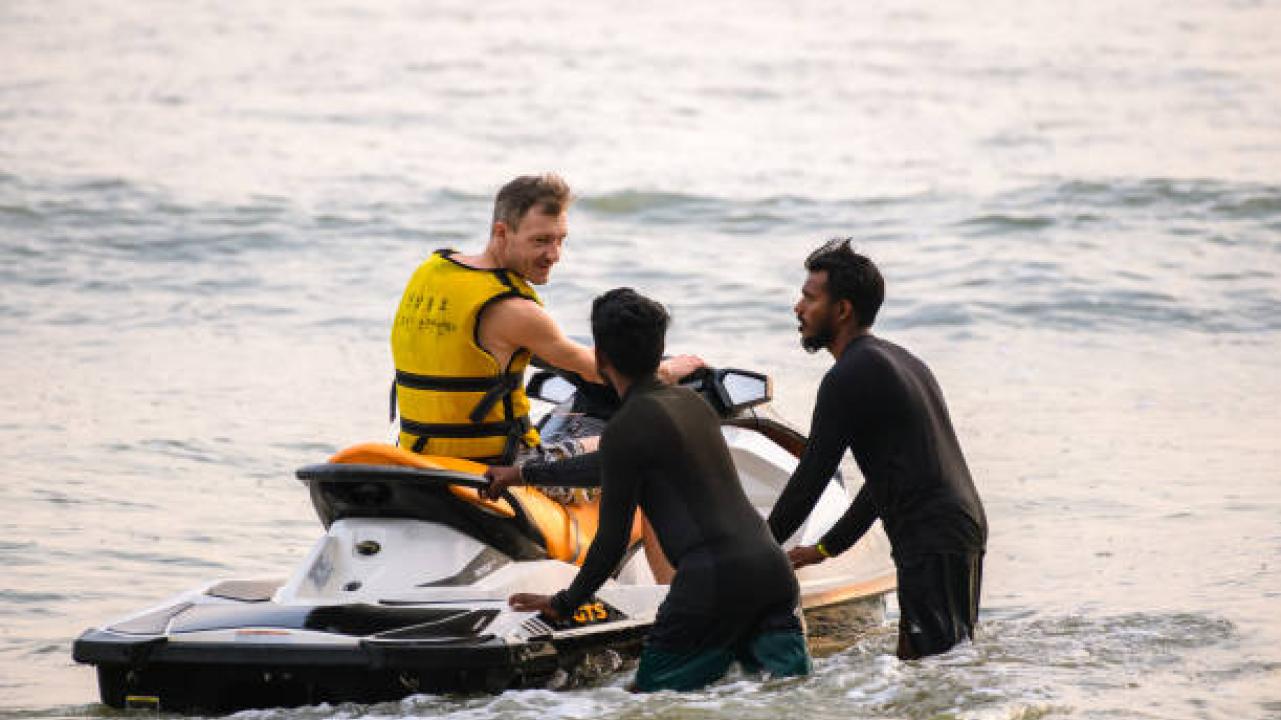
All of which is interesting context for something most people encounter as a hire experience on a foreign holiday, without thinking too much about what's involved in operating one safely.
Why Jet Ski Lessons Matter More Than Most People Assume
A modern sit-down personal watercraft can reach speeds of 60-70mph. Unlike a car or a boat, there's no brake in the conventional sense — cutting the throttle removes the steering, which is counterintuitive and catches out a significant number of first-time riders. A PWC steers by directing the jet thrust, meaning you need power applied to turn. Let off the throttle to slow down and you lose the ability to steer at exactly the moment you most want to turn. This is the single most important thing to understand before getting on one, and it's the first thing covered in any proper jet ski lesson.
Harbours, marinas, and coastal launch sites across the UK are increasingly requiring riders to hold a qualification before they'll grant a launch permit. On the water abroad — in Spain, Greece, Croatia, and most Mediterranean destinations — the same applies if you want to hire rather than just be a passenger. Without a certificate, your options narrow considerably.
The RYA PWC Proficiency Course
The Royal Yachting Association's Personal Watercraft Proficiency Course is the recognised UK qualification for jet ski riders — the equivalent of what the RYA Level 2 is for powerboats. It's a one-day course, run at RYA-recognised training centres around the country, and is designed for complete beginners as well as people who have ridden before but have never formalised their skills.
The day covers launching and recovery, slow-speed manoeuvring, high-speed handling and control, collision regulations and rules of the road on water, passage planning and decision-making, essential safety information, and what to do in an emergency. A safety boat and instructor are present throughout. Maximum class sizes are typically kept small — usually no more than six students — with two riders per machine, though some centres offer solo instruction where you have your own ski for the full day.
Children aged 12 and over can join most courses, with certificates for under-16s endorsed to show that adult supervision is required. The minimum age for unsupervised riding is 16.
On successful completion, the RYA PWC Proficiency Certificate is awarded. It's recognised internationally and can be used as the basis for an International Certificate of Competence — the document most European charter and hire operations want to see before they'll hand over the keys.
Beyond the Course
The jet ski lesson and course structure doesn't stop at the Proficiency Certificate. For those who want to turn the qualification into an income, the RYA Jet Ski Instructor course is the next step — increasingly relevant for anyone working in the superyacht industry, where PWC operation has become a standard skill expected of deck crew.
Poole Harbour on the south coast is one of the most popular locations for jet ski lessons and courses in the UK — offering sheltered inner harbour waters for initial training and easy access to open sea once confidence develops.
adventuro lists jet skiing courses and experiences across the UK at adventuro.com — a practical starting point for finding an RYA-recognised training centre near you and comparing what different operators offer.
The counterintuitive throttle-to-steer dynamic is the thing that trips most people up on their first ride. Spend a day learning it properly and everything else clicks into place fairly quickly.