Mutual funds have become the investment vehicle of choice for millions of Indians looking to build wealth over time. The allure of professional management, diversification, and the potential for strong returns makes them particularly attractive to both new and experienced investors. However, the path to successful mutual fund investing is often littered with avoidable mistakes that can significantly impact your returns.
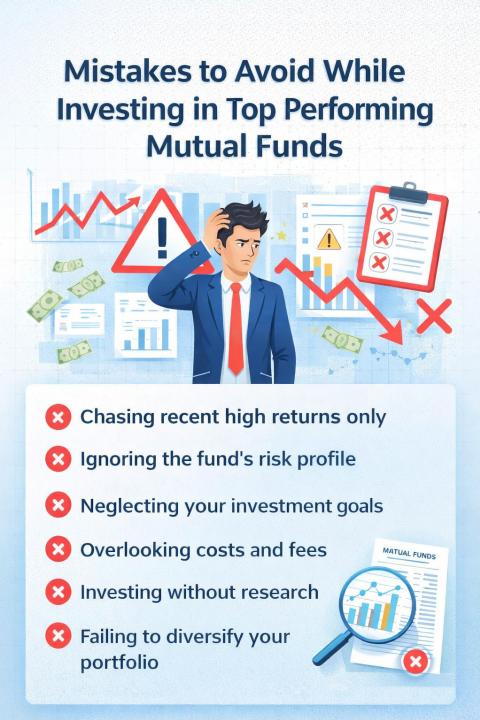
When investors search for top performing mutual funds, they're often drawn to schemes that have delivered exceptional returns in recent months or quarters. While past performance is an important consideration, relying solely on recent success can be a costly error. In this comprehensive guide, we'll explore the most common mistakes investors make when selecting and investing in high-performing funds, and more importantly, how you can avoid them to maximize your investment success.
The Trap of Chasing Recent Performance
One of the most prevalent mistakes investors make is choosing funds purely based on their recent stellar performance. A fund that topped the charts last year may not repeat that success this year. Market conditions change, sectors rotate in and out of favor, and what worked brilliantly in one period may underperform in another.
The stock market is cyclical by nature. A fund heavily invested in technology stocks might deliver outstanding returns when tech is booming, but the same fund could struggle when the market favors other sectors. Similarly, small cap funds often outperform during bull markets but can suffer significant declines during corrections.
Instead of chasing yesterday's winners, look for funds with consistent performance across multiple market cycles. A fund that has delivered steady returns over five to seven years, navigating both bull and bear markets successfully, is often a better choice than one with spectacular recent gains but an inconsistent track record. Consistency demonstrates that the fund manager has a robust investment strategy that works across different market conditions.
Misalignment with Personal Financial Goals
Many investors get swayed by the impressive returns of top performing mutual funds without considering whether these funds align with their personal financial goals and risk appetite. A small cap fund might have delivered 30% returns last year, but if you're a conservative investor nearing retirement, that level of volatility might not suit you.
Your investment choices should reflect your life stage, financial objectives, and emotional capacity to handle market fluctuations. Someone saving for their child's education five years away needs a different investment approach than someone building retirement wealth over twenty years. The former might prioritize capital preservation with moderate growth, while the latter can afford to take more risk for potentially higher returns.
Before investing, clearly define your financial objectives, investment timeline, and how much risk you're comfortable taking. A fund that's performing well but doesn't match your risk profile can cause you sleepless nights during market corrections and may lead to panic selling at the wrong time, locking in losses that could have been temporary.
The Hidden Cost of High Fees
High returns on paper don't always translate to high returns in your pocket. Expense ratios, which represent the annual fees charged by fund houses for managing your money, directly impact your net returns. A fund charging 2% annually versus one charging 1% might seem like a small difference, but over decades, this can amount to lakhs of rupees in lost wealth.
Consider this example: if you invest ten lakh rupees in two similar funds, both delivering 12% annual returns before fees, the fund with a 1% expense ratio would grow to approximately 76 lakhs over twenty years, while the fund with a 2% expense ratio would grow to only about 66 lakhs. That's a difference of ten lakh rupees, simply due to higher fees.
When comparing funds with similar performance, always factor in the expense ratio. Additionally, be aware of exit loads, which are penalties for redeeming your investment before a specified period. These hidden costs can eat into your profits significantly. Direct plans of mutual funds, which bypass distributor commissions, offer lower expense ratios and are generally a better choice for investors who can make their own investment decisions.
The Danger of Concentration Risk
Even if you've identified what appears to be the perfect fund with exceptional performance, concentrating your entire investment in a single scheme is risky. Market dynamics change, fund managers move, and investment strategies that worked in the past may not work in the future. Putting all your money in one fund, no matter how good it looks, exposes you to unnecessary concentration risk.
Diversification across different fund categories, asset classes, and investment >
Moreover, diversification should extend beyond just fund categories. Consider diversifying across fund houses as well, as different asset management companies have varying research capabilities, investment philosophies, and risk management practices. This multi-layered diversification provides robust protection for your wealth.
The Futility of Market Timing
Many investors try to time their entry and exit from mutual funds based on market movements. They wait for the "perfect" moment to invest or try to predict market tops to exit. The reality is that even professional fund managers and seasoned analysts struggle to time markets consistently. Research has repeatedly shown that time in the market beats timing the market.
When you try to time the market, you risk missing out on the best days of market performance. Studies indicate that missing just the ten best days in the market over a decade can reduce your returns by half or more. These best days often occur during periods of high volatility when fearful investors stay on the sidelines.
A better approach is to invest systematically through SIPs or use lump sum investments with a long-term perspective. Systematic investing removes the emotional burden of deciding when to invest and allows you to benefit from rupee cost averaging, where you buy more units when prices are low and fewer when prices are high.
Overlooking the Fund Manager's Role
The fund manager is the captain of your investment ship. Their experience, investment philosophy, and decision-making skills directly influence fund performance. When a fund manager with a strong track record leaves, the fund's performance can change dramatically, sometimes for the worse.
Before investing, research the fund manager's history thoroughly. How long have they been managing this fund? What's their track record with previous funds? Have they navigated market downturns successfully? A seasoned manager with proven expertise across different market cycles is often worth more than recent performance alone.
Pay attention to fund manager changes announced by the fund house. If a manager who has been successfully running a fund for years leaves, it might be time to reassess your investment in that fund. The new manager may have a different investment >
Ignoring Benchmark Performance
Every mutual fund has a benchmark index against which its performance should be measured. A fund might show positive returns, but if it's consistently underperforming its benchmark, it's not adding value beyond what you could achieve through a simple index fund at a fraction of the cost.
Always compare a fund's performance against its stated benchmark and category peers. A fund that consistently beats its benchmark demonstrates the fund manager's ability to add value through active management. If a fund trails its benchmark over three to five years, it's a red flag that the fund manager's strategy isn't working effectively.
Understanding benchmarks also helps you set realistic expectations. A large cap fund benchmarked to the Nifty 50 should be compared to the Nifty 50's performance, not to a mid cap fund's returns. Different categories have different risk-return profiles, and comparing them directly would be misleading.
The Importance of Regular Portfolio Review
Investing in mutual funds is not a set-it-and-forget-it activity. Market movements cause your asset allocation to drift over time. A fund that was 20% of your portfolio might become 40% due to strong performance, exposing you to more risk than intended. Conversely, an underperforming fund might shrink to an insignificant portion, reducing the diversification benefits you sought.
Review your portfolio at least once or twice a year. Check whether your current allocation still matches your target allocation and risk tolerance. Rebalance when necessary to maintain your desired asset distribution. This disciplined approach helps you book profits from outperformers and reinvest in undervalued assets, essentially forcing you to buy low and sell high.
During your review, also assess whether each fund is still meeting its objectives. Has the fund's strategy changed? Is the expense ratio still competitive? Is the fund manager still the same? These qualitative factors matter as much as quantitative performance metrics.
Avoiding Marketing Hype
Fund houses spend heavily on marketing their star performers. Flashy advertisements highlighting past returns can be tempting, but they rarely tell the complete story. They won't highlight the risks, the periods of underperformance, the impact of fees, or the fact that past performance doesn't guarantee future results.
Marketing materials are designed to attract investors, not necessarily to educate them. An advertisement might showcase a fund's exceptional one-year return without mentioning that it came with extreme volatility or that the fund significantly underperformed over longer periods.
Do your own research or use platforms like Quant Trade that provide unbiased, data-driven analysis of mutual funds. Independent research helps you see beyond marketing claims and make informed decisions based on comprehensive metrics, including risk-adjusted returns, consistency, portfolio quality, and fund manager credentials.
Making Data-Driven Investment Decisions
Making informed investment choices requires access to comprehensive data and analytical tools. Quant Trade offers a sophisticated platform designed specifically for investors who want to make evidence-based decisions. With features that allow you to analyze performance metrics, compare expense ratios, evaluate risk-adjusted returns, and track fund manager histories, you get everything needed to avoid common investment mistakes.
The platform's quantitative research approach removes emotional bias from your decision-making process, helping you identify genuine opportunities that align with your investment goals and risk profile. Rather than relying on gut feelings or marketing hype, you can base your decisions on solid data and thorough analysis.
Start Investing Smarter Today
Stop making costly mistakes with your mutual fund investments. Visit Quant Trade now to access powerful analytical tools, comprehensive performance data, and expert insights that help you select the right funds for your financial goals. Whether you're a beginner or an experienced investor, our platform provides the research-backed intelligence you need to invest with confidence.
Frequently Asked Questions
Q1: How long should I hold top performing mutual funds?
Mutual funds are best suited for long-term investing, ideally five years or more. This timeframe allows you to ride out market volatility and benefit from the power of compounding. Short-term holdings often result in missed opportunities and higher taxes.
Q2: Should I invest in a fund just because it's ranked number one?
No. Rankings change frequently and are based on past performance, which doesn't guarantee future results. Consider consistency, risk-adjusted returns, fund manager experience, and alignment with your goals rather than just rankings.
Q3: How many mutual funds should I have in my portfolio?
For most investors, holding 5 to 8 well-diversified funds across different categories is optimal. Too few funds mean inadequate diversification, while too many become difficult to monitor and may lead to over-diversification with diminishing returns.
Q4: What's the difference between regular and direct plans?
Direct plans have lower expense ratios because they eliminate distributor commissions. Over time, this results in significantly higher returns. Always choose direct plans when investing online or through platforms like Quant Trade.
Q5: How often should I review my mutual fund portfolio?
Review your portfolio quarterly to monitor performance, but make rebalancing decisions only once or twice a year unless there are significant changes in your financial situation or a fund's fundamentals deteriorate substantially.