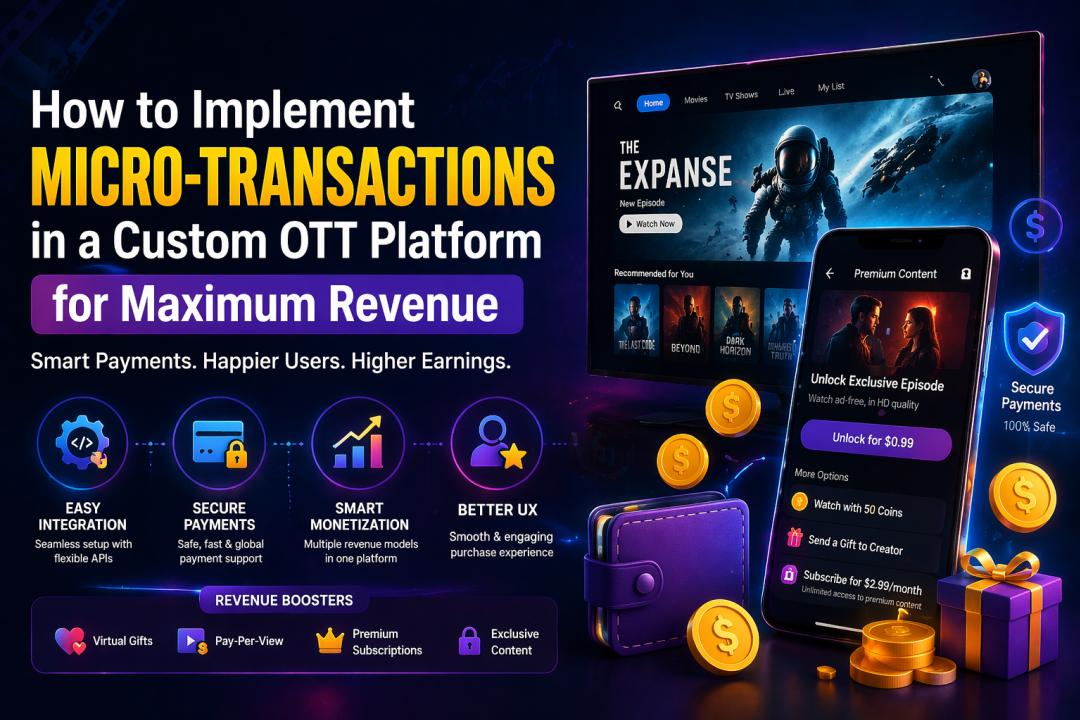
Introduction to Micro-Transactions in Custom OTT Platforms
The OTT industry has changed the way people consume content. From movies and series to short videos and live streaming, everything is now accessible on demand. But one of the biggest questions for anyone planning to build OTT platform is—how to monetize it effectively?
This is where micro transactions come in.
If you are wondering what are micro transactions, they are small payments made by users to access specific features or content. Instead of relying only on subscriptions, platforms now combine multiple revenue models. This is especially useful for creators building short video apps or launching a Video on demand solution (VOD solution).
In 2025, OTT monetization is expected to grow significantly. Reports suggest that nearly 35–40% of OTT platform revenue will come from hybrid models, including subscriptions, ads, and micro-transaction systems. This makes micro-transactions a key part of any OTT streaming solution.
Whether you're planning to how to build an OTT platform from scratch or scale an existing OTT video solution, understanding how to implement micro-transactions can help you maximize revenue.
Understanding Micro-Transaction Models for OTT Monetization
Before implementing, it's important to understand the different models.
The micro transactions meaning in OTT is simple—small, flexible payments for premium experiences. These models work across OTT TV solution, VOD platform provider, and live streaming solution ecosystems.
1. Pay-Per-View (PPV)
Users pay for individual videos or live events. This is common in sports and exclusive releases.
2. Freemium Model
Basic content is free, but premium features require payment. This is widely used in short video platforms.
3. Creator Tipping
Viewers can support creators through small payments during live sessions. This is growing in live video streaming solution platforms.
4. Content Unlocking
Users pay to unlock episodes or premium content in a whitelabel video on demand platform.
5. Virtual Goods
Digital items like badges or reactions enhance engagement in apps where you build live streaming app.
These models are flexible and work well when you build VOD platform or build live video streaming web application.
Choosing the Right OTT Solution Provider for Implementation
To successfully implement micro-transactions, choosing the right OTT solution provider is critical.
A good provider should offer:
Scalable infrastructure
Secure payment integration
Multi-device compatibility
Analytics and reporting tools
Platforms like Innocrux, known for their end to end OTT solution, help businesses easily integrate monetization features into their platform.
If you are exploring OTT solution providers in India, look for one that supports:
Custom OTT solution development
White label OTT solution
Integration with IPTV OTT solution
The right partner will simplify the process of how to build OTT apps and ensure long-term growth.
Key Features Required to Enable Micro-Transactions in OTT Apps
When planning to how to build an OTT app, certain features are essential to support micro-transactions.
1. Secure Payment System
A strong payment gateway is necessary for handling small transactions safely.
2. User Wallet System
Allows users to store balance and make quick payments.
3. Content Access Control
Controls who can view paid content.
4. Real-Time Analytics
Helps track user behavior and optimize pricing strategies.
5. Multi-Device Support
Ensures smooth experience across mobile, web, and smart TVs.
These features are critical whether you're working on a VOD solution, live streaming solution, or a complete OTT platform provider setup.
Step-by-Step Guide to Implement Micro-Transactions in a Custom OTT Platform
If you're serious about how to build OTT platform, follow these steps:
Step 1: Define Your Monetization Strategy
Decide how micro-transactions will fit into your platform—PPV, tipping, or content unlocking.
Step 2: Choose the Right Technology Stack
Select a scalable backend and a reliable OTT streaming solution.
Step 3: Integrate Payment Gateways
Add support for credit cards, UPI, wallets, and international payments.
Step 4: Build Content Pricing Logic
Set flexible pricing for videos, subscriptions, and add-ons.
Step 5: Develop User Interface
Make payments simple and user-friendly.
Step 6: Test and Optimize
Run A/B testing to find the best pricing strategy.
Step 7: Launch and Monitor
Use analytics to track performance and improve.
These steps apply whether you want to build VOD platform, build live streaming website, or create a build live streaming app.
Integrating Secure Payment Gateways and Multi-Currency Support
Payments are the backbone of micro-transactions.
A good OTT video solution must support:
Local payment methods (UPI, cards)
International payments
Multiple currencies
Fraud detection systems
In 2025, over 60% of OTT users prefer local payment methods, especially in emerging markets. This makes multi-currency support essential for global growth.
When choosing the best OTT solution, ensure it supports seamless payment integration to avoid user drop-offs.
Optimizing User Experience to Increase Micro-Transaction Conversions
User experience plays a huge role in conversion.
Here’s how to improve it:
Simple Checkout Process
Reduce steps to complete a transaction.
Transparent Pricing
Clearly show what users are paying for.
Personalized Recommendations
Suggest content based on user behavior.
Gamification
Use rewards, badges, and offers to encourage spending.
Mobile Optimization
Most transactions happen on mobile, so ensure smooth performance.
A well-designed UX is crucial when you build live streaming app or build live video streaming web application.
Best Practices to Maximize Revenue with Micro-Transactions
To get the most out of micro-transactions:
Combine multiple monetization models
Offer limited-time deals
Use data analytics to optimize pricing
Focus on high-quality content
Encourage creator engagement
Platforms that use a hybrid model (SVOD + AVOD + micro-transactions) see up to 25–30% higher revenue growth compared to single-model platforms.
Common Challenges and How to Overcome Them
Challenge 1: Payment Failures
Solution: Use reliable gateways and backup options.
Challenge 2: User Resistance
Solution: Offer value-driven pricing and free trials.
Challenge 3: Security Issues
Solution: Implement encryption and fraud detection.
Challenge 4: Complex Integration
Solution: Choose an experienced OTT platform provider.
Future Trends in Micro-Transactions for OTT & VOD Platforms
The future of micro-transactions is exciting.
AI-Based Pricing
Dynamic pricing based on user behavior.
Blockchain Payments
Secure and transparent transactions.
Creator Economy Growth
More platforms will support direct creator monetization.
Short Video Monetization
Short-form content will dominate micro-transaction revenue.
By 2025, short video platforms are expected to contribute over 50% of micro-transaction-based OTT revenue, making them a key focus area.
Conclusion
Micro-transactions are no longer just an optional feature—they are a core part of modern OTT monetization.
If you are planning to how to build an OTT platform from scratch, integrating micro-transactions will give you a competitive edge. Whether it's a VOD solution, live streaming solution, or a hybrid platform, this model allows you to generate consistent revenue while improving user engagement.
With the right strategy and the support of a reliable OTT solution provider like Innocrux, you can build a scalable and profitable streaming platform.
Start smart, focus on user experience, and combine monetization models to unlock the full potential of your OTT business 🚀