Introduction
AI is changing how software is built in a very fundamental way. Developers are no longer limited to writing every line of code manually. Instead, they are increasingly working with AI systems that can generate code, fix errors, and even manage parts of the development process on their own.
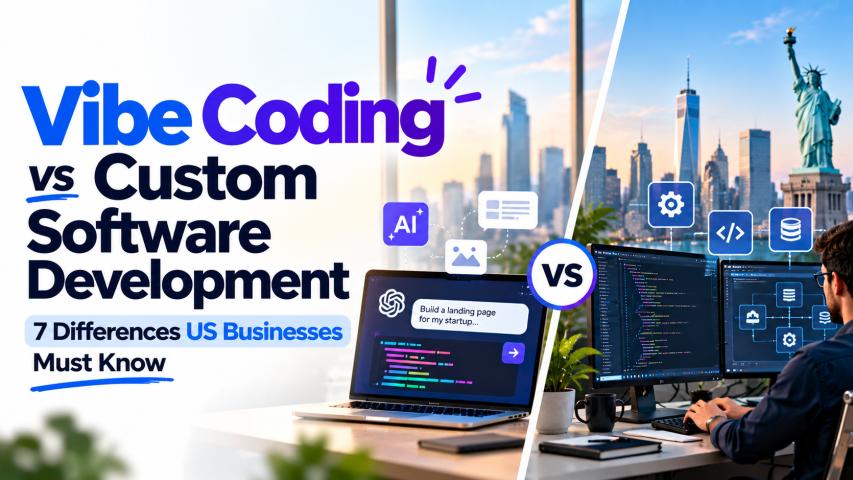
Within this shift, two approaches are becoming widely discussed: agentic coding and vibe coding. Both use AI to support development, but they represent very different ways of thinking and working. Understanding agentic coding vs vibe coding helps clarify how modern development workflows are evolving and where each approach fits.
Understanding Agentic Coding
Agentic coding is a structured and goal-driven approach where AI behaves like an autonomous agent. Instead of responding only to small prompts, the system is given a broader objective and is expected to figure out how to achieve it.
In practice, this means the developer defines what needs to be built, and the AI takes responsibility for breaking that goal into smaller tasks, planning the execution, writing the code, and improving it through iterations. The human role becomes less about micromanaging every step and more about guiding the direction and reviewing outcomes.
This approach is designed to reduce manual effort in complex development environments. It is especially useful when systems need to be consistent, scalable, and reliable. Because the process is structured, agentic coding fits well in production-level applications where stability is important.
Understanding Vibe Coding
Vibe coding takes a very different approach. It is more flexible, conversational, and experimental. Instead of defining a complete plan upfront, developers interact with AI in a continuous flow, adjusting their instructions based on what the AI produces.
The process often feels less formal. A developer might start with a rough idea, generate some code, review the output, refine the prompt, and repeat the cycle until the result feels right. There is no strict structure guiding the entire process, which is why it is often described as “going with the vibe.”
This makes vibe coding especially useful during early stages of development. When ideas are still forming and requirements are not fully clear, the ability to experiment quickly becomes more valuable than having a rigid workflow.
How Agentic Coding and Vibe Coding Differ
The difference between agentic coding vs vibe coding becomes clearer when looking at how control is distributed between the developer and the AI.
In agentic coding, the AI takes on a more independent role. Once the goal is defined, it can plan and execute tasks with limited human intervention. The system is built around structure, logic, and step-by-step execution.
In vibe coding, the developer remains closely involved throughout the process. Every output is shaped through feedback and iteration. Instead of following a predefined path, the development process evolves dynamically based on ongoing input.
One approach is designed for structured automation, while the other is designed for fluid experimentation.
Workflow Differences in Practice
In agentic coding, the workflow tends to follow a more predictable path. A goal is set, the AI breaks it down, executes tasks in sequence, tests the results, and refines the output until completion. The developer mainly oversees progress and ensures alignment with the intended outcome.
In vibe coding, the workflow is much less linear. It is more like a conversation between the developer and the AI. Each prompt leads to an output, which then influences the next prompt. The direction can change multiple times as new ideas emerge during the process.
This difference in workflow is what separates structured automation from creative exploration.
Where Each Approach Works Best
The usefulness of each method depends heavily on the stage of development.
Vibe coding is more effective when working on early-stage ideas, prototypes, or experimental features. It allows developers to move quickly, test concepts, and refine direction without worrying too much about long-term architecture.
Agentic coding becomes more valuable when those ideas need to be turned into stable, production-ready systems. It provides the structure needed for scalability, maintainability, and reliability, which are critical in real-world applications.
Many modern teams are not choosing one over the other but instead using both at different stages of development.
Why This Difference Matters
The rise of agentic coding vs vibe coding reflects a bigger shift in software engineering. Development is no longer just about writing code but about deciding how much control to give AI and how much remains with the developer.
This shift also changes how teams work. Developers are becoming more like system designers and reviewers, while AI handles more of the execution work. Depending on the approach used, the balance between structure and creativity changes significantly.
Understanding this helps teams choose the right workflow instead of applying a single method to every situation.
Conclusion
Agentic coding and vibe coding represent two different directions in AI-assisted development. One focuses on structured, autonomous execution, while the other focuses on flexible, iterative exploration.
Neither is better in all situations. Instead, they serve different purposes at different stages of building software. In many cases, the most effective approach is to use vibe coding for exploration and agentic coding for execution.
Together, they show how AI is not replacing developers but changing how developers think, build, and deliver software.