Ever landed on an online store, clicked around for a product, and felt confused between a page showing many products and another featuring just one item in detail? You’re not alone.
In ecommerce, two important page types, PDP (Product Detail Page) and PLP (Product Listing Page), often get mixed up by beginners, marketers, and even small business owners setting up their first online store. Understanding the difference between them is crucial for better SEO, higher conversions, and a smoother user experience.
Let’s break it down in a simple way so you never confuse them again.
What is a PLP (Product Listing Page) in E-commerce?
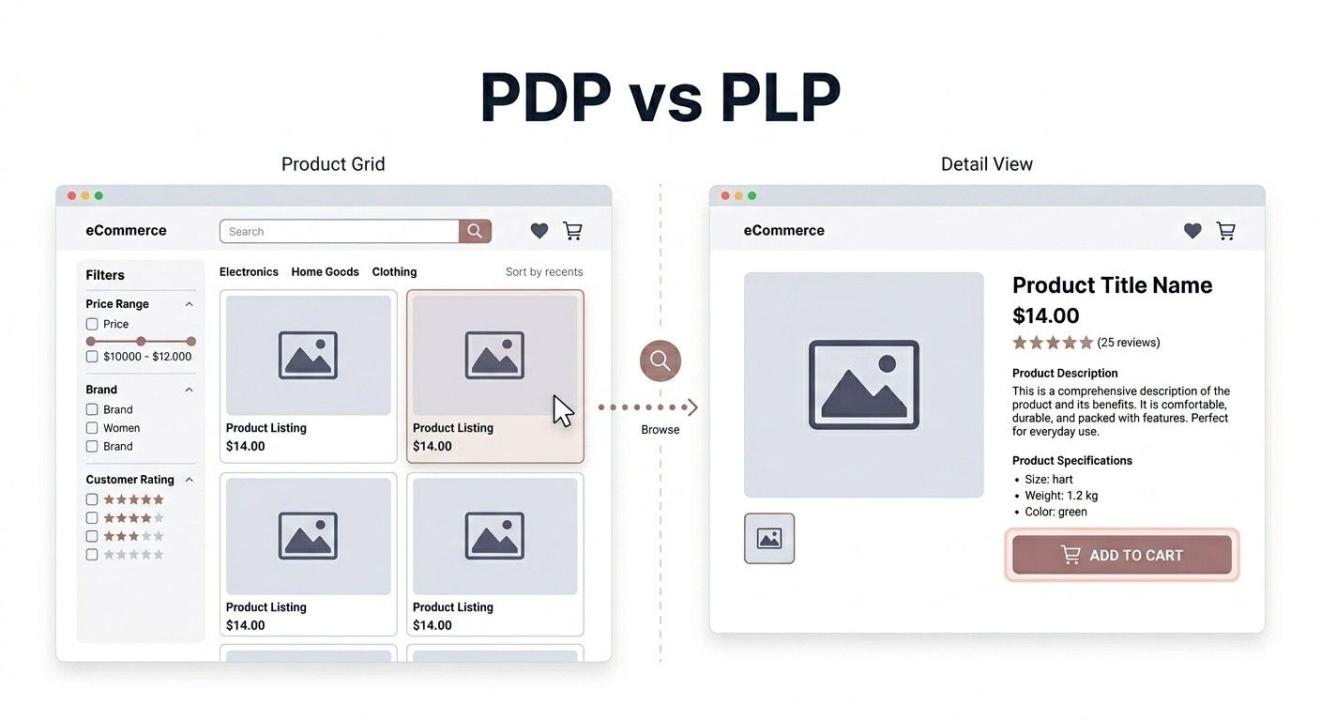
A PLP (Product Listing Page) is a category or collection page that shows multiple products together in a structured, easy-to-browse layout.
Think of it like walking through a supermarket aisle. You’re not looking at just one item. Instead, you see several options next to each other, which makes it easy to compare and choose what works best for you.
Key Characteristics of a PLP
- Displays multiple products at once in a grid or list format.
- Organized by categories like “Men’s Shoes,” “Smartphones,” or “Laptops.”
- Includes filters and sorting options for price, brand, ratings, size, or popularity.
- Designed for browsing and discovery, not for making quick purchase decisions.
- Helps users narrow down choices before going to a product detail page.
Example
If you search for “running shoes,” the page that shows options from Nike, Adidas, Puma, and other brands all in one place is a PLP.
In Short
PLP = Exploration + Comparison stage of the shopping journey
It helps users move from “I’m looking for something” to “I’ve shortlisted what I want.”
What is a PDP (Product Detail Page) in E-commerce?
A PDP (Product Detail Page) is a dedicated page that gives complete, in-depth information about a single product in an online store. This is where the customer shifts from browsing to seriously considering a purchase.
If a PLP is like a supermarket aisle with many options, then a PDP is like picking up one specific product and examining it closely before deciding to buy.
Key Characteristics of a PDP
- Focuses on one product only
- Displays detailed descriptions, images, and specifications.
- Shows important purchase details like price, stock availability, and delivery information.
- Includes action buttons like “Add to Cart” or “Buy Now.”
- Often features customer reviews, FAQs, and related product suggestions.
Example
Clicking on a specific product like “Nike Air Zoom Pegasus 40” and viewing its full details, such as images, size options, pricing, reviews, and delivery info, is a PDP.
In Short
PDP = Decision + Conversion stage
This is the page where users move from “I like it” to “I’m going to buy it.”
What is the Difference Between PLP and PDP?
Now that we understand both pages, let’s examine how they differ and how each has a unique role in the e-commerce journey. This difference is especially important for businesses using eCommerce management services. Optimizing both PLPs and PDPs can greatly affect traffic, user experience, and overall conversions.
1. Purpose
- PLP (Product Listing Page): Helps users browse, compare, and explore multiple products in one place.
- PDP (Product Detail Page): Helps users understand a single product in depth and make a purchase decision.
2. User Intent
- PLP: “I want options” or “I’m still exploring”
- PDP: “I’m interested in this specific product and want details before buying”
3. Content Type
- PLP: Quick product snapshots such as image, name, price, and rating. PDP:
- PDP: Detailed product information that includes features, specifications, reviews, FAQs, and delivery details.
4. SEO Focus
- PLP: Targets broader, high-volume keywords
- Example: “smartphones under 20000”
- PDP: Targets specific, high-intent long-tail keywords
- Example: “Samsung Galaxy S23 Ultra 256GB price in India”
5. Conversion Role
- PLP: Supports discovery and helps users navigate through options
- PDP: Drives the final decision and leads directly to purchase
Why Both PDP and PLP Are Important in Ecommerce
Many beginners focus only on product pages (PDPs) and overlook listing pages (PLPs). That’s a mistake.
A successful e-commerce website needs both because they work together in the customer journey.
- PLP brings traffic and options
- PDP converts visitors into buyers
Without PLP, users feel lost with too many individual pages. Without PDP, users don’t get enough information to trust and buy.
It’s a teamwork system.
UX (User Experience) Differences
Understanding the UX focus of both PLP and PDP is essential for creating a smooth and effective ecommerce experience. Each page has a different function, and the design should reflect that.
PLP UX Focus
The Product Listing Page emphasizes speed, clarity, and exploration. Users are usually browsing, so the experience should help them scan and filter quickly.
- Easy navigation to move across categories
- Quick product scanning with clear images and minimal clutter
- Filters and sorting tools (price, brand, ratings, etc.)
- Clean grid or list layout for effortless browsing
PDP UX Focus
The Product Detail Page focuses on decision-making and conversion. Once a user clicks in, they want confidence and clear information.
- High-quality product images (multiple angles, zoom, videos if possible)
- Clear pricing, discounts, and offers
- Trust signals like reviews, ratings, and testimonials
- Strong call-to-action buttons (“Add to Cart,” “Buy Now”)
- Detailed specifications and product information
A good ecommerce website makes sure that moving from PLP to PDP feels smooth and natural, not confusing.
SEO Differences Between PDP and PLP
Search engines view PLPs (Product Listing Pages) and PDPs (Product Detail Pages) differently because they serve unique roles in the user journey. Knowing this difference is crucial for building a solid e-commerce SEO strategy.
PLP SEO Strategy
PLPs are typically optimized for:
- Category-level keywords
- Broad search intent (users exploring options)
- Internal linking and site structure
These pages act as traffic drivers, helping users discover products.
Examples:
- “best gaming laptops”
- “wireless headphones under 5000”
PDP SEO Strategy
PDPs focus on:
- Product-specific keywords
- Brand + model searches
- High purchase intent queries
These pages are designed to convert visitors into buyers.
Examples:
- “Apple AirPods Pro 2 price”
- “Sony WH-1000XM5 specifications”
Pro Tip: PLPs attract traffic, PDPs convert it.
A strong e-commerce SEO strategy does not favor one page over the other. It connects both pages to guide users smoothly from discovery to purchase.
Common Mistakes People Make
Even well-designed eCommerce sites can miss out on conversions due to common mistakes. Here’s what to watch for:
1. Treating PLP like a PDP
Some websites overload product listing pages with too many details, including long descriptions, excessive specifications, or cluttered layouts. This slows down the page and overwhelms users who just want to browse.
2. Weak Product Descriptions on PDP
A Product Detail Page is where buying decisions are made. If it lacks clear descriptions, specifications, images, or trust signals, users are more likely to leave without buying.
3. Poor Navigation Between PLP and PDP
Users should be able to move easily between listing pages and product pages. If navigation is confusing or slow, such as having no back-to-results option or filters that reset, it creates friction and increases drop-offs.
4. Ignoring SEO Structure
Failing to optimize PLPs for category-level keywords and PDPs for product-specific queries can seriously limit your visibility in search engines. This reduces both traffic and sales opportunities.
Best Practices for PLP and PDP Optimization
For PLP:
- Use clean grid layouts
- Add filters (price, rating, brand)
- Keep product cards simple
- Optimize for fast loading speed
- Use category-focused keywords
For PDP:
- Add high-resolution images and videos
- Write detailed, benefit-driven descriptions
- Include FAQs and reviews
- Use clear “Buy Now” buttons
- Highlight offers and shipping info
When done right, both pages guide users smoothly from discovery to purchase.
Real-Life Analogy
Let’s simplify it even more:
- PLP is like a restaurant menu
- You see all dishes and choose what looks good
- PDP is like the dish you order
- You get full details about ingredients, taste, and presentation before eating
Both are necessary for a complete dining experience, just like both pages are essential in ecommerce.
Final Thoughts
Understanding PDP vs PLP is not just technical jargon; it’s a basic part of building a successful ecommerce website.
PLPs help users explore and discover products, while PDPs assist them in deciding and buying. When both are well-designed, optimized, and connected, they create a smooth shopping journey that boosts engagement, trust, and sales.
If you're building or improving an online store, don’t treat them as separate entities; think of them as two stages of the same customer journey.
FAQs: PDP vs PLP
1. What is the main difference between PDP and PLP?
PLP shows multiple products for browsing, while PDP displays detailed information about a single product for purchase.
2. Which is more important, PDP or PLP?
Both are equally important. PLP helps users discover products, and PDP converts them into buyers.
3. What does PLP stand for in ecommerce?
PLP stands for Product Listing Page, where multiple products are displayed in a category or collection.
4. What does PDP stand for in ecommerce?
PDP stands for Product Detail Page, which provides complete information about a specific product.
5. How does SEO differ for PDP and PLP?
PLPs target broad category keywords, while PDPs target specific, high-intent product keywords that lead to conversions.