Most roof leaks associated with solar installations don’t result from the panels themselves. The problem usually starts around the attachment points.
A penetration that looks properly sealed during installation can slowly become vulnerable after years of weather exposure, thermal movement, and seasonal expansion. In many cases, homeowners don’t notice the issue until ceiling stains, attic moisture, or damp insulation begin appearing months later.
According to the National Renewable Energy Laboratory (NREL), roof attachment and flashing quality play a major role in maintaining long-term roof integrity after solar installation. The challenge is that many traditional mounting systems still depend heavily on exposed sealants and field-applied waterproofing methods that can weaken over time.
That’s one reason self-flashing solar mounts have gained attention among roofing contractors focused on long-term waterproofing reliability.
What Self-Flashing Solar Mounts Actually Do
Traditional solar attachment systems often require several waterproofing steps during installation.
That can include:
- Separate flashing components
- Field-applied sealants
- Additional waterproofing layers
- Manual waterproofing adjustments around penetrations
Every extra step introduces more opportunity for installation inconsistency.
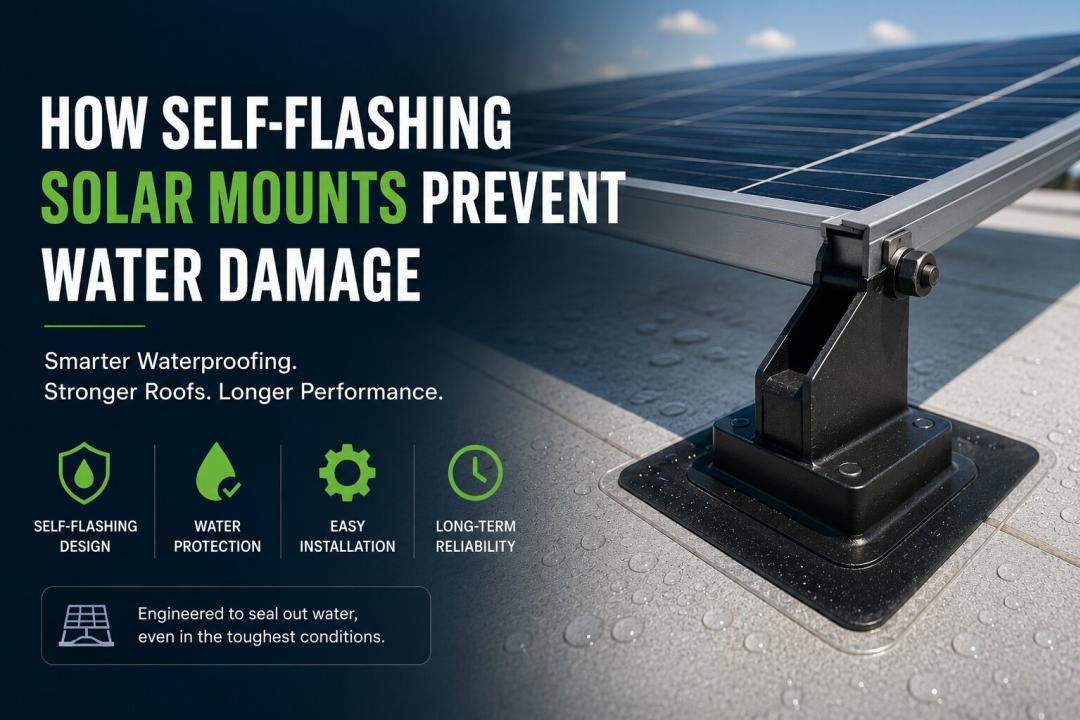
Self-flashing solar mounts simplify the waterproofing process by integrating flashing protection directly into the mounting system itself. Instead of relying entirely on exposed sealants or layered field assembly, the attachment point is designed to manage water more effectively around the penetration.
For roofing professionals, that matters because roof leaks rarely result from a single major failure. Most moisture problems develop slowly through repeated exposure to:
- UV radiation
- Freeze-thaw cycles
- Wind-driven rain
- Roof expansion and contraction
- Seasonal movement across the roof assembly
Reducing waterproofing complexity often improves long-term installation consistency.
Why Waterproofing Becomes More Important on Low-Slope Roofs
Water behaves very differently on low-slope roofing systems compared to steep-slope residential roofs.
On low-slope surfaces, water drains more slowly and remains in contact with penetrations longer after storms. That increases the importance of flashing integrity, drainage flow, and attachment design.
Contractors working with:
- TPO roofing
- PVC membranes
- Modified bitumen
- Standing seam metal systems
already understand how small waterproofing mistakes can eventually lead to expensive service issues if drainage patterns are disrupted around solar penetrations.
That’s why many commercial roofing contractors prioritize mounting systems designed around long-term waterproofing performance rather than simply installation speed.
Modern rail-less solar mounting systems are gaining attention because they simplify attachment layouts while supporting better waterproofing control across low-slope and weather-exposed roofing conditions.
Reduced Membrane Stress Helps Improve Long-Term Roof Performance
One of the biggest concerns on commercial solar projects is long-term membrane stress around attachment points.
When mounting systems create excessive pressure concentration or disrupt natural drainage flow, roofing materials can become vulnerable over time. Ponding water, seasonal movement, and repeated thermal cycling often expose weak waterproofing details much faster on low-slope roofs.
That’s why many contractors evaluating solar attachment strategies now focus heavily on:
- Membrane protection
- Water-shedding behavior
- Flashing integration
- Drainage efficiency
- Long-term maintenance access
Additional insights on low-slope solar waterproofing considerations can be found here: Low-Slope Roof Solar Installation Guide
For roofing-focused installers, minimizing unnecessary membrane disruption typically reduces long-term leak risks and maintenance exposure.
Sealant Alone Is Rarely a Long-Term Waterproofing Strategy
One common issue inspectors find in older solar installations is overreliance on sealants.
Sealants absolutely have a role in roofing systems, but they should not become the primary waterproofing defense around solar penetrations. Over time, UV exposure, moisture movement, and temperature cycling can cause sealants to dry out, crack, or separate from surrounding materials.
Roof leak investigations often uncover:
- Dried sealant edges
- Loose flashing integration
- Fastener movement
- Improper drainage flow
- Uneven mounting pressure
Self-flashing systems help reduce reliance on exposed-sealant-only waterproofing methods by integrating water-shedding protection more directly into the attachment design. That creates a more durable waterproofing approach under real-world weather exposure.
Installation Consistency Matters Just as Much as Product Design
Even high-quality mounting systems can fail if installation work becomes rushed or inconsistent.
A contractor in the Southwest recently inspected a commercial reroof project in which leaks developed around multiple solar penetrations less than two years after installation. The issue wasn’t panel failure or membrane defects. Several attachment points had inconsistent flashing integration, with field modifications made during installation.
Once thermal movement and seasonal storms stressed those weak areas, moisture intrusion began developing around the penetrations.
The repairs eventually required:
- Temporary array removal
- Membrane repair
- Flashing replacement
- Drainage correction
- Reinstallation labor
Situations like this are why experienced roofing contractors often prioritize mounting systems that simplify waterproofing details while reducing field variability during installation.
The fewer unnecessary waterproofing steps required on the roof, the lower the chances of future leak-related service calls.
Conclusion
Most solar-related roof leaks begin around penetrations, flashing failures, or waterproofing details that weaken over time due to real-world weather exposure. That’s why mounting design matters just as much as the solar panels themselves.
Self-flashing solar mounts help reduce waterproofing complexity by integrating flashing protection directly into the attachment system rather than relying heavily on exposed sealants or multi-step field assembly.
For contractors working on residential reroofing projects, commercial low-slope systems, or weather-exposed installations, reducing unnecessary waterproofing risks can significantly improve long-term roof performance.
Systems designed around simplified waterproofing principles, including solutions like RT-APEX, are becoming increasingly important as contractors look for ways to protect both solar performance and roof integrity over the long haul.
At the end of the day, the best solar installation is usually the one that still keeps the building dry years after the panels are installed.