If you've been searching for a sobriety app, quit drinking tracker, or alcohol-free companion that doesn't demand your email, your social graph, and your cloud storage just to count days, Sober Tracker is worth a serious look. It's a privacy-first sobriety tracker available on iOS and Android, built by Ivan Terekhin under the Trifoil Trailblazer brand. The backstory matters here: Terekhin is a programmer who struggled with alcohol himself, tried the other recovery apps on the market, and got tired of the accounts, cloud sync, and community feeds that most of them require. So he built the tool he actually wanted to use, and the result feels noticeably different from the competition.
What Sober Tracker Is and What Problem It Solves
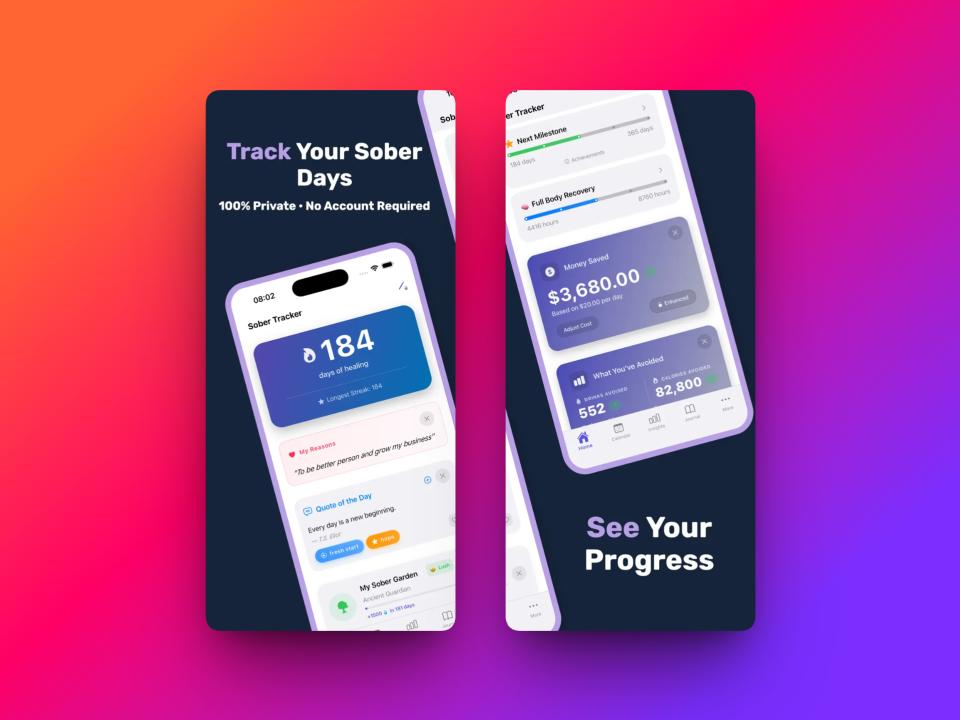
At its simplest, Sober Tracker is a sobriety counter and recovery companion app. You set your sobriety start date, the app tracks your streak, and you get a structured set of tools to support the rest of the journey: motivation, education, financial awareness, mood tracking, and craving management. It's positioned as a quit alcohol app, but it works equally well as a general sobriety tracker for anyone changing their relationship with any substance or habit.
What makes it different is the philosophy. Most alcohol recovery apps push you toward community-driven models with profiles, feeds, sponsors, and shared milestones. That works for some people, but it's a hard sell if you value discretion, if you're sober-curious rather than ready to commit publicly, or if you've simply learned that posting your recovery online creates its own pressures. Sober Tracker takes the opposite stance: no accounts, no cloud, no social layer. Your data stays on your device.
The Recovery Garden: The Standout Feature
The signature feature is the Recovery Garden, a virtual garden that grows alongside your sober streak. You start as a seed on day one and progress through nine stages, eventually reaching a magical tree at the one-year mark. Along the way you unlock new plants, flowers, and visual changes at specific milestones.
It sounds like a gimmick on paper, but in practice it works for the same reason streak apps like Duolingo work: it turns abstract progress into something visible. Day 47 means very little emotionally. A garden that's visibly different from how it looked at day 30 means a lot. It's a small, well-executed design choice that gives you something to look forward to beyond round-number milestones.
Achievements, Financial Tracking, and Coping Tools
Around the garden sit the features you'd expect from a full-featured sobriety app, and most of them are done well:
30+ achievement badges. These cover early wins (first 24 hours, first week), major milestones (30 days sober, 90 days sober, six months, one year sober), and behavioral or secret badges. The most thoughtful one is the Phoenix badge, earned by resetting your counter after a relapse and starting again. The framing matters: recovery isn't linear, and an app that rewards getting back up rather than punishing the reset gets the psychology right.
Financial tracker. You set your average alcohol spending and the app calculates real-time savings, breaks it down into five spending categories, and projects compound interest growth over 1, 3, 5, and 10 years. For moderate drinkers, the numbers add up faster than expected, and the investment projection turns "I'm saving money" into "here's what that money could become." It's a strong motivational lever, especially in early sobriety when the abstract benefits of quitting alcohol haven't fully kicked in yet.
Mood journal. Daily mood logging with pattern recognition for identifying triggers. Useful for understanding what situations, emotions, or times of day put your sobriety at risk.
Coping toolkit. Eleven evidence-based strategies for handling cravings, including breathing exercises, urge surfing, grounding techniques, and distraction tactics. This is where the app earns its keep on hard days.
The Privacy Angle Is Genuinely Different
This deserves its own section because it's rare. Sober Tracker stores everything on-device. No accounts to create, no email required, no cloud sync, no social feed, no data sold to advertisers. The only thing that leaves your phone is anonymous usage analytics for improving the app. If you've ever felt uneasy about an alcohol app knowing your name, your location, your contacts, and your daily mood, this is the obvious antidote.
Educational Content That's Actually Worth Reading
A real strength of the project, beyond the app itself, is the quality of the supporting content on the website. The Health Benefits page lays out a clear timeline of what happens to your body when you stop drinking: blood sugar stabilization within 24 hours, sleep improvements in the first week, liver fat reduction starting at 2 to 4 weeks, normalized liver enzymes within 1 to 3 months, and significant cognitive and immune improvements by the 90-day mark. It's the kind of timeline content people search for constantly and rarely find in a non-clickbait format.
The Blog goes considerably deeper with long-form guides on practical recovery topics: a complete quit drinking guide, an alcohol withdrawal timeline broken down day by day, the honest truth about 30 days without alcohol, the 90 days sober neuroplasticity breakthrough, weight loss after quitting alcohol, a one year sober transformation guide, a sober curious starter guide, and a 2026 comparison of the best sobriety apps. The writing avoids the two failure modes of recovery content: it's not preachy AA->
Quick Rundown
| Aspect | Details |
|---|---|
| Platforms | iOS (App Store), Android (Google Play) |
| Price | Free with optional Premium upgrade |
| Privacy model | On-device only, no accounts, no cloud sync |
| Standout feature | Recovery Garden with 9 growth stages |
| Achievements | 30+ badges including the Phoenix (post-relapse) |
| Financial tracking | 5 categories, compound interest projections over 1, 3, 5, 10 years |
| Coping tools | 11 evidence-based strategies for cravings |
| Mood tracking | Daily journal with trigger pattern recognition |
| Works for | Alcohol, other substances, general habit change |
| Best for | Dry January, Sober October, long-term recovery, sober-curious |
| Made by | Ivan Terekhin / Trifoil Trailblazer |
| Social features | None (by design) |
Who Should Use Sober Tracker
It fits several distinct user groups well. Dry January and Sober October participants get the streak system, daily motivation, and milestone celebrations at the one-week, two-week, and full-month marks. The sober-curious crowd, people who aren't sure they're quitting forever but want to experiment with not drinking, gets a low-pressure entry point that doesn't require commitment to a community. People in long-term recovery who want utility without surveillance get a serious set of tools. High-functioning drinkers who don't identify with traditional recovery framing get a tracker that focuses on personal data and progress rather than group identity. And anyone doing Dry January 2027, a "damp" life>
It's worth being clear about what's deliberately not in the app. There's no social feed, no sponsor matching, no meeting finder, no AA integration, and no in-app community. If group accountability is essential to your recovery, Sober Tracker complements that approach but doesn't replace it. You'd use it alongside meetings, a therapist, or whatever support structure you already have.
Verdict
Sober Tracker gets the fundamentals of a quit drinking app right and layers on enough thoughtful design choices, the Recovery Garden, the Phoenix badge, the compound interest projections, the on-device privacy, to feel meaningfully different from the crowded field of sobriety counter apps. The educational content on the Health Benefits page and the Blog is good enough to be useful even if you never download the app. The fact that the core experience is free removes most of the reason not to try it.