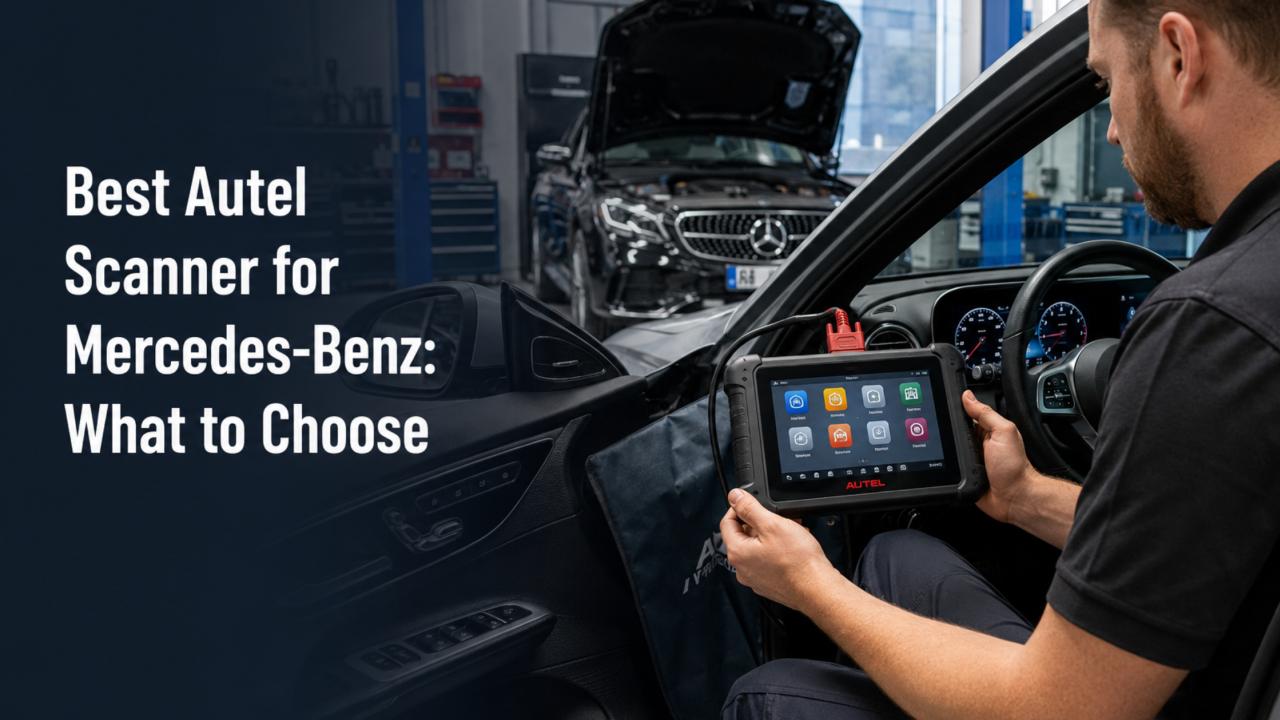
Modern Mercedes-Benz is packed with electronics, sensors, and the interconnection of various control modules. That's why many owners, searching for reliable Mercedes repairs, soon discover that their code reader isn't enough anymore. Selecting the best Autel scanner for Mercedes-Benz depends on the depth of your diagnostic needs, as well as your requirements for coding, bidirectional testing, and/or module adaptation.
There are scanners that clear engine codes only, and others that have access to almost every major system in the car. This is especially important for newer cars that come packed with advanced technologies.
Why Mercedes Diagnostics Need Better Scan Tools
Mercedes-Benz vehicles rely on highly sophisticated communication systems between various modules. Engine, transmission, suspension, steering, brakes, and comfort systems communicate constantly with each other.
A generic OBD2 scanner will have access to only a limited amount of data, potentially missing vital fault codes in other vehicle systems. This becomes problematic if the problem concerns:
Air suspension
Transmission adaptation
Steering sensors
Battery management systems
Electronic braking systems
Various ADAS features
And others.
A professional-level Mercedes scanner should be able to access deeper into these systems.
Autel Scanner Mercedes-Benz Compatibility – What To Look For?
Not all Autel scanners are equally good at Mercedes diagnostics. There are some entry-level models with only OBD2 capabilities, and others designed specifically for deep diagnostics in European vehicles.
When selecting scanners for your Mercedes, focus on:
Scanning of full systems.
Ability to perform ECU coding.
Bidirectional testing.
Monitoring of live data.
Diagnostic of Mercedes-Benz modules.
Ability to perform system/service reset.
A Mercedes-Benz scanner should not interact only with the engine computer; that is a very simplistic approach to diagnostics.
Why ECU Coding is Important on Mercedes-Benz Vehicles
Most modern repairs on Mercedes-Benz vehicles involve coding or adapting the systems of replaced parts.
Common examples include:
Battery registration.
Reset of transmission adaptation.
Steering angle recalibration.
Injector coding.
Resets for the electronic parking brake.
And other tasks.
Without the proper scanner, all these jobs are impossible to accomplish. That is why specialized mechanics for Mercedes repairs often prefer high-end diagnostic tools over cheap code readers.
Autel MaxiCom VS MaxiSys - Which Is Best for Mercedes-Benz?
Often, people looking for a scanner for their Mercedes are torn between the Autel MaxiCom and MaxiSys scanners. They are both capable of diagnosing Mercedes-Benz vehicles. But what is the main difference?
Simple Diagnostic
Autel MaxiCom: Yes
Autel MaxiSys: Yes
Full System Scanning
Autel MaxiCom: Yes
Autel MaxiSys: Yes
ECU Coding
Autel MaxiCom: Basic
Autel MaxiSys: Premium
Bi-directional
Autel MaxiCom: Yes
Autel MaxiSys: Yes
Mapping Topology
Autel MaxiCom: Some models
Autel MaxiSys: All-in-one
ECU Programming (Flashing)
Autel MaxiCom: Poor
Autel MaxiSys: Good
Usually, the MaxiCom is enough for general diagnostics and service checks. If you need deep diagnostics and access to all Mercedes systems, MaxiSys is probably the better choice.
Why Cheap Scanners Create More Problems
One of the errors people make when choosing a scanner for their Mercedes is price. This usually results in:
No manufacturer-specific fault codes.
Lack of communication between the different modules.
Incompleteness of diagnostic checks performed.
Misinformation regarding fault codes.
Problems with the newer Mercedes communication system.
The result is additional waste of time and money on unnecessary parts replacement. With better diagnostic equipment, most problems can be solved simply by accurate diagnostics.
Which Scanner Should You Get Based on Your Needs?
Not all Mercedes owners necessarily need high-end diagnostic equipment for their vehicles.
Basic Owners: Need to read codes, clear dashboard lights, and handle basic maintenance.
Best Choice: Autel MaxiCOM MK808S - A budget-friendly, highly capable tablet for entry-level tasks.
DIY Car Mechanics: Enthusiasts doing brake service, battery registration, and steering adaptations.
Best Choice: Autel MaxiCOM MK900 - Let bi-directional controls and deeper system capabilities without the professional price.
Professional Repair Shops: Needs advanced topology mapping, module flashing and premium ECU coding.
Best Choice: Autel MaxiSys MS906 Pro or MaxiSys Elite II Pro - Full-fledged diagnostic powerhouses built for complex European vehicle networks.
Such functions are increasingly necessary with the further development of Mercedes systems.
Common Mercedes Problems That Need Advanced Diagnostics
Several common problems found on Mercedes-Benz vehicles require deep-scan capabilities. They include:
Calibrations of air suspension.
Electronic steering lock malfunction.
Transmission module malfunction.
Problems with the battery management system.
Faulty blind spot monitoring systems.
Problems with sensor calibration.
And many more.
Simple scanners often struggle to communicate with these complex systems. That is why diagnostic tools have become an integral part of professional European car servicing.
Why Real Diagnostic Performance Matters More Than Marketing
There are many reviews of diagnostic tools' features, but not how they really work in the real world. More experienced professionals will be looking for:
Quick scanning speed.
Stable communication with the car.
Accurate display of live data.
Convenient navigation
Regular updates
Instead of fancy marketing claims, owners interested in advanced Mercedes diagnostics can review the top Mercedes diagnostic tools mechanics swear by.
Choosing the Right Autel Scanner for Your Mercedes-Benz
The selection of the appropriate Autel scanner depends on the nature of diagnostic needs. Some owners are only interested in simple code reading. Others might require more complex diagnostics, including ECU coding, module adaptation, bidirectional testing, and so on.
With recent advances in Mercedes-Benz, high-end scanners have become a vital component of the automotive repair process, enabling earlier detection of problems before they cause more serious damage.