
The global prediction market industry is experiencing
unprecedented growth, driven largely by the rise of blockchain technology and
decentralized applications. As one of the most-watched sporting events on the
planet, the FIFA World Cup 2026 represents a once-in-four-years opportunity —
and for entrepreneurs and tech ventures, it signals the perfect launchpad for a
high-performance sports prediction market platform.
Whether you are a startup exploring new revenue streams or
an established business looking to expand into decentralized finance (DeFi), building
a feature-rich prediction market before FIFA 2026 kicks off could be
the most strategically sound move you make this decade.
Why the FIFA World
Cup 2026 Creates an Unmatched Market Opportunity
A Global Audience
Like No Other:
The FIFA World Cup consistently ranks as the most-watched
live sporting event in human history, drawing billions of viewers across every
continent. The 2026 edition — hosted across the United States, Canada, and
Mexico — is set to be the largest World Cup ever, featuring 48 teams competing
in expanded group stages.
This international reach means that a sports
prediction platform launching ahead of FIFA World Cup 2026 can attract
users from dozens of countries simultaneously. Fans are not passive during the
World Cup — they actively analyze player statistics, team form, and match
outcomes. This behavioral tendency makes them a natural, highly-engaged
audience for prediction market platforms.
Blockchain Platforms
vs. Traditional Prediction Models
Legacy prediction and sports betting platforms suffer from
persistent issues: lack of transparency, slow payouts, centralized control, and
limited cross-border accessibility. Blockchain-based prediction markets solve
all of these pain points by recording every transaction, prediction, and reward
on an immutable, public ledger.
This shift is already underway. Decentralized prediction
platforms are attracting users who previously avoided traditional sports
betting due to trust concerns. The FIFA World Cup amplifies this trend —
millions of new users enter the digital prediction space every four years, and
2026 is the year to capture them on a modern, transparent platform.
Core Features That
Define a High-Performance FIFA 2026 Prediction Platform:
Building a competitive prediction market platform requires
more than a basic interface. The following features are essential for user
acquisition, engagement, and long-term retention:
1. Live Score and
Real-Time Data Integration:
Accurate, low-latency match data is the backbone of any
credible sports prediction platform. Integrating live score feeds, player-level
statistics, and real-time match events allows users to make informed
predictions and strengthens trust in the platform's data integrity. Without
live data integration, user engagement drops significantly during active match
periods.
2. Real-Time Odds
Engine and Performance Analytics:
Users expect dynamic odds that reflect current match
conditions. A robust odds engine that updates based on live scoring events, possession
statistics, and historical team performance gives the platform a professional
edge. Offering pre-match analysis dashboards, win probability calculators, and
head-to-head comparisons significantly increases the time users spend on the
platform before placing predictions.
3. AI and Machine
Learning-Powered Prediction Insights:
Artificial intelligence is transforming how users interact
with prediction platforms. By deploying machine learning models trained on
historical tournament data, squad performance, injury reports, weather
conditions, and market sentiment, your platform can offer AI-assisted
prediction recommendations. This feature adds significant value, especially for
casual users who are less familiar with deep sports analytics.
4. Blockchain-Backed
Transparency and Smart Contract Automation:
Every prediction placed, every transaction processed, and
every reward distributed should be governed by smart contracts — self-executing
agreements that operate without human intervention. This eliminates the
possibility of manipulation, delayed payments, or unauthorized modifications.
For users considering prediction platforms for the first time, blockchain
transparency is often the deciding factor in platform selection.
5. Multi-Currency and
Multi-Chain Crypto Payment Support:
Given that FIFA 2026 draws participation from over 200
countries, supporting a diverse range of cryptocurrencies — including Bitcoin,
Ethereum, BNB, USDT, and others — is critical for global accessibility. A
multi-chain payment infrastructure ensures faster settlement times, lower
transaction fees, and a frictionless experience for users regardless of
geographic location.
6. Mobile-First UI/UX
Design:
The majority of sports engagement today happens on mobile
devices, particularly during live match moments. Your prediction platform must
be fully optimized for mobile — including intuitive wallet management, seamless
prediction placement, push notifications for match events, and one-tap reward
claims. A well-designed mobile experience directly correlates with higher
retention rates and word-of-mouth growth.
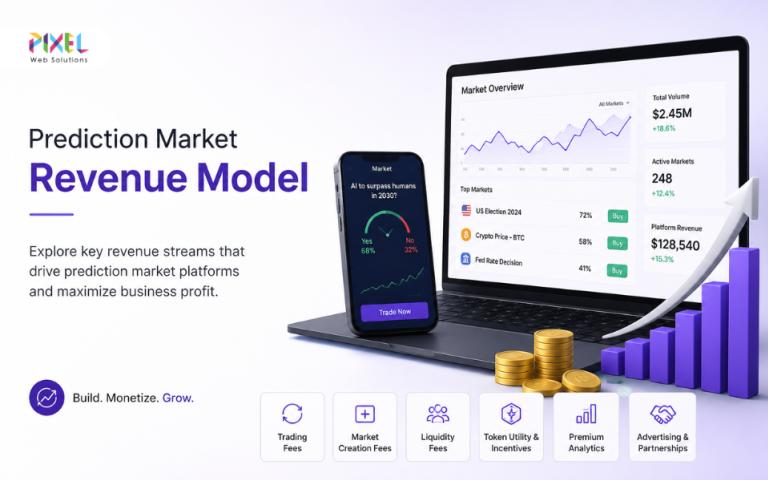
Revenue Models for
FIFA World Cup 2026 Prediction Platforms:
A well-architected prediction market platform offers
multiple, simultaneous revenue streams:
Entry Fees and
Participation Charges:
Charging a small, standardized entry fee for prediction
contests is one of the most consistent revenue sources — particularly during a
global event like the World Cup, where millions of users actively seek
platforms to participate in.
Transaction Fee
Commissions:
Every crypto transaction on the platform — deposits,
withdrawals, prediction placements, and reward claims — can carry a minimal
processing fee. Given the volume of transactions expected during FIFA 2026,
even fractional commissions accumulate into substantial platform revenue.
NFT-Based Reward
Ecosystems:
Non-fungible tokens (NFTs) introduce a compelling rewards
mechanic unique to Web3 platforms. Prediction platforms can issue NFT
collectibles tied to World Cup moments — match highlights, limited-edition
player cards, tournament milestone badges — as rewards for top predictors.
These digital assets carry long-term value and create viral sharing
opportunities that amplify platform visibility.
Native Token Utility
Models:
Launching a platform-native utility token enables users to
stake, earn, vote, and participate in governance decisions. As user demand for
the token grows alongside FIFA 2026 excitement, the token's utility drives
platform engagement while creating a native economic layer.
Premium Subscriptions
and Contextual Advertising:
A tiered subscription model — offering AI predictions,
ad-free browsing, advanced analytics, and priority support — generates
predictable monthly recurring revenue. Simultaneously, contextual advertising
partnerships with sports brands, crypto exchanges, and gaming companies provide
a complementary income layer that scales with platform traffic.
Benefits for Both
Platform Users and Platform Operators:
For Users:
·
Access to transparent, tamper-proof prediction
outcomes
·
Real-time analytics and AI-assisted insights for
smarter predictions
·
Instant crypto payouts via smart contracts
·
NFT rewards with real-world collectible value
·
Participation in a global community of football
fans and crypto enthusiasts
For Platform
Operators:
·
Multiple simultaneous revenue streams from day
one
·
Massive inbound user traffic driven by FIFA 2026
media coverage
·
Long-term platform value built through token
ecosystems and NFT economies
·
Scalable infrastructure to support post-World Cup
expansion into other sports
Long-Term Growth
Strategy: Beyond FIFA 2026:
Retaining Users After
the Tournament Ends:
One of the most critical questions for prediction platform
businesses is post-tournament user retention. The answer lies in proactive
content planning. Before FIFA 2026 concludes, platform operators should have
the next series of prediction events ready — covering UEFA Champions League,
IPL cricket, NBA playoffs, golf majors, and Formula 1. Transitioning users from
one event to the next minimizes churn and maintains platform momentum.
Expanding into
Multi-Sport and Multi-Category Prediction Markets:
A platform built on robust infrastructure for FIFA 2026 can
be expanded into cricket, basketball, golf, esports, and even non-sports
prediction markets such as political elections and entertainment award shows.
Diversifying prediction categories broadens the addressable audience and
reduces dependency on any single sporting calendar.
Building a Web3
Prediction Ecosystem:
The future of blockchain prediction markets is deeply
intertwined with the broader Web3 economy. Platforms that implement
decentralized autonomous organization (DAO) governance, cross-chain
interoperability, and DeFi staking mechanisms will be well-positioned to
capture the next wave of decentralized application users — a demographic that
will only continue to grow.
Conclusion: Build
Your Prediction Market Platform Before FIFA 2026 Kicks Off
The countdown to FIFA World Cup 2026 is also a countdown for
prediction market entrepreneurs. The convergence of record-breaking global
viewership, accelerating crypto adoption, and rising demand for transparent,
decentralized platforms creates a market condition that will not repeat itself
for another four years.
Choosing a development partner with proven expertise in
blockchain architecture, smart contract development, and sports data
integration is as important as the platform itself. A well-executed launch
before the tournament begins is not just an advantage — it is the competitive
edge that separates market leaders from latecomers.
Why Hivelance is the
best place for build your Prediction Market App:
Hivelance Technologies is a leading
prediction market development company offering white-label,
feature-rich , and fully customizable Prediction Market software solutions
tailored for global sports events like FIFA World Cup 2026. From smart contract
development and AI integration to real-time data feeds and mobile-optimized UI,
Hivelance delivers end-to-end platform builds designed to support millions of
concurrent users.