Surgical Robotics Market Size
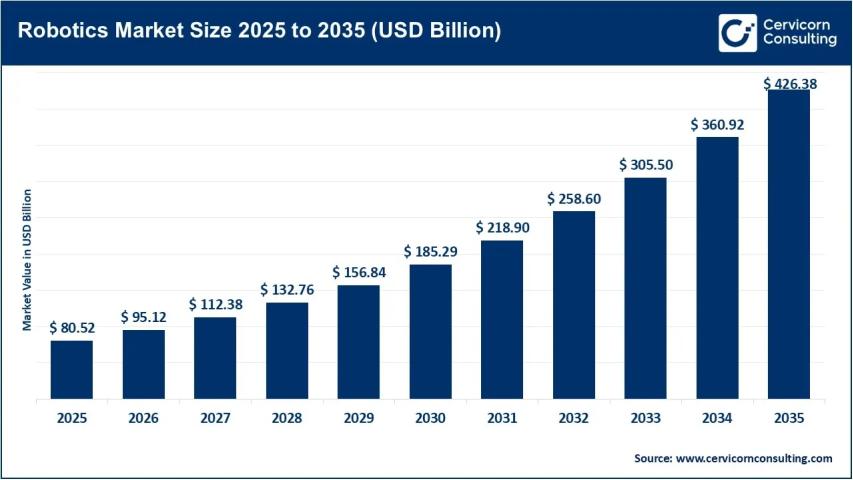
The global surgical robotics market was valued at approximately USD 14.23 billion in 2025 and is projected to reach nearly USD 51.08 billion by 2035, growing at a CAGR of 13.63% from 2026 to 2035.
Overview of the Surgical Robotics Market
The surgical robotics market comprises the global network of companies, technologies, and healthcare providers involved in developing, manufacturing, and deploying robotic systems that support surgeons during medical procedures. These advanced platforms combine robotic arms, sophisticated imaging systems, navigation software, artificial intelligence, and surgeon-controlled consoles to enhance surgical performance.
Unlike fully autonomous machines, surgical robots operate under the direct guidance of trained surgeons. They convert the surgeon’s hand movements into highly accurate robotic actions, enabling minimally invasive procedures through smaller incisions while improving precision, flexibility, and visualization.
Today, robotic-assisted surgery has become an essential component of modern healthcare, helping hospitals improve clinical outcomes, reduce recovery times, and increase operational efficiency.
Get a Free Sample: Request Free Sample Report
Major Drivers Accelerating Market Growth
Several trends are fueling the rapid expansion of the surgical robotics industry, including:
- Increasing prevalence of chronic diseases requiring surgical treatment
- Growing preference for minimally invasive procedures
- Rising adoption of robotic-assisted orthopedic and laparoscopic surgeries
- Technological advancements in artificial intelligence, machine vision, and robotic automation
- Expansion of healthcare infrastructure in emerging economies
- Higher investments in next-generation surgical technologies
- Aging populations driving demand for complex surgical interventions
- Favorable reimbursement policies in developed countries
- Growing acceptance of robotic platforms among surgeons and healthcare providers
- Continuous innovation in imaging, navigation, and robotic systems
Collectively, these factors are boosting demand for technologies that enhance surgical accuracy, reduce complications, and speed patient recovery.
Why Surgical Robotics Is Transforming Healthcare
The value of surgical robotics extends beyond technological innovation, offering meaningful benefits to patients, surgeons, and healthcare institutions.
Greater Surgical Precision
Robotic platforms enable highly controlled movements, allowing surgeons to perform complex procedures with exceptional accuracy while minimizing unintended tissue damage.
Faster Recovery Times
Smaller incisions often result in less postoperative pain, reduced blood loss, shorter hospital stays, and quicker returns to normal activities.
Enhanced Visualization
High-definition cameras and advanced 3D imaging technologies provide detailed views of the surgical area, helping clinicians make better-informed decisions during procedures.
Reduced Risk of Infection
Minimally invasive robotic techniques generally lead to fewer postoperative complications and lower infection rates compared to conventional open surgery.
Broader Access to Specialized Care
Integration with telemedicine and remote surgical support technologies helps extend expert surgical guidance to underserved regions.
Improved Hospital Performance
Healthcare facilities can optimize operating room utilization, reduce readmissions, and streamline workflows through robotic-assisted surgical programs.
Leading Companies Shaping the Surgical Robotics Industry
Several prominent medical technology companies continue to drive innovation and market expansion in robotic-assisted surgery.
- Intuitive Surgical, Inc. – Market leader known for the da Vinci Surgical System and Ion platform, supported by a vast installed base and comprehensive surgeon training programs.
- Stryker Corporation – A major force in robotic orthopedics through its Mako SmartRobotics technology, offering personalized planning and real-time surgical guidance.
- Medtronic plc – Expanding its presence through the Hugo platform, with a focus on soft tissue and general surgery applications.
- Smith & Nephew plc – Focused on orthopedic and sports medicine robotics with portable, data-driven surgical platforms.
- Zimmer Biomet Holdings, Inc. – Strengthening its robotics portfolio through solutions for joint replacement, spine surgery, and neurosurgical procedures.
Emerging Trends Reshaping the Market
Artificial Intelligence Integration
AI-powered features are becoming increasingly common in robotic surgery systems, enabling:
- Advanced surgical planning
- Real-time clinical decision support
- Predictive analytics
- Improved procedural accuracy
Expansion of Minimally Invasive Procedures
Growing patient demand for less invasive treatments continues to drive investments in robotic technologies.
Benefits include:
- Higher procedure volumes
- Greater hospital adoption
- Growth of ambulatory surgical centers
- Expansion into additional medical specialties
Broader Clinical Applications
Initially popular in urology and gynecology, robotic surgery is now expanding into:
- Orthopedics
- Neurosurgery
- Thoracic surgery
- Cardiac surgery
- Colorectal surgery
- General surgery
Compact and Portable Robotic Platforms
Manufacturers are introducing smaller, more affordable robotic systems that can be implemented across a wider variety of healthcare environments.
Remote Surgery and Tele-Robotics
Advancements in digital connectivity are enabling remote collaboration, surgical mentoring, and tele-assisted procedures.
Data-Driven Surgical Ecosystems
Modern robotic systems generate valuable procedural data that can support:
- Surgeon education and training
- Quality improvement programs
- Clinical outcome tracking
- Workflow optimization
Notable Global Adoption Examples
United States
The United States remains the largest market for robotic surgery, with widespread adoption across procedures such as prostatectomy, hysterectomy, colorectal surgery, and hernia repair.
Japan
Japan has accelerated adoption through government-backed reimbursement policies and increasing demand from its aging population.
Germany
Germany continues to lead Europe through strong collaboration among hospitals, research institutions, and technology developers.
South Korea
South Korea has emerged as a global center for robotic surgery innovation, supported by advanced training programs and government initiatives.
China
China is witnessing rapid growth as healthcare modernization efforts and government support encourage adoption of both domestic and international robotic systems.
Regional Market Outlook
North America
North America maintains the largest share of the market due to:
- High healthcare expenditures
- Rapid adoption of advanced technologies
- Supportive reimbursement frameworks
- Presence of leading industry players
Europe
Europe remains a key market supported by:
- Well-established healthcare systems
- Aging populations
- Demand for precision medicine
- Government investment in healthcare modernization
Asia-Pacific
Asia-Pacific is expected to record the fastest growth over the forecast period, driven by markets such as:
- China
- Japan
- India
- South Korea
- Australia
Government-led healthcare digitization initiatives and technology adoption programs continue to support regional expansion.
Latin America
Countries such as Brazil, Mexico, and Argentina are increasingly investing in advanced surgical technologies as healthcare infrastructure improves.
Middle East & Africa
Growing investments in smart healthcare systems are encouraging adoption across nations including Saudi Arabia, United Arab Emirates, and South Africa.
Future Outlook
The surgical robotics market is expected to remain one of the fastest-evolving segments within the global medical technology industry. Continued advancements in artificial intelligence, machine learning, computer vision, augmented reality, and robotic automation are likely to improve surgical precision and expand clinical applications. As costs decline and accessibility improves, robotic-assisted surgery is anticipated to move beyond large academic hospitals into community healthcare facilities and emerging markets worldwide.
For additional information, visit: Cervicorn Consulting Contact Us