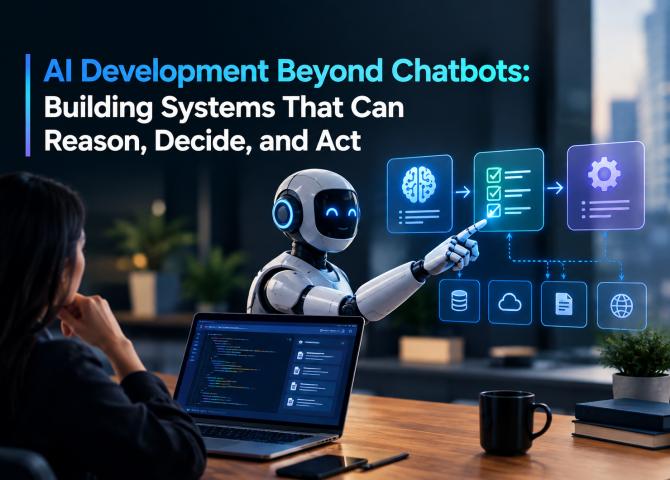
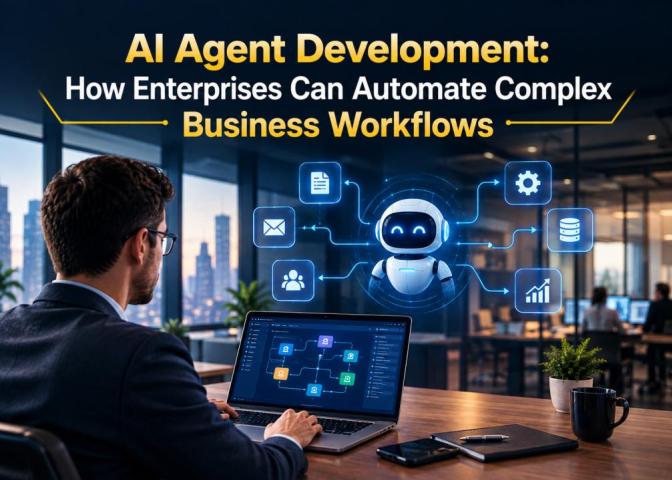
Artificial Intelligence has evolved far beyond chatbots and virtual assistants. Today, businesses are leveraging autonomous AI agents that can understand context, make decisions, execute multi-step tasks, and continuously learn from interactions.
From automating customer support and streamlining workflows to enhancing software development and data analysis, AI agents are transforming how organizations operate. However, building secure, scalable, and business-ready AI agents requires deep expertise in AI technologies, Large Language Models (LLMs), system integrations, and enterprise architecture.
Partnering with an experienced AI agent development company helps organizations design intelligent AI agents tailored to their unique business processes while ensuring reliability, security, and measurable ROI.
What is an AI Agent?
An AI agent is an intelligent software system capable of perceiving information, reasoning, planning, and taking actions to accomplish specific goals with minimal human intervention.
Unlike traditional automation tools that follow predefined rules, AI agents can:
- Understand natural language
- Analyze structured and unstructured data
- Make contextual decisions
- Interact with multiple software systems
- Learn from previous interactions
- Execute complex multi-step workflows
Think of AI agents as digital employees capable of handling repetitive tasks while continuously improving their performance.
What Does an AI Agent Development Company Do?
An AI agent development company specializes in designing, developing, deploying, and maintaining intelligent AI systems customized for business requirements.
These companies help organizations:
- Build custom AI agents
- Develop AI copilots
- Integrate Large Language Models
- Connect enterprise applications
- Implement Retrieval-Augmented Generation (RAG)
- Create multi-agent systems
- Ensure AI governance and security
- Optimize AI performance and costs
Rather than offering one-size-fits-all solutions, they build AI agents that align with existing business workflows.
Types of AI Agents Businesses Can Build
1. Customer Support AI Agents
Provide instant responses, resolve FAQs, retrieve customer information, and escalate complex issues to human agents.
Key Features:
- 24/7 support
- Omnichannel communication
- Personalized responses
- CRM integration
- Ticket automation
2. Sales AI Agents
Help sales teams qualify leads, prepare proposals, answer product queries, schedule meetings, and recommend next actions.
Capabilities include:
- Lead qualification
- CRM updates
- Email drafting
- Meeting scheduling
- Sales forecasting
3. Employee Productivity Agents
Internal AI assistants that help employees search documents, summarize meetings, answer HR questions, and automate administrative work.
Examples:
- Knowledge assistants
- HR assistants
- IT helpdesk agents
- Meeting assistants
4. Software Development AI Agents
Assist developers throughout the software development lifecycle.
Common capabilities include:
- Code generation
- Bug detection
- Documentation
- Test case creation
- Code review assistance
5. Finance AI Agents
Automate financial operations such as invoice processing, expense verification, financial reporting, and compliance monitoring.
AI agents integrate with enterprise platforms including:
- CRM systems
- ERP software
- HRMS
- Ticketing platforms
- Cloud applications
- Custom APIs
- Vector Databases
Vector databases allow AI agents to search business knowledge semantically rather than relying on exact keyword matching.
Benefits include:
- Faster information retrieval
- Better contextual understanding
- Improved response quality
- Benefits of Hiring an AI Agent Development Company
- Accelerated Development
Experienced AI teams shorten development cycles using proven frameworks and best practices.
Custom Business Logic
Every business has unique workflows. Custom AI agents are built around your operational requirements rather than forcing process changes.
Enterprise-Grade Security
Professional AI development companies implement:
- Role-based access
- Encryption
- Data privacy controls
- Compliance standards
- Secure API integrations
- Seamless Integration
AI agents work alongside existing software instead of replacing your technology stack.
Scalability
As business needs grow, AI agents can support:
- Higher user volumes
- Additional workflows
- Multiple departments
- Global operations
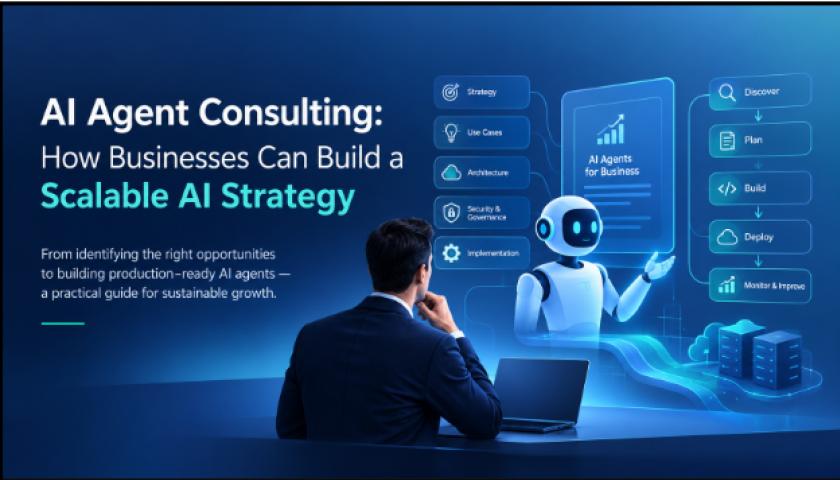
- AI Agent Development Process
1. Discovery
Business objectives are identified, workflows analyzed, and automation opportunities prioritized.
2. Solution Design
Architects define:
- AI workflows
- System integrations
- Knowledge sources
- User experience
- Security architecture
3. Development
Developers build the AI agent using:
- LLMs
- APIs
- Vector databases
- Business logic
- Prompt engineering
4. Testing
AI agents undergo extensive testing for:
- Accuracy
- Security
- Reliability
- Performance
- Edge cases
5. Deployment
The AI solution is deployed across cloud or on-premise environments.
6. Continuous Optimization
Usage analytics, user feedback, and model updates help improve AI performance over time.
Industries Using AI Agents
AI agents are delivering measurable value across multiple industries.
- Clinical documentation
- Medical record analysis
- Banking & Financial Services
- Customer support
- Fraud monitoring
- Financial reporting
- Retail & E-commerce
- Product recommendations
- Customer service
- Inventory assistance
- Manufacturing
- Predictive maintenance
- Supply chain optimization
- Quality inspection
- Logistics
- Shipment tracking
- Route optimization
- Order management
- Education
- Student support
- Personalized learning
- Administrative automation
How to Choose the Right AI Agent Development Company
Before selecting a technology partner, evaluate their expertise in:
- Custom AI development
- Enterprise software integration
- LLM implementation
- RAG architecture
- Cloud platforms
- AI security
- Data engineering
- MLOps
- Industry experience
- Long-term support
Request proof through case studies, technical capabilities, and measurable project outcomes.
Future of AI Agents
AI agents are rapidly evolving from simple assistants into autonomous digital workers capable of collaborating across teams, executing complex workflows, and making informed decisions in real time.
Emerging trends include:
- Multi-agent collaboration
- Autonomous business operations
- Industry-specific AI agents
- AI-powered software engineering
- Agentic workflow automation
- Human-AI collaboration models
Organizations adopting AI agents today will be better positioned to improve operational efficiency, reduce costs, and deliver superior customer experiences.
Conclusion
AI agents are reshaping how businesses operate by automating repetitive tasks, improving decision-making, and enhancing productivity across departments. Whether you're looking to streamline customer service, optimize internal workflows, or build intelligent enterprise applications, investing in custom AI agents can unlock significant business value.
Partnering with an experienced AI agent development company ensures your solution is tailored to your goals, integrates seamlessly with existing systems, and is built with security, scalability, and long-term success in mind. As AI technology continues to advance, organizations that embrace intelligent automation today will be well-positioned to lead in tomorrow's digital economy.