When you walk onto a dealership lot, the first thing that usually catches your eye is the big, bold number stamped on the side of a tractor's hood. That number tells you the machine’s horsepower, and it is incredibly tempting to use it as your main decision-making tool. However, looking only at that shiny sticker doesn't tell the whole story of what a machine can actually accomplish on your property.
New buyers often have an uninformed understanding of horsepower ratings. Most think that a 35-horsepower tractor can run any implement that operates within 35 horsepower. This leads to stalled engines, broken gearboxes, and a lot of regret over purchases.
To make a smart investment, you have to understand the critical difference between Engine HP vs PTO HP. While one number tells you how much raw muscle the motor creates, the other tells you how much of that muscle actually makes it to your tools. Getting this distinction right is especially crucial when working with tractor dealers in Texas, where dealing with tough, stubborn native clay and heavy-duty brush clearing demands every single ounce of functional power your machine can muster.
Breaking Down the Basics: What Do These Numbers Mean?
To understand how a compact tractor splits its energy, we have to look at the two distinct ways power is measured and rated by manufacturers.
What is Engine Horsepower?
Engine horsepower (often called gross or brake horsepower) is the total amount of power the engine produces right at the flywheel. This is the maximum force the motor can generate under ideal laboratory conditions, completely independent of the rest of the tractor's physical body.
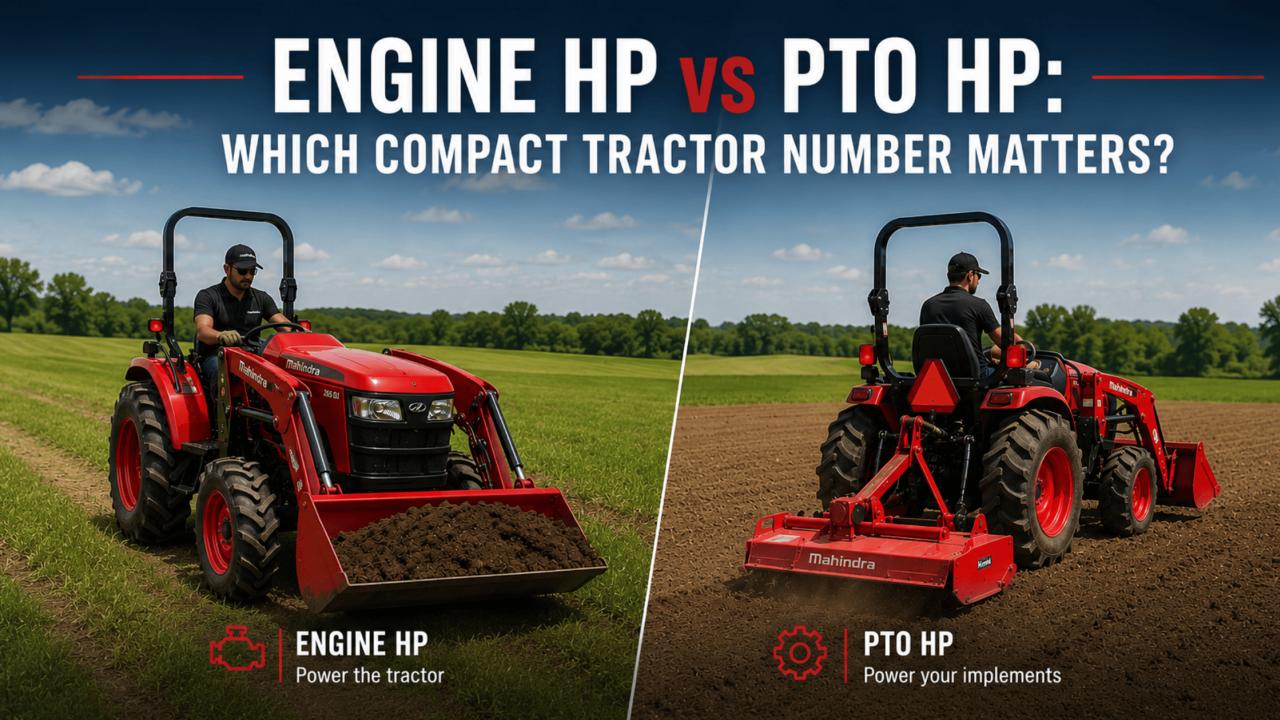
When you blend the concepts of tractor engine HP vs PTO HP, think of engine horsepower as the total raw budget of the tractor. It is the initial pool of energy that has to pay for everything the tractor does, from rolling the tires forward and lighting up the dashboard to pumping hydraulic fluid for the front-end loader.
What is PTO Horsepower?
PTO, which stands for Power Take-Off, is the splined driveshaft usually located at the rear of the tractor. This shaft transfers rotational energy directly from the tractor to your heavy-duty implements, such as rotary cutters, wood chippers, tillers, and post-hole augers.
The fundamental difference between HP and PTO comes down to location and usability. PTO horsepower measures only the energy available at that rear shaft. It represents the actual, functional muscle left over exclusively to spin your attachments.
The "Power Drain" Reality
Why doesn't power used and power produced match? Mechanical friction and auxiliary tax are the main contributors to the difference. Consider a tractor is a factory on wheels. Before power can reach the PTO shaft, all the auxiliary systems must be powered. These systems include the engine's water pump, power steering pump, the alternator, and large hydraulic pumps that power the 3-point hitch.
Furthermore, as power travels through the transmission gears down to the PTO shaft, energy is naturally lost as heat and friction. Because of this reality, your PTO horsepower will always be roughly 15% to 20% lower than the engine horsepower. If you buy a tractor rated at 30 engine horsepower, your actual working PTO power might only be around 24 or 25 horsepower.
The Mechanics: Engine PTO vs. Transmission PTO
Not all power take-off systems are engineered equally. How that power is delivered depends heavily on the internal design of the tractor's drivetrain. When shopping around, you will typically run into two main configurations.
Transmission-Driven PTO
An older and more basic design is the transmission-driven PTO. In this setup, the rear shaft is directly linked to the tractor’s main clutch and gearbox. Because they share the same link, anytime you step on the clutch pedal to stop the tractor or shift gears, your PTO shaft and your attached implement will instantly stop spinning.
This creates a clear operational challenge when weighing engine PTO vs transmission PTO. With a transmission-driven system, if you hit a thick patch of heavy brush with a rotary cutter and need to slow down your ground speed, stepping on the clutch drops the RPMs of your mower blade exactly when you need them to stay high. It requires a lot of footwork and careful planning to keep from bogging down the engine.
Live and Independent PTO
Contemporary designs for compact tractors mainly incorporate either live PTO or fully independent PTO. With independent PTO, a separate hydraulic clutch controls engagement of the rear shaft. This allows the engine to send power to the implement regardless of the position of the tractor tires. The tractor can be fully stopped, backed up, or even gear shifted while the tiller or mower continues to operate at full speed. This system is preferred for extra safety while operating in tight and uneven terrain.
Choosing the Right Machine for Your Property
If you buy a tractor based solely on the engine number, you risk severely underpowering your workspace. For example, if a heavy-duty rotary cutter requires a minimum of 30 horsepower to slice through thick pasture grass, and you hook it up to a tractor with a 30-horsepower engine, your machine is going to struggle, choke, and likely overheat. You actually needed a tractor with a 30-horsepower PTO rating, which means looking for a machine with an engine rating closer to 36 or 38 horsepower.
Beyond just the horsepower equations, finding the perfect match for your land requires a big-picture approach. When you are standing on the dealership lot looking at different sizes, frames, and features, you have to weigh how the machine fits your specific daily workflow. For a deeper dive into making the right long-term choice for your land, check out these 5 factors to consider when buying a compact tractor to ensure you don't miss critical details like lift capacity, chassis weight, and transmission types.
Choosing the Right Power for Your Needs
When managing tractors, it is vital to balance engine and PTO horsepower. The engine horsepower drives the tractor, while the PTO horsepower performs the majority of the work. If you are primarily interested in loading and transporting dirt, then the engine horsepower and weight are important. If you are going to be using PTO driven implements on a regular basis to manage your land, then the PTO horsepower is the most important of all the tractor specifications.
Investing in the right power dynamics upfront protects your tractor in the long run. While your investment protects your wallet while preventing severe mechanical damage from enabling power strain, once you have a tractor that, for whatever reason, you have overworked, are operating out of its rated job capacity, and is now making a grinding noise out of the back of the drive line, don't ignore the signs.
Just like with any other defect, if small problems go unaddressed, they could lead to much larger and more expensive problems. A good tractor repair near me search can yield results for a mechanic that can help you repair the damage of tractor overuse by diagnosing drive line damage, checking and replenishing your hydraulic fluids, and preparing your tractor to withstand the next demanding job ahead.