Key Takeaways
|
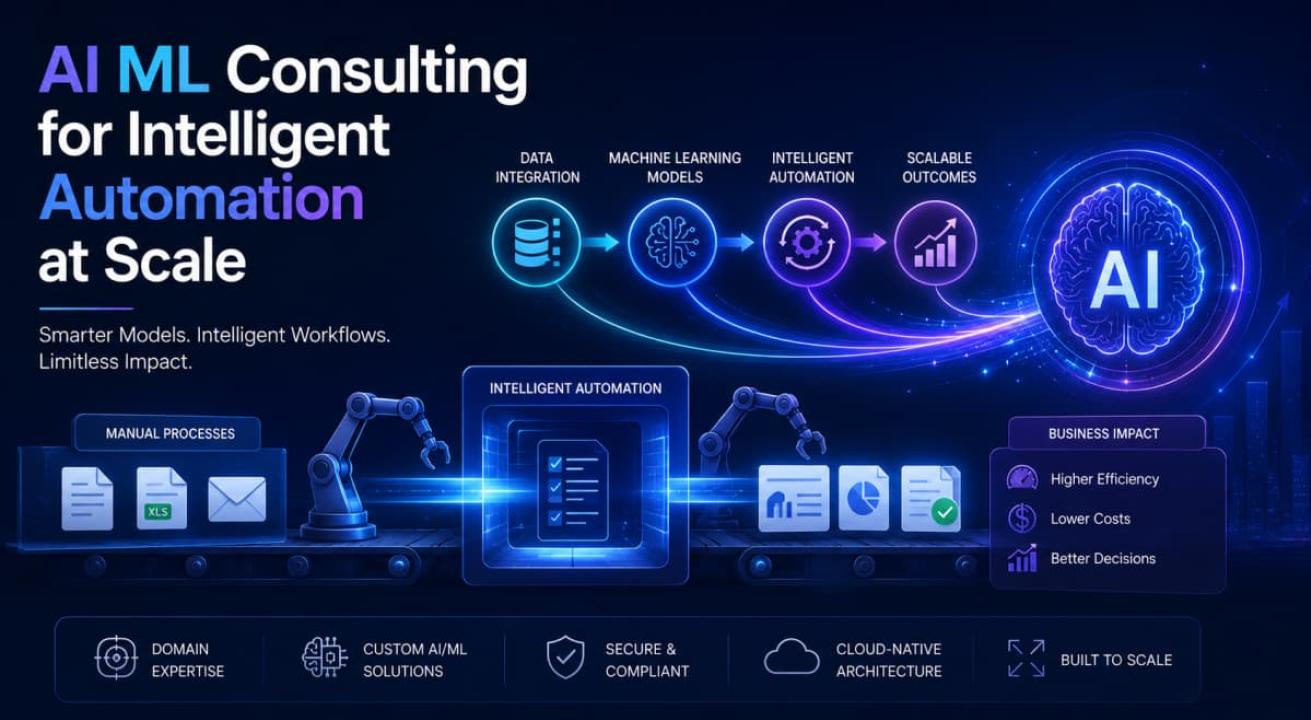
Roughly one-third of large organizations report scaling artificial intelligence (AI) across the enterprise, even though most have run pilots for two years or more. The pattern repeats across industries. A promising proof of concept works in one team, then dies on the way to production. The reason is rarely the model. It is the friction between the systems that hold the data, the teams that own the process, and the governance that has to sign off before anything touches a customer. That friction is why disciplined ai ml consulting has become the difference between a demo and a running capability.
Scaling intelligent automation is an operating-model problem before it is a technology problem. The technology mostly works. What breaks is the handoff: data trapped in one department's warehouse, a compliance team that was never consulted, a process owner who never agreed to change how their people work. Well-structured AI and ML services address those handoffs directly, sequencing the organizational and data decisions that let automation survive contact with the real enterprise. This piece maps where the friction sits, why more tooling does not remove it, and what consulting actually delivers.
Where Enterprise Automation Actually Stalls
The obstacles that kill automation programs are organizational, and they cluster in predictable places. Naming them makes the fix easier to plan.
- Data Silos: The training data lives in one system, the operational data in another, and neither team is accountable for reconciling them.
- Integration Gaps: A model produces a prediction, but nothing wires that output into the tool where a human or a downstream process would act on it.
- Unclear Ownership: No single person is accountable for the automated workflow end to end, so decisions stall between IT, the business unit, and risk.
- Change Resistance: The people whose jobs change were told about the automation after it was built, not asked to shape it.
- Governance Gaps: Legal, security, and compliance review arrives late, forcing rework or an outright halt near launch.
- Pilot Purgatory: A proof of concept succeeds on a clean sample, then has no funded path, no owner, and no integration plan to reach production.
The scale of the integration problem is documented. In the 2025 MuleSoft Connectivity Benchmark, 95 percent of organizations reported difficulty integrating data across systems, the average enterprise ran 897 applications, and only 29 percent of those were integrated. When four out of five leaders name data integration as their biggest obstacle to AI, the bottleneck is plainly not the algorithm.
Each of these friction points sits between functions, which is exactly why they resist a purchased solution.
Why Buying More Tools Does Not Fix an Operating-Model Problem
A new platform arrives with the promise that it will finally connect everything. Six months later the same silos exist, now with one more license to manage. The tool was never the missing piece.
Friction lives in decisions, not features. Deciding which team owns a shared dataset, who approves a model that affects customers, and how a process changes when a machine handles part of it are governance and design choices. No product ships those choices pre-made for a specific enterprise. Adding software to an unresolved operating model tends to multiply the integration surface rather than shrink it, because every new tool needs its own connections, permissions, and owners.
The failure data reflects this. Gartner projects that 50 percent of generative AI projects will be abandoned after proof of concept, citing poor data quality, unclear business value, and inadequate risk controls. Those are operating-model failures wearing a technology costume. The enterprises that break the pattern treat scaling as a redesign of how work flows, then choose tools to fit the redesigned flow.
What AI ML Consulting Delivers Beyond a Model
Serious ai ml consulting starts with the operating model and works outward to the technology, in a deliberate order. The sequence matters as much as the parts.
- Use-Case Prioritization: Rank candidate workflows by value, data availability, and organizational readiness, then fund the few that clear all three rather than the many that sound impressive.
- Data and MLOps Foundation: Establish the pipelines, feature stores, monitoring, and retraining discipline that keep a model accurate after launch, so accuracy does not decay silently in production.
- Organizational Fesign: Assign a named owner to each automated workflow, and define how IT, the business unit, and risk share responsibility for it.
- Governance: Build model documentation, bias testing, audit trails, and human-in-the-loop checkpoints into the workflow from the first sprint, not as a pre-launch scramble.
- Adoption and Change Management: Bring affected teams into the design, retrain them on the new process, and measure usage, because an automation nobody trusts is an automation nobody runs.
The McKinsey State of AI survey found that workflow redesign correlates most strongly with earnings impact from AI, yet only 21 percent of organizations using generative AI had redesigned any workflows. Redesign is precisely the work that consulting drives, and it is the work internal teams most often skip under delivery pressure.
Data Readiness as the Precondition
Nothing above works on data that is inconsistent, undocumented, or owned by no one. A model trained on a clean historical extract behaves differently against live operational data with missing fields and shifting definitions. Getting data ready means defining ownership, standardizing key fields across source systems, and building the monitoring that flags drift before a customer notices. That groundwork is unglamorous, and it is the reason many programs quietly reset in their second year.
AI and ML Services in Practice
Abstract friction becomes concrete inside real workflows. A few patterns recur across sectors, and each shows the operating-model work behind the automation.
- Financial services: Banks route loan documents through machine learning classification and extraction, cutting manual review time while a governance layer logs every decision for the regulator. The hard part was agreeing which team owned a disputed classification, not training the extractor.
- Insurance: Carriers triage first notice of loss with predictive models that flag likely fraud and fast-track simple claims. Adoption held because adjusters helped define the thresholds rather than receiving them.
- Healthcare Administration: Providers automate prior authorization and coding support with human review on edge cases, which required patient-safety governance agreed before the first model ran.
- Supply Chain: Manufacturers forecast demand and reroute logistics with ML, then feed those predictions directly into planning tools so a forecast becomes an action, not a report.
Well-integrated AI and Machine Learning services share a trait in these examples. The model is a small component inside a redesigned process with a clear owner, live data feeds, and governance from day one. That is the difference between automation that scales and a pilot that impresses in a meeting.
The Benefits Enterprises Actually Realize
Numbers help separate genuine outcomes from vendor optimism. Value shows up when scaling is treated as an operating discipline.
McKinsey reports that only 6 percent of organizations achieve significant enterprise-wide impact from AI, defined by a measurable contribution to earnings before interest and taxes. The gap between that 6 percent and the majority is not model quality; it is whether the enterprise rebuilt its operating model to absorb the automation. Programs that do the redesign tend to see faster cycle times on high-volume processes, fewer manual handoffs, and lower error rates because a governed model applies the same rules every time.
Just as important, disciplined AI and ML consulting reduces the hidden cost of failure. Every abandoned pilot carries sunk engineering time, licensing, and organizational fatigue. Fixing the operating model first raises the share of initiatives that reach production, which is where any return lives. The benefit is not a single dramatic figure. It is a higher hit rate across a portfolio of automations.
Challenges That Still Need Managing
Consulting reduces friction; it does not erase it. Several challenges persist and deserve honest planning.
Talent remains scarce, particularly the profile that AI and Machine learning consulting depends on: engineers who understand both the models and the specific business domain. Data quality work is continuous, not a one-time cleanup, because source systems keep changing. Governance can slow delivery if it becomes a gate rather than a design partner, so the discipline is to embed reviewers in the team. Model risk is real: predictions drift, edge cases surface, and a workflow that ran cleanly for months can degrade quietly. And organizational fatigue sets in when a program overreaches, which is why Gartner found that many infrastructure and operations leaders trace AI failures to expecting too much, too fast.
None of these is a reason to wait. Each is a reason to sequence the work and keep scope honest.
Agentic Orchestration and the 2025-2026 Shift
The current wave raises the stakes on everything above. Agentic AI moves beyond a single prediction toward systems that chain steps, call tools, and act across workflows with limited supervision. Orchestration ties those agents to enterprise data and processes.
The friction points do not disappear with agents; they compound. An agent that acts across three departments needs clear ownership, integrated data, and governance across all three, or it fails in three places at once. Gartner predicts that more than 40 percent of agentic AI projects will be canceled by the end of 2027, driven by escalating costs, unclear business value, and inadequate risk controls. The same firm projects that a third of enterprise software applications will embed agentic AI by 2028, up from less than 1 percent in 2024. Both facts point the same way: adoption is accelerating, and the operating-model gap decides who benefits.
Enterprises that already fixed data ownership, integration, and governance can extend those foundations to agents. Those that skipped the groundwork will meet the same friction, now moving faster and touching more systems at once.
Where This Goes Next
The direction is set. Automation will keep spreading from single tasks to connected workflows to semi-autonomous operations, and the constraint will stay organizational rather than technical. Enterprises that treat scaling as an operating-model discipline, deciding ownership, integration, and governance before the next tool, will keep pulling ahead of those chasing the newest platform. The winners will not be the ones with the most models. They will be the ones whose models actually run in production, trusted by the people around them, month after month.
Enterprise automation stalls on friction between systems and teams, not on the technology itself, and closing that gap is what AI ML consulting exists to do. Scaling is an operating-model discipline: prioritize the right use cases, ready the data, assign ownership, embed governance, and bring affected teams into the design. Tools follow that work; they do not replace it.
Damco Solutions helps enterprises sequence exactly this progression through its AI and ML services, turning stalled pilots into governed workflows that run every day. As agentic orchestration reshapes 2026, the operating model built now will decide which automations scale and which quietly reset next year.