The global High Integrity Pressure Protection System (HIPPS) Market is witnessing steady growth as industries increasingly prioritize operational safety, asset protection, and regulatory compliance. High Integrity Pressure Protection Systems (HIPPS) are safety instrumented systems designed to prevent overpressure events by automatically isolating high-pressure sources before critical equipment is exposed to unsafe conditions. These systems are widely deployed across the oil & gas, petrochemical, chemical, power generation, and process manufacturing industries. Rising investments in industrial automation, stringent safety regulations, and growing adoption of digital monitoring technologies are significantly driving market expansion.
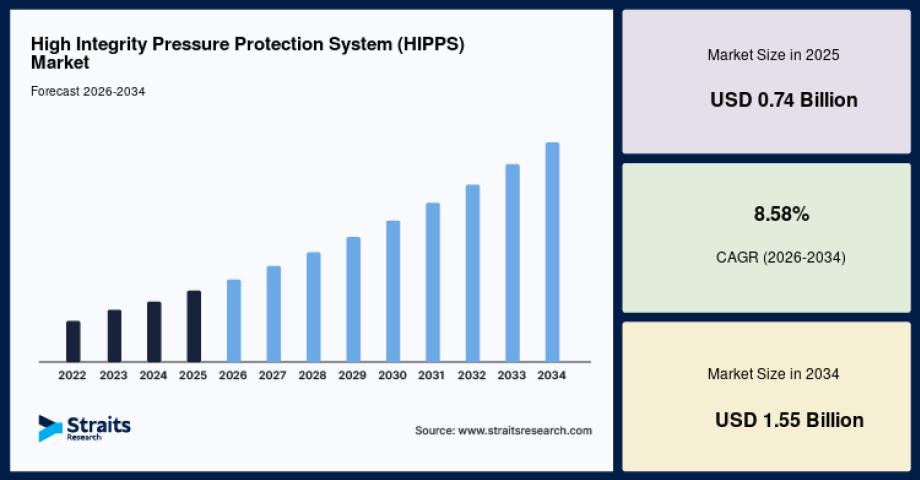
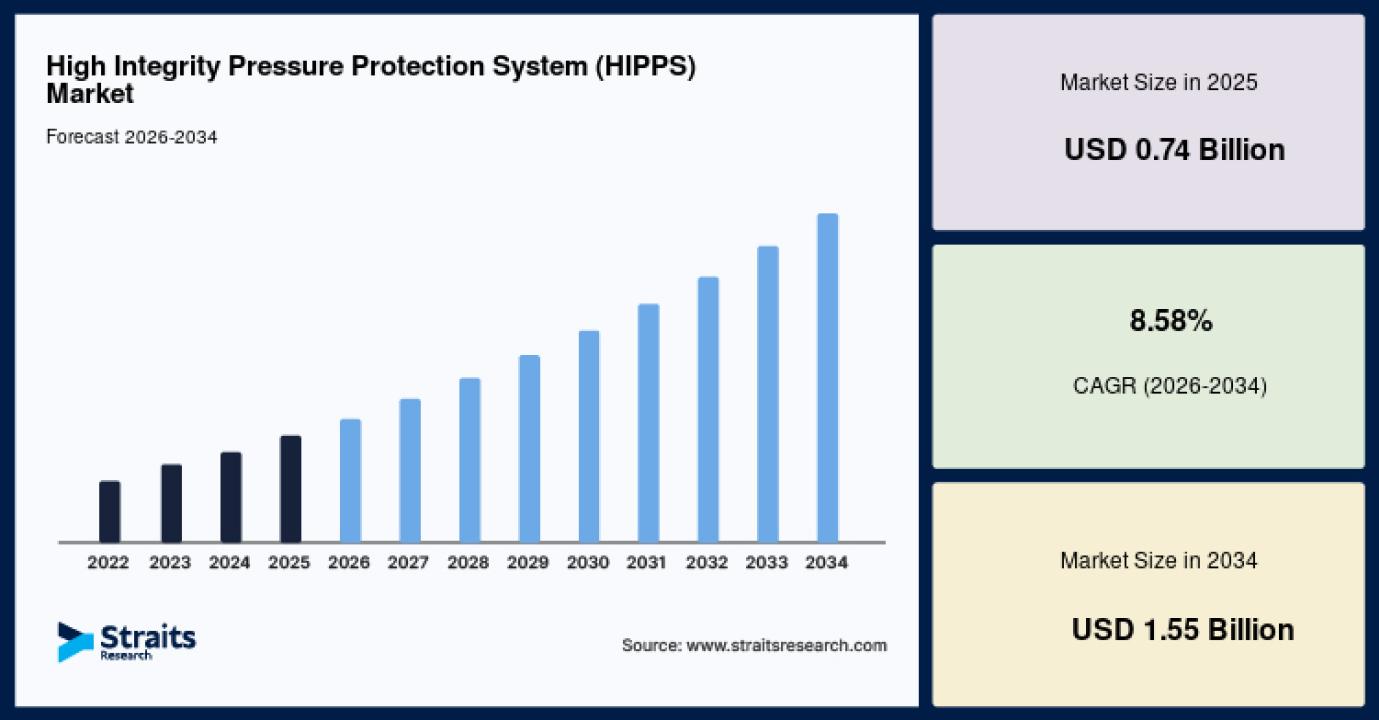
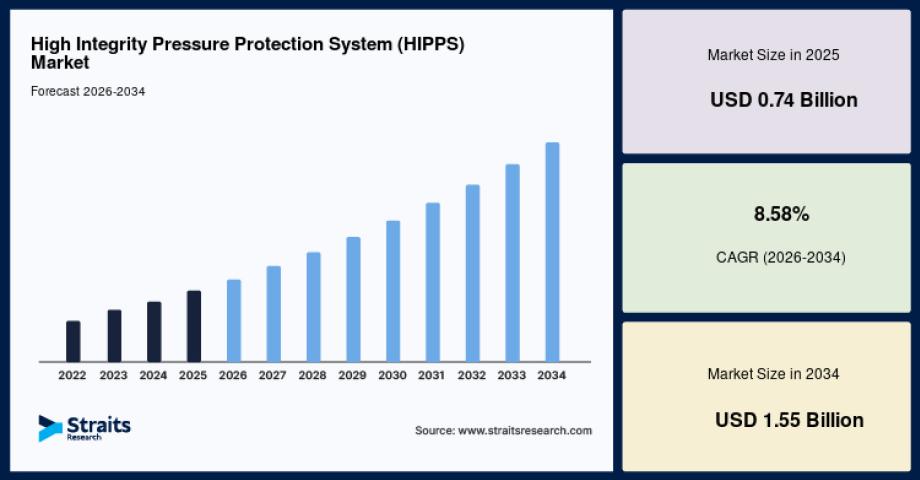
According to industry analysis, the global High Integrity Pressure Protection System (HIPPS) Market size was valued at USD 0.74 billion in 2025 and is projected to grow from USD 0.80 billion in 2026 to USD 1.55 billion by 2034, exhibiting a CAGR of 8.58% during the forecast period (2026–2034).
Read Full Report: https://straitsresearch.com/report/high-integrity-pressure-protection-system-market
The increasing focus on industrial safety, expansion of oil and gas exploration activities, rising demand for Safety Integrity Level (SIL)-certified systems, technological advancements in industrial automation, and modernization of aging industrial infrastructure are among the primary factors driving market growth. Industries are increasingly adopting HIPPS solutions to reduce operational risks, improve process reliability, and minimize environmental impacts.
Rising Focus on Industrial Safety Fuels Market Growth
One of the primary drivers of the High Integrity Pressure Protection System (HIPPS) Market is the increasing emphasis on workplace safety and accident prevention across high-risk industries. Overpressure incidents can result in equipment damage, production downtime, environmental hazards, and serious safety risks.
HIPPS solutions provide rapid automatic shutdown capabilities, helping operators prevent catastrophic failures while ensuring safe and reliable plant operations.
The growing importance of process safety is expected to support long-term market growth.
Stringent Safety Regulations Accelerate Adoption
Governments and regulatory authorities worldwide continue to strengthen industrial safety standards for hazardous operations. Compliance with international safety standards such as IEC 61508 and IEC 61511 is encouraging industries to deploy Safety Integrity Level (SIL)-certified protection systems.
HIPPS installations help organizations meet regulatory requirements while reducing reliance on conventional pressure relief systems and minimizing operational risks.
Supportive regulatory frameworks continue to strengthen market expansion.
Expansion of Oil and Gas Exploration Activities
The oil and gas industry remains one of the largest end users of High Integrity Pressure Protection Systems. Offshore platforms, refineries, natural gas processing facilities, pipelines, and upstream production sites increasingly rely on HIPPS solutions to protect critical infrastructure operating under high-pressure conditions.
Growing investments in deepwater exploration, liquefied natural gas (LNG) infrastructure, and pipeline expansion continue to drive market demand.
The expansion of global energy infrastructure remains a major contributor to market growth.
Technological Advancements in Industrial Automation
Continuous innovation in industrial automation is enhancing the capabilities of modern HIPPS solutions. Advanced programmable logic controllers (PLCs), intelligent pressure sensors, digital valve technologies, Industrial Internet of Things (IIoT) connectivity, and predictive maintenance platforms improve system reliability, response speed, and operational efficiency.
Digital monitoring and real-time diagnostics also enable operators to identify potential issues before failures occur, reducing maintenance costs and improving plant availability.
Technological innovation continues to strengthen market competitiveness.
Modernization of Aging Industrial Infrastructure
Many industrial facilities are upgrading aging equipment to improve safety, efficiency, and regulatory compliance. Retrofitting existing plants with advanced HIPPS solutions allows operators to enhance pressure protection without making extensive modifications to existing process infrastructure.
Infrastructure modernization projects across oil & gas, chemicals, and power generation sectors continue to create favorable market opportunities.
The growing need for plant upgrades is expected to support sustained market growth.
Increasing Demand from Chemical and Petrochemical Industries
Chemical and petrochemical facilities operate under high-pressure conditions that require reliable pressure protection systems to ensure safe production. HIPPS solutions help protect reactors, pipelines, storage systems, and processing equipment while minimizing the risk of hazardous material releases.
As global chemical production continues to expand, demand for advanced safety systems is expected to increase steadily.
Growing investments in chemical processing continue to accelerate market expansion.
North America Maintains Market Leadership
North America currently holds a significant share of the global High Integrity Pressure Protection System (HIPPS) Market due to its well-established oil and gas industry, stringent industrial safety regulations, advanced automation infrastructure, and ongoing investments in energy production. The United States and Canada continue driving regional demand through modernization of industrial facilities and increasing adoption of functional safety systems.
The region's strong industrial and energy ecosystem continues to support market leadership.
Asia-Pacific Emerges as the Fastest-Growing Region
Asia-Pacific is expected to witness the fastest growth during the forecast period due to rapid industrialization, expanding oil and gas infrastructure, increasing chemical manufacturing, growing investments in power generation, and strengthening industrial safety regulations. Countries such as China, India, Japan, South Korea, and Southeast Asian nations continue investing in advanced automation and safety technologies to support industrial growth.
The region's expanding manufacturing and energy sectors continue to create significant market opportunities.
Europe Experiences Strong Market Growth
Europe represents a major market for High Integrity Pressure Protection Systems, supported by strict safety regulations, advanced industrial automation, expanding renewable and conventional energy infrastructure, and modernization of aging industrial facilities. Countries including Germany, the United Kingdom, Norway, France, and the Netherlands continue investing in high-performance safety instrumented systems to improve operational reliability and regulatory compliance.
Growing investments in industrial digitalization continue to strengthen the regional market.
Competitive Landscape Focuses on Functional Safety and Digital Innovation
The High Integrity Pressure Protection System (HIPPS) Market remains highly competitive, with leading companies focusing on SIL-certified safety solutions, intelligent pressure sensors, smart valves, digital diagnostics, Industrial Internet of Things (IIoT) integration, and predictive maintenance technologies. Companies are investing heavily in research and development to improve system reliability, operational efficiency, cybersecurity, and regulatory compliance.
Strategic partnerships among automation providers, engineering companies, energy firms, valve manufacturers, and industrial technology vendors are accelerating innovation and expanding market reach. Manufacturers are also developing integrated safety platforms that combine pressure protection, process monitoring, and advanced analytics for enhanced operational performance.
These initiatives are expected to drive continuous innovation and strengthen competition across the industry.
Future Outlook for the High Integrity Pressure Protection System (HIPPS) Market
The future of the High Integrity Pressure Protection System (HIPPS) Market remains highly promising as industries continue prioritizing operational safety and automation. Rising investments in oil and gas infrastructure, expanding chemical processing capacity, increasing adoption of industrial automation, strengthening safety regulations, modernization of aging industrial facilities, and advancements in digital monitoring technologies are expected to support sustained market growth through 2034.
Innovations in AI-powered predictive maintenance, digital twins, smart safety instrumented systems, IIoT-enabled diagnostics, edge computing, cloud-based monitoring, and autonomous industrial operations will continue to reshape the industry. As industrial operators increasingly focus on minimizing operational risks and maximizing plant reliability, HIPPS solutions are expected to remain a critical component of modern process safety strategies.
Frequently Asked Questions
What is the current size of the High Integrity Pressure Protection System (HIPPS) Market?
The market was valued at USD 0.74 billion in 2025.
What is the projected market size by 2034?
The market is expected to reach USD 1.55 billion by 2034.
What is the CAGR of the High Integrity Pressure Protection System (HIPPS) Market?
The market is projected to grow at a CAGR of 8.58% during 2026–2034.
What factors are driving market growth?
Key drivers include rising focus on industrial safety, stringent safety regulations, expansion of oil and gas exploration activities, technological advancements in industrial automation, modernization of aging industrial infrastructure, and increasing demand from chemical and petrochemical industries.
Which region holds a significant market share?
North America currently maintains a significant share of the global High Integrity Pressure Protection System (HIPPS) Market.
Which region is expected to grow the fastest?
Asia-Pacific is expected to witness the fastest growth during the forecast period due to rapid industrialization, expanding energy and chemical sectors, increasing automation investments, strengthening industrial safety regulations, infrastructure modernization, and growing adoption of advanced process safety solutions across emerging economies.