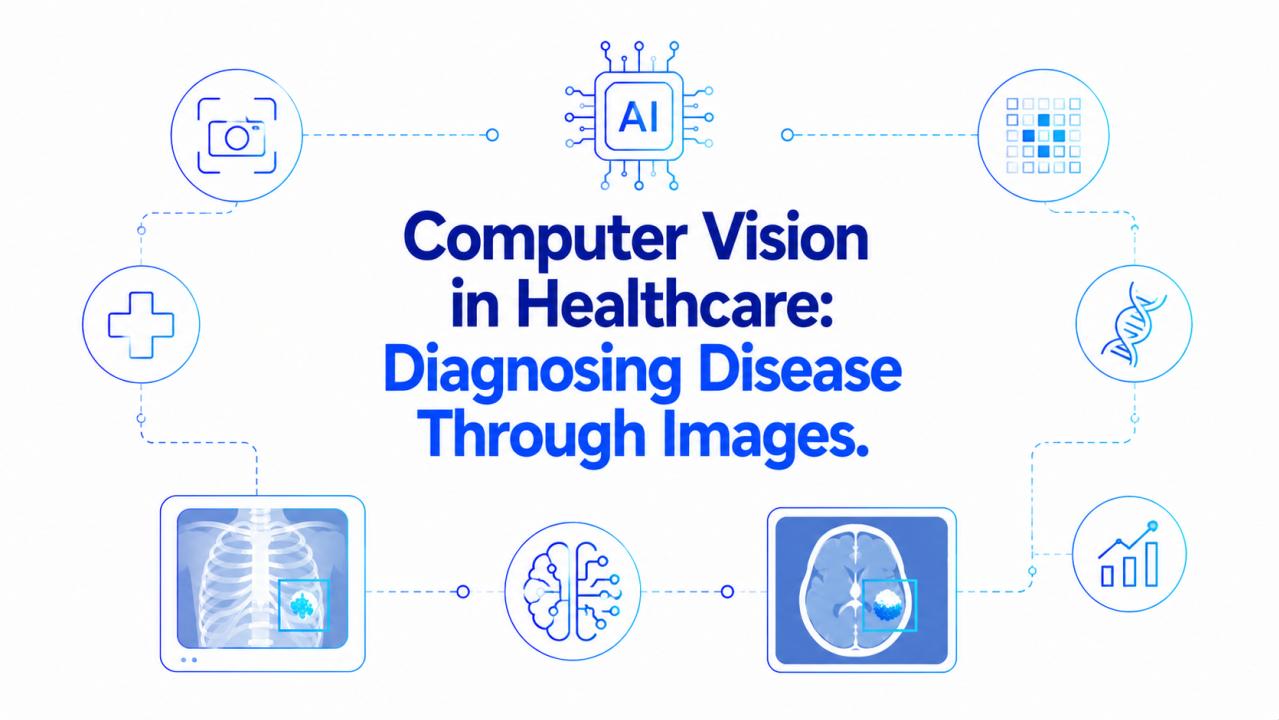
The healthcare industry is currently witnessing a rapid adoption of artificial intelligence to improve patient outcomes and optimize operations. Computer vision in healthcare is one such application of AI that is proving to be valuable in identifying diseases through medical imagery. Be it tumors in MRI scans or fractures in X-ray images, computer vision is playing a crucial role in facilitating faster and more accurate diagnosis, helping medical professionals identify diseases and reduce the chances of errors.
With medical image analysis technology becoming more sophisticated, the healthcare industry is turning to Artificial Intelligence development services to build computer vision systems that can assist doctors in diagnosing diseases. AI-enabled medical image analysis solutions are disrupting the traditional ways of diagnosis by offering faster treatment and personalized healthcare.
How Is Computer Vision Helping in Medical Diagnosis?
Computer vision technology helps computers and systems understand and analyze medical images such as CT scans, MRI, ultrasonography, retinal scans, and X-rays, among others. By using deep learning algorithms that have been trained on thousands of medical image datasets, computer vision systems can easily identify patterns that could be used in disease diagnosis.
Healthcare organizations are partnering with AI development services companies to develop computer vision applications that can be used in diagnostic imaging to support doctors and radiologists in analyzing medical scans and pictures. Using these systems, radiologists can prioritize the medical images they analyze while also increasing diagnostic accuracy and reducing the likelihood of missing a disease.
Use Cases of Computer Vision in Healthcare
Computer vision is proving to be valuable in numerous medical fields, including:
Radiology
Computer vision is playing a significant role in helping radiologists detect subtle indications of diseases such as tumors, lung cancer, and fractures from medical scans and images. This technology has proven to be quite efficient as it can help analyze chest X-rays, CT scans, and MRI scans within seconds. It also helps radiologists provide timely treatment to patients once the disease has been diagnosed accurately.
Oncology
This technology is being used in oncology to help medical experts diagnose and treat cancerous tumors effectively. Computer vision is useful in analyzing medical images in oncology to determine if the tumors are malignant, measure the rate of their growth, and evaluate the effectiveness of the treatment.
Eye Care
Computer vision is being applied in detecting a wide range of eye diseases by analyzing retinal scans. With these systems, it becomes possible to identify vision-threatening conditions such as diabetic retinopathy, glaucoma, and age-related macular degeneration at an early stage.
Pathology
Computer vision systems can help analyze tissue samples under microscopes to help detect diseases such as cancer more accurately.
Organizations that are considering investing in AI development solutions are working towards building computer vision applications that can help detect diseases such as cancer while also supporting professional medical diagnosis.
Benefits of Computer Vision in Healthcare
Healthcare professionals and organizations that are using AI-enabled image analysis systems to detect diseases are registering numerous benefits, including:
Faster Diagnosis
Computer vision systems can process thousands of medical scans and images within a short time, leading to faster diagnosis. This is crucial as it enables timely medication of the diseases detected.
Accurate Analysis
These systems can detect irregularities that may be minute and easily missed when using traditional methods of diagnosis. Therefore, computer vision can be used in applications that demand higher accuracy levels, such as disease diagnosis.
Early Detection of Diseases
Most diseases, especially cancerous ones, are easier to treat when they are detected early. Computer vision can help in detecting diseases at an early stage, improving the likelihood of successful treatment while also reducing the overall cost of treatment.
Healthcare organizations are increasingly adopting this innovative technology to develop diagnostic platforms that enable them to improve patient care. Some companies have partnered with computer vision development services to invest in building and deploying computer vision systems for their ability to transform traditional healthcare delivery models by optimizing the diagnosis process.
Computer Vision in Healthcare: Challenges of Medical Imaging Technology
Like with all other technologies, medical imaging systems face a lot of challenges, including the need for extensive training data to train the AI systems. There is also a need to ensure that the privacy of patients' data is protected while also adhering to the relevant laws and regulations. Another challenge that healthcare organizations experience when adopting this technology is the need to validate and test the accuracy of the medical image recognition systems.
Hospitals and clinics can work with custom Artificial Intelligence development services to design and implement computer vision systems that are reliable and meet the data security requirements of the healthcare industry.
The Role of AI Experts in Developing Medical Image Recognition Systems
Developing advanced healthcare image recognition technology requires extensive expertise in AI and related areas, including cloud computing, machine learning, and computer vision. Most healthcare organizations that want to adopt computer vision are opting to hire dedicated developer teams that offer end-to-end AI solutions. Professional developers understand the different regulations governing the healthcare sector and the best ways to ensure that computer vision systems operate effectively while maintaining the highest level of data security.
Healthcare professionals are partnering with Artificial Intelligence development services specialists to build powerful computer vision applications that support radiologists and pathologists in detecting diseases while also reducing the overall cost of running a clinic or hospital.
Future of Computer Vision Technology in Healthcare
Computer vision technology has the potential to revolutionize the healthcare sector by enabling faster disease diagnosis and detection. It has proven to be quite valuable in helping radiologists and pathologists detect conditions such as tumors and eye diseases while also helping in early disease detection. Advanced computer vision systems will continue to be quite valuable in healthcare as they will be able to analyze CT scans and MRI scans more accurately, thus enabling medical professionals to come up with more precise diagnoses and treatment options.
Organizations that are considering investing in AI development solutions to build computer vision systems will be at the forefront of providing high-quality patient care while also reaping the substantial benefits that come with using this innovative technology.