Running an ecommerce business today is more complex than ever. As product catalogs grow, managing thousands of listings across websites, marketplaces, and social commerce platforms becomes increasingly difficult. Manual updates, inconsistent product information, duplicate listings, and missing attributes can confuse customers and reduce sales. These issues not only consume valuable time but also impact search visibility and customer trust.
This is where AI product catalog management makes a significant difference. Artificial intelligence helps businesses automate repetitive catalog tasks, improve data quality, and create a seamless shopping experience. Instead of spending hours manually maintaining product information, companies can use AI to efficiently organize, optimize, and update catalogs, thereby reducing errors and improving overall productivity.
Why AI Product Catalog Management Is Becoming Essential
Product catalogs are the foundation of every ecommerce business. Customers rely on accurate product titles, descriptions, specifications, pricing, and images before making a purchase decision. Even small inconsistencies can lead to abandoned carts, increased product returns, and poor customer satisfaction.
Traditional catalog management often requires teams to manually categorize products, write descriptions, upload images, assign attributes, and monitor inventory updates. As businesses scale, these tasks become difficult to manage consistently.
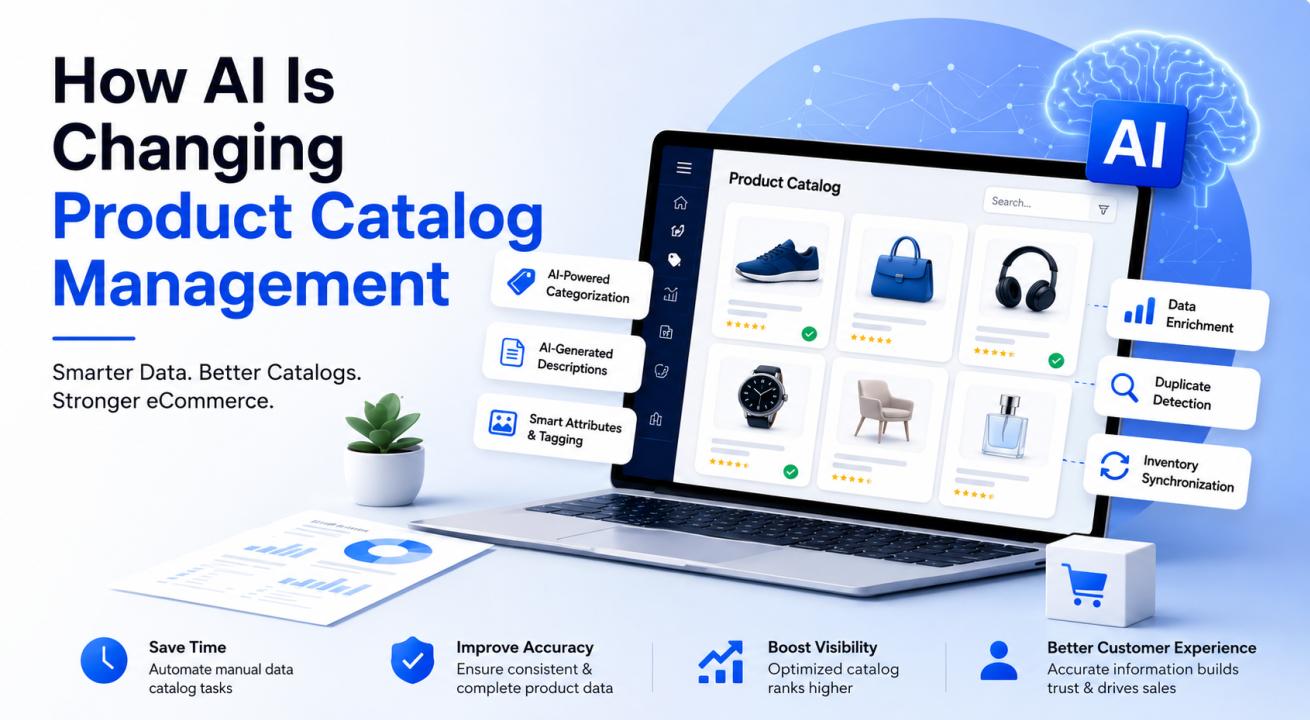
With AI product catalog management, businesses can automate many of these repetitive processes. AI systems can analyze product information, classify items into appropriate categories, generate SEO-friendly descriptions, identify duplicate listings, and automatically fill in missing product attributes. This allows ecommerce teams to focus on strategic initiatives rather than routine data entry.
Businesses looking to strengthen their overall product data strategy should also understand the fundamentals of ecommerce catalog management. Combining best practices with AI-powered automation creates a more scalable and efficient workflow that supports long-term business growth.
AI Improves Product Data Quality and Operational Efficiency
One of the biggest advantages of artificial intelligence is its ability to process and organize large volumes of product information in a fraction of the time required by manual methods. AI can identify inconsistencies across thousands of products, standardize naming conventions, recommend appropriate categories, and detect missing specifications before products are published.
For example, if a retailer imports product data from multiple suppliers, the information often arrives in different formats. One supplier may use "Blue," another may write "Navy Blue," while another simply lists "Dark Blue." AI can recognize these variations and standardize product attributes to create a more consistent catalog.
Key Tasks AI Can Automate
- Automatic product categorization
- Attribute enrichment
- Duplicate product detection
- Metadata optimization
- Product title generation
- SEO-friendly descriptions
- Image recognition and tagging
- Inventory synchronization
These capabilities significantly reduce manual effort while improving the accuracy and consistency of product listings.
Industry research shows that organizations across industries are rapidly adopting AI to improve efficiency and business operations. According to the latest McKinsey State of AI report, companies are increasingly using generative AI to streamline workflows, improve productivity, and enhance customer experiences.
This growing trend demonstrates why AI is becoming an important investment for ecommerce businesses that manage large, dynamic product catalogs.
AI Creates Better Shopping Experiences for Customers
A well-managed product catalog directly influences how customers interact with an online store. When product information is complete, accurate, and easy to understand, shoppers can compare products with confidence and make purchasing decisions more quickly.
AI helps improve customer experiences in several ways:
- It generates detailed and consistent product descriptions that highlight key features and benefits, improving both readability and SEO.
- It enriches product data by identifying missing attributes such as size, color, material, dimensions, compatibility, or technical specifications.
- AI-powered search understands customer intent rather than relying solely on exact keyword matches, making products easier to discover.
- Personalized recommendations analyze browsing behavior and purchase history to suggest relevant products, increasing customer satisfaction and average order value.
The result is a smoother shopping journey that benefits both customers and ecommerce businesses.
Real-World Example of AI Product Catalog Management
Imagine an online electronics retailer preparing for a major holiday shopping season. The company receives product data for over 15,000 new items from dozens of manufacturers. Each supplier provides information in a different format, with inconsistent product names, incomplete specifications, and varying image quality.
Without AI, employees would need several weeks to manually review every listing, write descriptions, assign categories, verify specifications, and correct formatting errors.
Using AI product catalog management, the retailer automates much of this process. The AI platform scans incoming product information, identifies duplicate entries, standardizes product titles, enriches missing specifications, generates optimized descriptions, and categorizes products based on historical data and machine learning models. Image recognition technology verifies product photos and flags low-quality images for review.
Once the catalog is organized, the business can publish products across multiple sales channels much faster than before. Teams spend less time correcting data and more time focusing on marketing campaigns, customer service, and business growth.
Businesses can further improve product presentation and customer engagement by implementing catalog integration with Shopify, which helps synchronize digital catalogs with an ecommerce store while creating a more interactive shopping experience.
This combination of AI automation and digital catalog integration enables businesses to launch products faster while maintaining a consistent brand experience across every customer touchpoint.
The Future of AI in Product Catalog Management
Artificial intelligence continues to evolve rapidly. Future AI-powered catalog management systems will become even more intelligent by predicting customer preferences, automatically updating product information based on market trends, translating listings into multiple languages, and generating personalized product content for different customer segments.
Businesses operating internationally will benefit from AI-powered localization, allowing them to adapt product descriptions, currencies, and measurements for different markets without extensive manual effort.
Voice commerce and visual search are also expected to play a larger role. AI will help optimize product catalogs so customers can discover products using voice assistants or image-based searches, creating additional opportunities for ecommerce growth.
Companies that invest in AI today will be better prepared to compete as these technologies become standard across the ecommerce industry.
Conclusion
Managing a growing ecommerce catalog manually is becoming increasingly challenging. As product assortments expand and customer expectations rise, businesses need smarter ways to maintain accurate, consistent, and engaging product information.
AI product catalog management offers an effective solution by automating repetitive tasks, improving data quality, enhancing search visibility, and delivering better shopping experiences. From generating product descriptions and enriching attributes to identifying duplicate listings and personalizing recommendations, AI helps businesses save time while increasing efficiency.
Organizations that combine AI-powered automation with proven catalog management practices are better positioned to scale their operations, reduce manual workload, and improve customer satisfaction. By adopting these technologies now, ecommerce businesses can build stronger product catalogs that support long-term growth, improve conversions, and create a competitive advantage in an increasingly digital marketplace.