The Blinking Cursor and the Checkout Friction: My Quiet Shift to AI-Assisted Shopping
A personal reflection on the exhaustion of modern discount hunting, and the unexpected magic of finding a tool that actually listens.
The other evening, I found myself staring at a familiar sight: the digital checkout screen. My cart was loaded with a couple of items I’d been debating over for weeks, and there it was-that empty, blinking box labeled "Promo Code."
It is a modern psychological trap. I’ve developed this stubborn habit over the years where I simply cannot bring myself to click "Complete Purchase" without at least attempting to fill that box. It feels like a quiet tax on the impatient. If I don't search for a code, I feel like I'm willingly leaving money on the table. So, following a routine etched deep into my muscle memory, I opened three new browser tabs and prepared myself for the usual tedious ritual.
Living in the UK, especially with the cost of everything creeping up over the last few years, this ritual has felt less like a choice and more like a necessity. Whether it’s renewing my home broadband contract, buying a subscription for a software tool I need for work, or just ordering some basic household items, I have trained myself to scour the web. My browser bookmark bar used to be a graveyard of giant, household-name coupon directories. You know the ones-the massive platforms that dominate the search results, promising "Verified Codes" and "100% Success Rates."
But lately, that ritual has begun to feel incredibly exhausting.
The Exhaustion of the Digital Coupon Hunt
I realized recently that the joy of finding a good deal has been completely swallowed by the friction of the search. I would spend fifteen, twenty minutes jumping between tabs, closing aggressive newsletter pop-ups, and dodging flashing banner ads that felt like they belonged in the early 2000s.
The flow is almost always the same, and it’s always disappointing. You find a code that looks promising. You click "Reveal Code," which forces open a new window you didn’t want, cookie banners tracking your every move. You copy the code, paste it into the merchant's box, click apply, and wait. Three seconds of hope, followed by the inevitable red error text: "This code has expired" or "This code does not apply to items in your cart."
You try another. And another. After the fourth or fifth attempt, you realize you've spent twenty minutes of your precious evening to save absolutely nothing. You feel slightly manipulated, your time wasted by platforms that keep expired codes active just to draw search traffic and collect affiliate clicks. Eventually, you resign yourself to paying full price, your mood slightly soured by the whole experience.
That was my state of mind when I stumbled upon a mention of a relatively quiet website on a niche online forum a few days ago: vouchermate.co.uk.
A Clean Slate and a Skeptical Click
Honestly, I didn’t expect much. In the coupon industry, lesser-known sites usually mean neglected databases, broken links, and even more frustration. But when the page loaded, I was struck by how incredibly clean it was. There were no chaotic flashing banners, no demands for my email address before I could even look at a page, and no intrusive trackers slowing my laptop to a crawl.
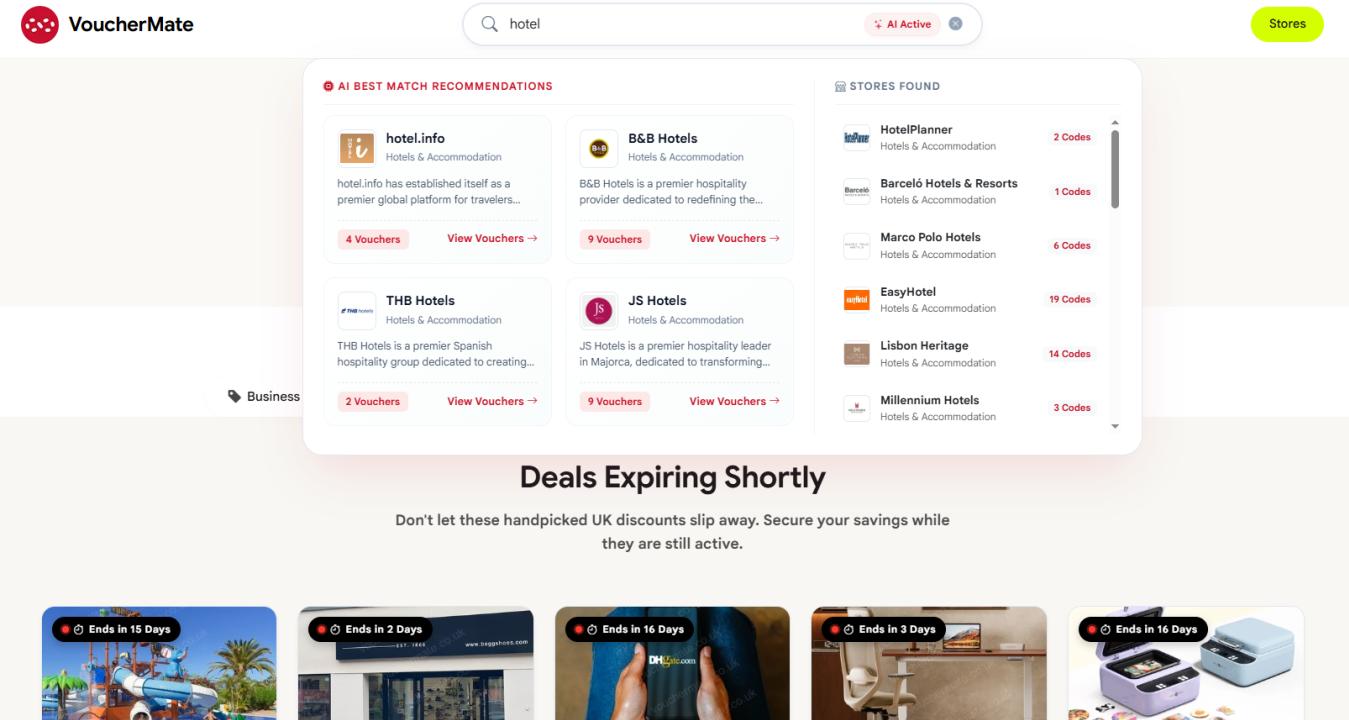
But what really caught my eye was the search bar right in the middle of the homepage. It didn't just ask me to type a brand name. Instead, it bore a simple prompt: "Ask our AI for UK brands & vouchers..." with a small, pink "AI Active" tag glowing quietly next to it.
My immediate reaction was skepticism. We live in an era where every single tech startup rushes to slap an "AI" sticker on their product, often just to hide a basic, rigid keyword search behind a trendy buzzword. I assumed that if I typed anything other than a precise brand name like "Dell" or "Nike," the system would break or throw back a generic "No results found" message.
At that moment, I was actually looking to buy two very different things. I wanted to upgrade my desk setup with a new monitor light bar to reduce eye strain, and I also needed to renew a subscription for a writing and markdown app I use daily for work. Usually, this would mean two entirely separate, tedious search journeys across multiple legacy coupon directories.
I decided to test this AI search, fully expecting it to fail. Instead of typing in a brand or a category, I typed a conversational, slightly messy sentence, exactly as if I were talking to a colleague:
"I'm upgrading my home office setup and need some discounts on desk accessories and some productivity software subscriptions."
I hit enter.
The Moment of Frictionless Discovery
What happened next felt genuinely refreshing.
The system didn't give me an error. It didn’t force me to choose between rigid categories like "Home" or "Software." Instead, the algorithm seemed to actually comprehend what I was trying to accomplish. In a split second, it mapped the intent behind my sentence and brought back a beautifully curated selection of offers.
There, right in front of me, were active discount codes for a popular UK electronics retailer carrying the exact light bar I had in mind, alongside a verified discount for a major productivity software suite.
It felt like a subtle shift in how we interact with the web. For years, we have been trained to think like computers. We have had to translate our human desires into rigid keywords, navigating complex, nested menus designed by developers who wanted to maximize page views rather than solve our problems. But here, for the first time on a savings platform, I was able to speak like a human, and the system did the work of translating my thoughts into actual, practical results.
I didn't have to navigate to three different category pages. I didn't have to close five pop-ups. I just stated my intent, and the relevant pieces of the database came to me.
The Subtle Power of Transparency
As I explored the site more over the next few days, I began to appreciate the quieter details of how it operates. One of the most frustrating aspects of the coupon industry is the lack of honesty. Giant sites will happily show you a code they know hasn't worked for six months, simply because keeping you on the page for an extra thirty seconds increases their ad impressions.
On VoucherMate, I noticed that each coupon card had a clear, real-time success rate and an actual expiry countdown. When a code was nearing its end, or if its success rate had started to dip, the site showed it clearly.
No platform can ever guarantee that every single code will work 100% of the time—merchant rules change, campaigns end abruptly, and terms are often incredibly specific. But there is a massive difference between a site that tries to trick you with false promises and one that is honest about the probabilities. Seeing a code marked with a "65% success rate" actually makes me trust the platform more, because it tells me they are actively tracking user feedback and adjusting the data in real time, rather than leaving dead links to rot in their database.
It felt like a platform built for the modern, busy consumer—someone who values their time just as much as they value their money.
How Intent-Based Saving Fits Our Current Lives
I think the reason this experience resonated with me so deeply is that our relationship with spending has changed. With the cost-of-living challenges in the UK, we are all looking for ways to trim our expenses. We review our subscriptions, compare energy providers, and look for better deals on our daily essentials.
But the cognitive load of constantly trying to optimize our lives is incredibly high. If saving five pounds requires thirty minutes of frustrating, ad-filled searching, our brains eventually decide that the mental energy isn't worth the reward. We choose convenience over savings, even when we can ill afford to do so.
What intrigued me about VoucherMate’s approach was how it seemed to lower that cognitive load. It’s particularly useful for those high-value, practical categories that are usually neglected by major coupon sites. If you look at the giant directories, their homepages are almost entirely dominated by fast fashion, beauty products, and major food chains. They are designed for impulse retail shopping.
But what about the boring, practical expenses that actually make up the bulk of our monthly budgets?
VoucherMate features dedicated focus areas like "Business Energy & Utilities," "Software & Digital Downloads," and "Online Gaming & Subscriptions." These are areas where finding active codes is traditionally incredibly difficult because the margins are tight and the merchants are highly specialized. By using AI to bridge the gap, the platform makes it possible to find discounts on the things that actually matter to our monthly balance sheets, rather than just encouraging us to buy more clothes we don't need.
Reflecting on the Future of Digital Tools
When I successfully applied the software discount code I found on the site and watched the total in my cart drop, I felt a strange sense of quiet satisfaction. It wasn't just the few pounds I’d saved. It was the fact that the entire process had taken less than two minutes, and I hadn't had to sacrifice my peace of mind to get there.
It made me realize that the future of the web shouldn't be about building bigger, louder databases. It should be about building quieter, smarter interfaces that respect our time and our intelligence. We don't need more sites with millions of disorganized links; we need tools that can listen to what we are trying to achieve and guide us there with as little friction as possible.
My browser bookmark bar looks a little cleaner now. The bloated, ad-stuffed portals have been removed, replaced by a single, quiet link. While VoucherMate might still be a relatively small player in a market dominated by massive corporate directories, its approach feels like a breath of fresh air.
If you, like me, have grown tired of the tedious discount code rat race, of copying and pasting expired codes into empty boxes while your evening slips away, it might be time to stop thinking like a search engine. Sometimes, the best way to save is simply to find a tool that knows how to listen.