Selling to schools is completely different from selling to most industries. Schools have budgets that move slowly, buying decisions that involve committees, and administrators who are buried in email, curriculum planning, and student issues. If you sell EdTech software, classroom supplies, textbooks, professional development, or facility services, you already know the challenge: you can identify the school or district you want to reach, but actually getting your message to the superintendent, principal, or curriculum director who can make a decision takes real strategy.
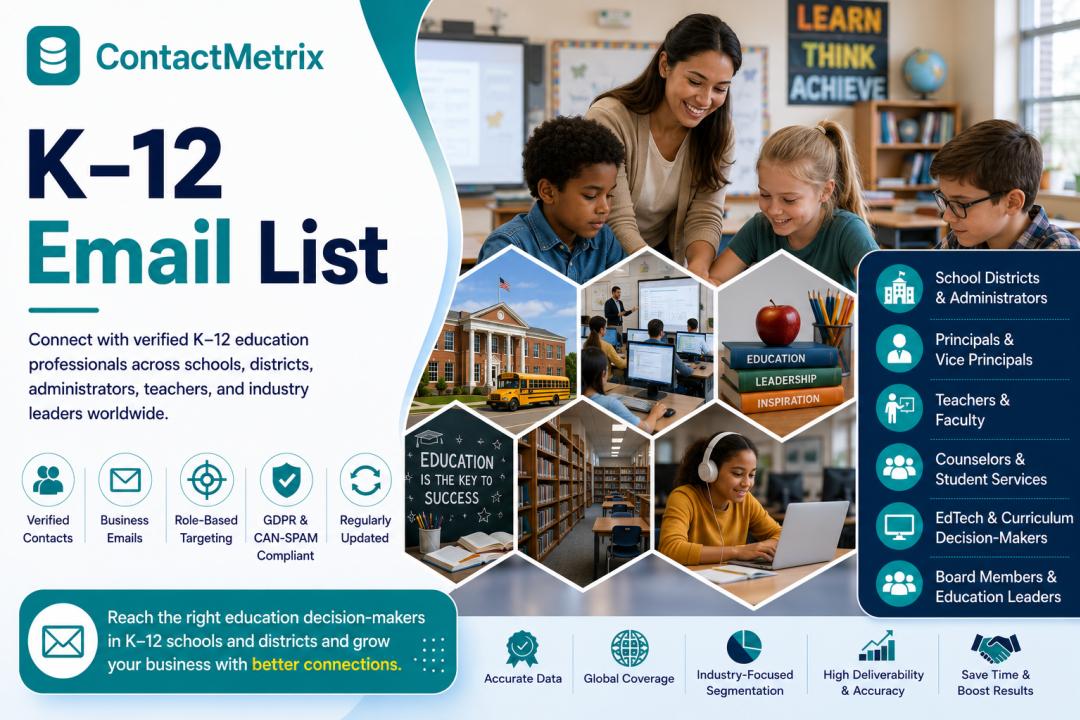
That's what a K-12 email list is designed to solve. It's a database built specifically for the education sector, with verified contact details for the decision-makers at schools and districts: superintendents, principals, curriculum directors, technology coordinators, and procurement heads. Providers like ContactMetrix build these lists so you're not sending a generic pitch to a school's main office line and hoping it gets forwarded to the right person. You're reaching someone whose job includes evaluating exactly what you sell.
What's Actually in One of These Lists
A useful K-12 contact list is far more than a name and a school email address. A solid one includes 20 or more data fields, and each one helps you figure out whether a school or district is actually worth your time. Expect things like:
- Full name and job title
- Business email and direct phone number
- School or district name and website
- School type, such as public, private, charter, or parochial
- Grade levels served
- Student enrollment and number of schools
- Geographic location by city, county, state, and zip code
- Title I status and free/reduced lunch data, where available
- Technology platforms in use, where available
That last group of fields is what sets a targeted K-12 list apart from a generic education directory. Knowing whether a district serves 50,000 students or 2,000 changes everything about approach and fit. Similarly, knowing the technology platforms a school already uses tells you a lot about whether your EdTech product is even compatible or relevant.
Who Gets the Most Out of This Data
Not every business needs K-12-specific contacts, but if your customers are schools or districts, this kind of list can save months of guessing. A few examples:
Educational publishers can go straight to curriculum directors and instructional coaches who actively evaluate textbooks, digital curricula, and assessment tools, instead of hoping a catalog gets noticed by the right person.
EdTech companies can reach technology coordinators, IT directors, and district administrators adopting learning management systems, classroom apps, or student information systems, right when they're evaluating solutions.
School suppliers and equipment providers can connect with procurement heads and facilities directors shopping for classroom furniture, lab equipment, playground structures, or cafeteria supplies, which is a much more useful audience than a general school directory.
Event organizers can target principals and superintendents interested in education conferences, teacher training workshops, or STEM events, giving them a head start before organizers start making calls.
Education consultants can reach district administrators and school improvement leads seeking consulting services in curriculum design, teacher training, or special education compliance.
Educational research organizations can access research directors and data analysts at districts participating in educational studies or program evaluations.
The K-12 sector also breaks down into clear categories: public school districts, elementary schools, middle schools, high schools, private and parochial schools, charter schools, special education centers, and district administrative offices. Each has its own decision-makers and budget holders. A Principal at an elementary school and a Superintendent at a district office have completely different roles and purchasing authority, and a well-built list should let you filter down to the exact school type and role instead of buying one massive, unsorted file.
Why Data Quality Matters More Than Data Quantity
This is especially important in education. Schools have high staff turnover, especially at the administrator level, and people change roles frequently. A list with 150,000 contacts is only useful if those contacts are current. A principal you pitched last year might have been promoted to district level, moved to another school, or left education entirely. A list that hasn't been refreshed recently will waste your time and hurt your campaign performance.
Before buying any K-12 contact database, whether it's from ContactMetrix or another provider, it's worth asking a few questions:
- How often is the data verified and refreshed? In education, monthly is reasonable. Anything longer than 45 days is risky.
- Are the contacts opt-in, meaning people who've agreed to be reached for business purposes?
- What happens with a hard bounce? Some providers replace bad contacts at no extra cost, which matters a lot when you're dealing with high turnover.
- Can the list be filtered by school type, grade level, district size, or geography, instead of just "K-12" as a broad label?
A provider that refreshes data every month or so and stands behind it with a replacement guarantee is making a real commitment to accuracy.
Getting Started Without Wasting Budget
The smartest way to test any contact list is to request a sample before buying anything. A handful of real (even if partially masked) records will show you the data structure and whether the schools and roles listed actually match what you're targeting. If you sell middle school math software, you want to see Curriculum Coordinators and Math Specialists at middle schools in that sample, not a random mix of unrelated school positions.
From there, most providers, ContactMetrix included, let you build a custom list around your ideal customer profile: school type, grade level, enrollment size, and geography. That's a far better use of a marketing budget than sending a mass email to a generic K-12 list and hoping it lands with someone who can move things forward.
School administrators are busy, under-resourced, and skeptical of vendor pitches. They get dozens of emails a week from companies selling something. A well-built, regularly updated contact list won't close a deal by itself, but it does mean your first message reaches someone with actual purchasing authority instead of getting lost in a shared inbox or forwarded to the wrong department