You've collected three or four quotes for a rooftop solar system, and every proposal lists different credentials next to the installer's name. One says "NABCEP certified." Another lists a "manufacturer-authorized installer" badge. A third simply reads "licensed and insured." Which of these actually tells you the crew climbing onto your roof knows how to run a structural load calculation, wire a string inverter to code, or seal a penetration so it doesn't leak by year three?
This is where Solar Installer Certification becomes relevant. It isn't a single universal badge, and knowing what it does (and doesn't) verify can be the difference between a system that passes inspection cleanly and one that turns into a warranty dispute or a roof leak two winters later.
What Solar Installer Certification Actually Verifies
The most recognized voluntary credential in the U.S. residential and commercial solar space comes from the North American Board of Certified Energy Practitioners (NABCEP). Its PV Installation Professional (PVIP) certification requires candidates to document a minimum number of hands-on installations, complete qualifying training hours, and pass a technical exam covering system design, electrical code, and safety protocols. NABCEP also offers narrower credentials, including a PV Technical Sales credential and an Associate-level entry credential for people new to the field, so not every "NABCEP" mention in a proposal reflects the same depth of hands-on experience.
It's worth separating two things that homeowners often confuse:
Contractor licensing is a legal requirement, issued by a state or local licensing board, that permits a business to perform electrical or roofing work at all. Requirements differ by state; some require a dedicated solar or C-46 electrical contractor classification, while others fold solar work under a general electrical or roofing license.
Certification is a competency credential, typically voluntary, that verifies an individual has demonstrated specific technical knowledge, often tied to a national standards body or a manufacturer's product line.
A crew can be fully licensed to do the work legally without holding any product-specific or NABCEP certification. Neither one substitutes for the other, and a homeowner vetting installers really needs to ask about both rather than assuming one implies the other.
Manufacturer Training and the Roofing-Specific Skill Gap
General electrical certification doesn't automatically cover the roofing side of a solar install, and that gap is where a surprising number of post-installation problems originate. Flashing sequencing, penetration sealing, and rail versus railless attachment methods vary by roofing material (asphalt shingle, standing-seam metal, tile) and by mounting hardware manufacturer. A crew trained on one flashing system won't necessarily install a different manufacturer's hardware correctly on the first attempt, and the failure mode usually shows up months later as a slow leak rather than an immediate, obvious defect.
That's why most reputable mounting hardware manufacturers now run their own certification or training tracks, separate from NABCEP, focused specifically on their attachment hardware, flashing components, and installation sequence. Manufacturers have started pairing this technical training with structured post-installation support programs, part of what's described as Roof-Tech's new era in customer relationships, where the manufacturer's accountability doesn't end the moment the crew packs up and leaves the roof.
For homeowners, this means asking a second, more specific question beyond "are you licensed": which mounting hardware is being used, and is the crew trained on that specific product line?
The Technical Curriculum Behind Certification
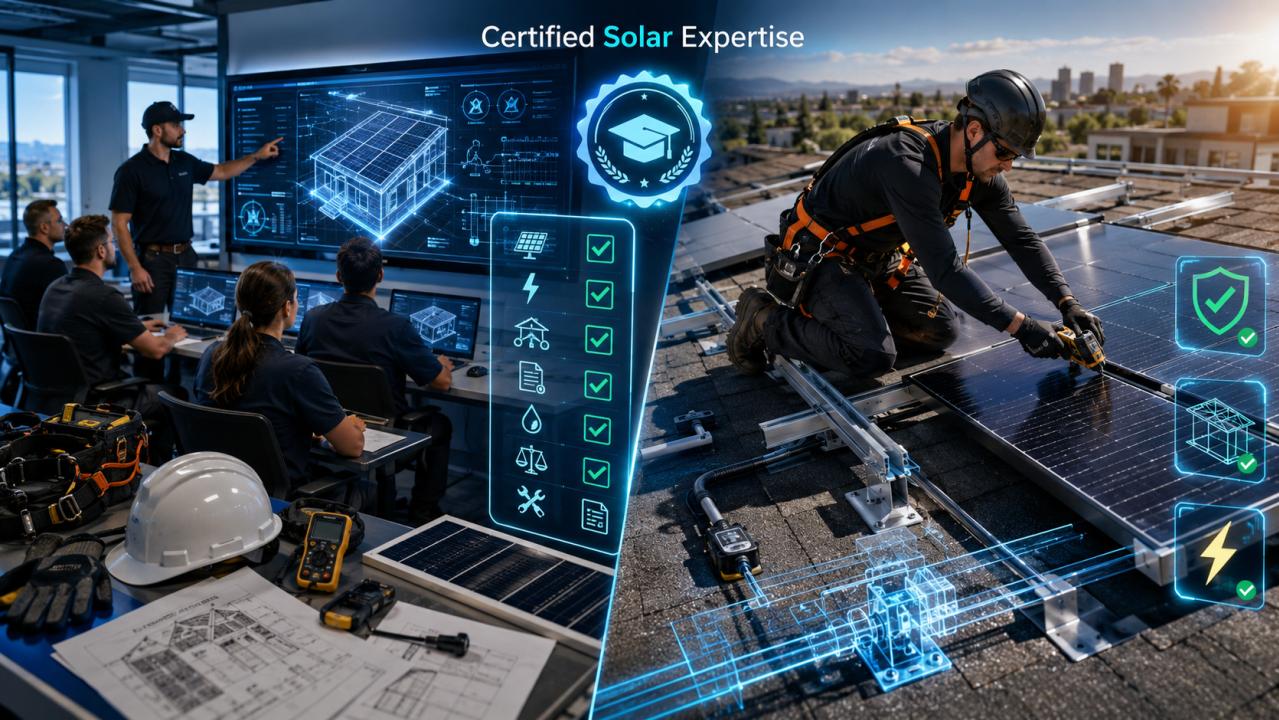
A legitimate certification program, whether NABCEP or manufacturer-run, generally covers the following areas:
Electrical code compliance: NEC Article 690 (Solar Photovoltaic Systems) and Article 705 for interconnected systems, covering wiring methods, disconnects, rapid shutdown, and grounding
Structural load principles: how wind, snow, and dead loads factor into rooftop attachment spacing, drawing on ASCE 7 wind and snow load provisions
Attachment and flashing methods: proper penetration sealing, flashing sequencing under shingles or membrane, and torque specifications for structural fasteners
Product evaluation standards: familiarity with ICC-ES evaluation reports (such as AC428 for solar mounting systems) and UL 2703 for mounting system and grounding safety
Fall protection and jobsite safety: separate from PV-specific training but often bundled into a certified installer's broader safety credentials
A crew that only knows the electrical side but has no working knowledge of AC428-evaluated attachment points or proper flashing sequencing can produce a system that's electrically sound and still leaks. This is a common blind spot: an inspector checking for code compliance is usually verifying electrical and structural attachment points, not chasing down a flashing detail three courses under the shingles, which means a poorly sealed penetration can pass inspection and still fail two winters later.
Continuing Education and Why Certification Isn't a One-Time Event
Codes change. NEC updates on a three-year cycle, and rapid shutdown requirements, arc-fault detection rules, and grounding methods have all shifted meaningfully across recent revisions. NABCEP requires certified professionals to complete continuing education hours and renew their credential periodically, rather than holding it indefinitely off a single exam. Manufacturer training tends to follow a similar logic: hardware lines get updated, evaluation reports get renewed or revised, and a crew trained three product generations ago may not be current on the latest attachment specifications.
This matters when comparing quotes. A certification date from several years ago, with no evidence of renewal or continuing education, tells you less than a current one. It's reasonable to ask an installer when their certification was last renewed, not just whether they hold one.
What Certification Does Not Guarantee
Certification is a floor, not a ceiling, and it's worth being direct about its limits. It confirms baseline technical competency at the time of testing or training. It does not guarantee:
Ongoing quality control on every individual job
That the certified individual personally performs (rather than supervises) the installation
Compliance with local permitting or jurisdiction-specific amendments to the IBC or IRC, which vary by municipality
Long-term workmanship, since day-to-day field execution isn't directly measured by a credential
Homeowners sometimes treat a certification logo on a website as a finished due-diligence checklist. It's a strong starting filter, not a replacement for asking about the specific crew, checking references, and confirming permit history with the local building department.
How to Verify an Installer's Credentials
A few concrete steps make this easier than it sounds:
Ask for the installer's NABCEP certification number and verify it directly through NABCEP's public database rather than taking a website badge at face value.
Ask which mounting hardware manufacturer they're using and whether the crew holds that manufacturer's installation training or certification, and how recently it was completed.
Confirm the contractor's state license number through your state's licensing board search tool.
Request the ICC-ES evaluation report number for the mounting system being proposed, and check that it matches your roof type (asphalt shingle, tile, metal, membrane).
Ask who pulls the permit and whether the jurisdiction has any local wind or snow load amendments beyond the base ASCE 7 requirements.
None of these questions require an engineering background to ask. They just require knowing that certification, licensing, and manufacturer training are three separate things that all need checking, and that a credential's age matters almost as much as its existence.
Common Mistakes When Evaluating Installer Credentials
A few patterns show up often when homeowners or property managers evaluate installers:
Treating any "certified" claim as the same. A NABCEP Associate credential, which is entry-level and doesn’t require field experience, and a NABCEP PV Installation Professional credential, which requires documented installs, are not the same thing. However, both can be loosely labeled as "NABCEP certified" in marketing materials.
Assuming licensing covers roofing skills. A general electrical license does not test knowledge of flashing or waterproofing, which is more related to roofing skills than electrical codes.
Not asking who is actually on the roof. A company might have one certified person who oversees several crews. The hands-on work may be done by less experienced installers under general supervision instead of direct, on-site guidance.
Skipping the permit and inspection record check. A complete permit history with the local building department is often a more reliable sign of consistent code compliance than any single credential.
Certification Value Shifts by Climate Zone
Not all certifications are equal across regions, an aspect homeowners rarely consider. A crew certified for a low-wind, low-snow climate may be unexperienced in high-wind zone attachment calculations per ASCE 7, which require tighter fastener spacing. Coastal properties pose galvanic corrosion risks from dissimilar metals, like aluminum rails and steel fasteners, which inland installers might not frequently encounter.
This is why some certification and training programs include region-specific modules covering high-velocity hurricane zones, heavy snow-load areas, or coastal corrosion resistance, in addition to the general curriculum. Asking whether an installer's training or field experience matches your specific climate exposure, not just their certification status in the abstract, is a reasonable and often overlooked question.
Conclusion
A certification badge on a proposal signals quality but only partially. Solar hardware involves electrical code, structural engineering, and roofing waterproofing, with no single credential covering all. Knowing the difference between a state contractor license, NABCEP credential, and manufacturer training helps homeowners and managers assess qualification for roof work. Spending ten minutes verifying licenses or training saves money by preventing errors like poorly flashed penetrations or non-compliant systems.
Frequently Asked Questions
1. Is solar installer certification legally required?
No. It's voluntary. A state or local contractor license is the legal requirement.
2. What's the difference between NABCEP certification and a contractor's license?
A license authorizes a business to operate legally. NABCEP certification verifies individual technical competency. Neither substitutes for the other.
3. How long does it take to become a certified solar installer?
NABCEP's PV Installation Professional credential generally takes one to two years of qualifying experience and training. Manufacturer hardware training is usually completed in days.
4. Does hiring a certified installer affect the warranty on solar equipment?
Often yes. Many manufacturers require certified installation to keep mounting hardware and inverter warranties valid.