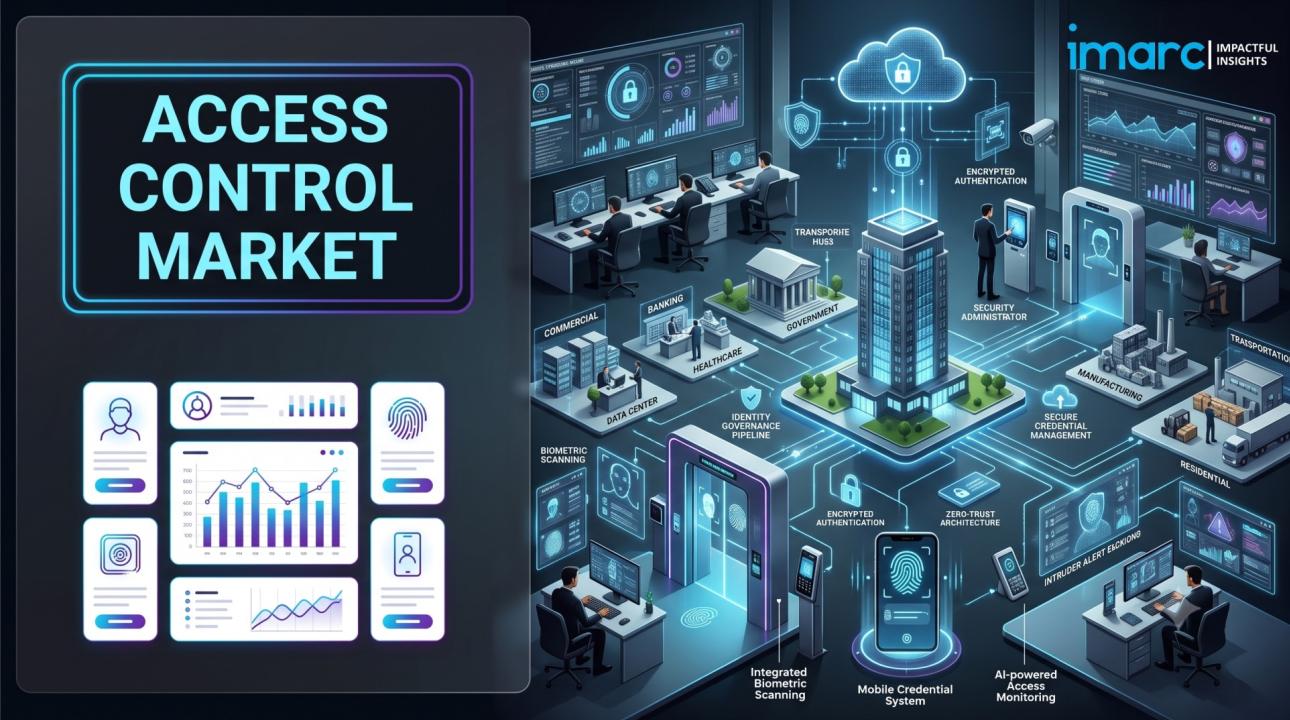
IMARC Group, a leading global market research and management consulting firm, has published its latest market intelligence report on the Access Control Market. The global access control market size was valued at USD 11.3 Billion in 2025. Looking forward, IMARC Group estimates the market to reach USD 19.9 Billion by 2034, exhibiting a CAGR of 6.28% from 2026-2034, with the industry witnessing steady expansion, driven by the rising number of cyber threats, increasing adoption of cloud-based solutions, growing integration of biometric and IoT technologies, and expanding regulatory compliance requirements across healthcare, finance, and commercial real estate.
The market is experiencing strong growth momentum driven by the increasing alignment between organizational security priorities and the operational advantages that modern access control systems offer across commercial, government, and residential settings. Businesses and institutions are seeking security solutions that deliver real-time monitoring, remote management, and seamless integration with existing infrastructure, a need that cloud-based controllers, smart locks, and biometric readers are uniquely positioned to meet. The corporate and government sectors, encompassing offices, healthcare facilities, financial institutions, and public buildings, are reinforcing this demand by relying on access control systems to safeguard sensitive data, protect physical assets, and maintain regulatory compliance at scale. Simultaneously, advances in artificial intelligence and IoT connectivity are extending system capabilities without compromising ease of use, enabling both large enterprises and smaller organizations to deploy increasingly sophisticated security infrastructure.
How AI is Reshaping the Future of the Access Control Market
- AI-Powered Biometric Authentication and Real-Time Threat Detection: Machine learning platforms are enabling security providers to enhance facial recognition, fingerprint scanning, and iris detection systems with real-time anomaly detection, allowing organizations to identify unauthorized access attempts, flag suspicious behavior patterns, and reduce false rejection rates, ensuring more accurate and secure authentication across government facilities, corporate campuses, and critical infrastructure sites without the vulnerabilities that have historically challenged single-factor authentication methods.
- Intelligent Access Analytics and Predictive Security Management: AI-driven analytics platforms integrated into access control systems are automating the analysis of entry and exit patterns, occupancy trends, and credential usage data at speeds and precision levels that manual security audits cannot match, reducing insider threat risk and improving incident response times while ensuring compliance with data privacy and workplace safety standards across regulated markets in North America, Europe, and Asia Pacific where security thresholds are highest.
- Smart Building Integration Using Occupancy and Sensor Data: AI-powered building management tools are enabling access control providers to mine occupancy sensor data, HVAC usage, and lighting patterns to optimize energy consumption alongside security enforcement, shortening the gap between physical security and facility efficiency, and enabling property managers to deploy touchless entry, personalized climate zones, and automated lockdown protocols with greater confidence in both safety and sustainability outcomes.
Grab a sample PDF of this report: https://www.imarcgroup.com/access-control-market/requestsample
Access Control Market Trends and Drivers
The global access control market is witnessing steady expansion, fueled by the convergence of rising security threats, structural shifts in regulatory compliance, and accelerating technological innovation that is repositioning access control as a strategic enterprise investment rather than a routine facilities expense. Security concerns remain the foundational demand driver across both public and private sectors, with organizations prioritizing solutions that deliver consistent protection without the operational friction of outdated lock-and-key systems. The Identity Theft Resource Center recorded the highest data breach volumes in its history, a 72% rise over the previous high, exposing millions of personal records and pushing enterprises toward more robust access governance frameworks. Access control has become one of the essential pillars of an integrated security strategy used for securing sensitive data, protecting physical assets, and ensuring personnel safety, with regulatory bodies across healthcare, finance, and government intensifying their demands for compliant access solutions under frameworks such as HIPAA, GDPR, and PCI DSS.
Technological advancement is reshaping system capabilities, with biometric authentication, cloud-based platforms, and IoT integration propelling adoption forward. Industry estimates point to 16.6 billion connected IoT devices in circulation, growing at double-digit rates year over year, a trend that is directly expanding the addressable footprint for smart access control deployment. Leading manufacturers are responding with dedicated innovation. For instance, HID Global unveiled its biometric facial recognition platform, HID BioX, purpose-built for seamless IoT-integrated access control, while ASSA ABLOY introduced a cloud-based smart lock system enabling real-time monitoring and remote access management. Smart building adoption is compounding this trend further, with commercial properties expected to house over four billion connected IoT devices, powered by 5G and next-generation Wi-Fi infrastructure, reinforcing access control's expanding role beyond doors and into holistic building management encompassing HVAC, lighting, and occupancy monitoring.
Evolving workforce dynamics are also reshaping demand. Remote and hybrid work arrangements now represent a substantial share of the US workforce, translating into more than 35 million remote workers, a shift that requires access credentials to be issued and revoked from anywhere. Cloud-based access control solutions are proving to be key enablers of this flexibility, allowing administrators to manage onboarding and offboarding for employees and contractors across multiple locations without the overhead of physical key logistics.
Ask an analyst for a customized report: https://www.imarcgroup.com/request?type=report&id=4689&flag=E
Access Control Industry Segmentation
Breakup By Component:
- Controller
- Reader
- Locks
- Software
Controllers lead the component landscape, commanding the largest market share as the central processing units that manage authentication requests, enforce access policies, and log system events. As access control deployments grow more complex with biometric authentication and IoT integration, demand for powerful, scalable controllers continues to anchor this segment's dominance.
Breakup By Type:
- Card-based (Contact, Contactless)
- Biometric-based (Fingerprint, Face Recognition, Face Recognition and Fingerprint, Iris Recognition, Others)
Card-based systems hold the largest share by type, favored for their affordability, familiarity, and ease of integration with existing infrastructure. Proximity cards, magnetic stripe cards, and contactless smart cards remain widely deployed even as biometric alternatives gain ground in higher-security environments.
Breakup By End User:
- Government
- Military and Defense
- Commercial
- Healthcare
- Manufacturing
- Transport
- Education
- Residential
- Others
The commercial segment accounts for the largest end-user share, spanning offices, retail stores, hotels, and entertainment venues that require access control for asset protection, loss prevention, and employee and customer safety. This sector often leads in adopting emerging access technologies to balance security with user convenience.
Breakup By Region:
- North America (United States, Canada)
- Asia Pacific (China, Japan, India, South Korea, Australia, Indonesia, Others)
- Europe (Germany, France, United Kingdom, Italy, Spain, Russia, Others)
- Latin America (Brazil, Mexico, Others)
- Middle East and Africa
North America dominates the global access control market, commanding over 38% of global market share, driven by strong emphasis on security, stringent regulations, and widespread adoption of advanced technologies. Within the region, the United States accounts for the substantial majority of North American demand, supported by government cybersecurity investment and rising biometric adoption across corporate and public buildings. Europe follows closely, propelled by strict data protection regulations under GDPR, with the UK, Germany, and France leading biometric and RFID deployment across commercial and government facilities.
Competitive Landscape
The report provides a comprehensive analysis of the competitive landscape in the access control market, with detailed profiles of all major companies, including:
- Allegion plc
- Assa Abloy AB
- Axis Communications AB (Canon Inc.)
- Bosch Security Systems LLC
- Dormakaba Holding AG
- Honeywell International Inc.
- IDEMIA
- Identiv Inc.
- Johnson Controls International
- NEC Corporation (AT&T Inc.)
- Nedap N.V.
- Panasonic Corporation
- Schneider Electric SE
- Thales Group
What Does The Full Report Cover?
If you are tracking the access control market for investment decisions, market entry planning, competitive benchmarking, or strategic advisory, IMARC Group's report gives you everything in one place:
- Complete market sizing with revenue forecasts covering the full projection period
- Quantified growth driver analysis with impact scoring across component, type, end user, and regional markets
- Sub-segment breakdowns for controller, reader, locks, software, card-based, and biometric-based categories with individual share data
- Country-level data for the United States, Canada, Germany, France, the United Kingdom, Italy, Spain, Russia, China, Japan, India, South Korea, Australia, Indonesia, Brazil, and Mexico
- Competitive profiles of 14 leading companies with strategic landscape assessment
- Porter's Five Forces, value chain analysis, and pricing intelligence
- Latest innovation trends covering biometric authentication, cloud-based platforms, and IoT-integrated smart building solutions shaping competition across key regional markets
Recent News and Developments in the Access Control Market
- November 2024: Allegion Ventures announced a lead investment in Serenity's Series A funding round. The AI-powered EHS software provider is known for scalable cloud solutions, including OSHA reporting and mobile inspections, that enhance workplace safety and compliance efficiency.
- June 2024: Honeywell completed its USD 4.95 billion acquisition of Carrier's Global Access Solutions business, adding brands LenelS2, Onity, and Supra to its security portfolio, aligning with automation megatrends and cloud-based innovation opportunities.
- April 2024: IDEMIA Public Security and SECURE Systems launched a solution enabling the MorphoWave biometric terminal to operate in transparent card reading mode, expanding deployment of contactless biometric technology in secure environments.
Note: If you require specific details, data, or insights that are not currently included in the scope of this report, we are happy to accommodate your request. As part of our customization service, we will gather and provide the additional information you need, tailored to your specific requirements.
Key Questions This Report Answers
- What is the current global access control market size and what is its projected value?
- Which component segment holds the largest share in the global access control market?
- What are the key drivers of global access control market growth?
- Which region dominates the global access control market and why?
- How are AI, biometrics, and IoT integration reshaping product development and competitive strategies in the access control industry?
- Who are the top companies in the global access control market and what are their competitive strategies?
- What are the investment and market entry opportunities across biometric, cloud-based, and smart building-focused access control segments?
About Us
IMARC Group is a global management consulting firm that helps the world's most ambitious changemakers create a lasting impact. The company provides a comprehensive suite of market entry and expansion services, including thorough market assessment, feasibility studies, company incorporation assistance, regulatory approvals and licensing navigation, branding, marketing and sales strategies, competitive landscape and benchmarking analyses, pricing and cost research, and procurement research.
Media and Sales Contact
IMARC Group
Email: sales@imarcgroup.com
United States: +1-201-971-6302
India: +91-120-433-0800
United Kingdom: +44-753-714-6104