Toddlers are in the midst of a period of significant development. Children are learning to move with increasing control, express their needs, and understand and communicate with others and the world around them. Although toddlers learn the majority of their skills at home, some group sessions can provide them with extra learning opportunities in the areas of important skills.
SOCCER can be particularly helpful as it incorporates mobility with play and socialization. Toddlers don't need to know the rules of a match or to do any complicated moves to enjoy the game. Activities like running towards a ball, trying to kick a target, listening to a coach, and waiting for a go, etc., can help develop several early learning areas.
Good designs of toddler soccer Sydney programmes do not intend to produce competitive players. Their purpose is to introduce children to physical activity in a safe, playful, and encouraging environment. Super Best Friends is a programme for little ones that facilitates age-appropriate soccer activities, where they can move, learn, enjoy, and become more confident too when spending time with other children.
Building Confidence Through Small Achievements
Children build up confidence when they succeed. Success can be kicking the ball the first time, following a simple instruction, or taking part in an activity without a parent's hand for a toddler.
These accomplishments might not seem significant, but to a youngster, they might be. All are conveying the message that there is progress to be made with a new experience.
A good coach takes into account hard work instead of perfect performance. If the target is not met, the coach can let the child know to try again. Praise should be geared toward their effort and persistence when the child is successful.
This will reinforce the idea to toddlers that that is how learning goes – they often make mistakes. They become more confident to persevere with an activity even if they find it new or different.
When selecting amongst the best soccer academy Sydney has to offer, parents should bear in mind the way coaches act when a youngster hesitates or makes a mistake. It's time for encouragement, not pressure, from patients.
Developing Balance, Coordination, and Movement Skills
Young children are still developing their body awareness. To adults,s running, stopping, turning, and changing direction may seem straightforward, but they are actually a series of complex exercises involving balance, coordination, and body awareness.
These movements are repeated in socce,r giving the children more opportunities to practice. Toddlers could walk toward a ball, run between markers, step over small obstacles, or kick a ball toward a large target during a session. Activities help to develop gross motor skills, those that rely on the larger muscles and are necessary for everyday activities.
Basic soccer games can be used for:
Balance and stability
Hand-eye and foot-eye coordination
Running and stopping
Directional movement
Spatial awareness
Controlled kicking
General body confidence
Toddlers don't have to be able to do every move flawlessly. The benefit is to learn about movement and get used to using their body more and more.
Due to the quality of the program, children work as they are able. Coaches should not compare one toddler to another, as there are differences in physical development in the early years of life.
Encouraging Healthy and Active Habits
Getting plenty of physical activity is an important aspect of a healthy childhood. But, if presented as a formal workout, toddlers will not likely want to engage in the exercise. They respond much better to games, stories,s and imaginative challenges.
Children could be encouraging children to repeat words or expressions, ns such as a coach saying 'dribble a ball around the pretend islands, run away from imaginary animals,s or kick the ball into a colourful goal'. Although he thinks it is play, the toddler is continually moving and practicing his physical skills.
Positive experiences taking part in an activity can develop a positive attitude towards the activity in the child. Growing up with this mindset can make them more inclined to engage in sports, play in the playgrounds, and base their hobbies in physical activity.
Parents who are thinking about enrolling their children in a kids' soccer program in Sydney should look for a program that provides activities that engage children but are not strenuous or push them into stressing out. Toddlers should not do long drills; short activities, regular water breaks, and a flexible pace will be more appropriate.
Super Best Friends' goal is to make movement fun, so that kids want to come back instead of it being "one more soccer thing to do.
Supporting Social Skills and Group Participation
Toddlers are starting to learn how to behave with those beyond their close circle of family. Group Soccer instruction enables them to learn the fundamentals of group play with children.
Toddlers might practice learning to:
To wait for a few moments, especially for a player's turn.
Take and share balls & equipment.t
Listen when another child is taking part
Follow group instructions
Congratulate the players' successes
Respect personal space
Participate in basic group play
Children will not instantaneously learn these behaviors, especially young children. An infant can take off a ball from another player, can be distracted, and is unable to wait for their turn. These are normal times/opportunities for gentle teaching.
Coaches can demonstrate good behaviour and provide clear directions. As toddlers get used to the group routines over time, they will know what to expect.
This preparation can also help to ease the transition to preschool or school. Children develop greater awareness of listening to an adult guide, join in organised activity, and spend time with peers.
Strengthening Listening and Communication Skills
Soccer sessions are more than just actions. Children will also have to listen, watch,h and act in response to basic instructions.
A coach can coach toddlers to halt at the sound of a whistle or to provide a foot for the ball, or move to a colour marker. It takes attentiveness to the instructions, understanding, and response to perform following the instructions.
Coaches can assist with communication development by speaking in short sentences, showing, and repeating. Instructions need to be easily understood by the toddlers, but not overwhelming.
Children can also start to use some new movement, direction and equipment vocabulary. Words like “stop”, “go”, “pass”, “kick”, “left”, “right ", ht” hit ", and “goal” can be added to their expanding vocabulary.
Good Sydney toddler soccer coaching understands that toddlers can't hold their attention for long periods of time. Coaches should avoid giving long explanations for children to listen to with the expectation that they will remain still. Learning should be for action, demonstration, and play.
Encouraging Problem-Solving and Early Decision-Making
Decision-making can be part of even a simple soccer activity. The child might need to choose how hard to kick the ball, the direction in which to move, or how to direct the ball around an obstacle.
In these situations, children learn to make observations, carry out experiments, and make adjustments. If it goes too long, the next time they may have to try a softer kick. When they encounter an obstacle,e they have to be able to do something different.
This kind of problem-solving comes organically from play. The coach does not need to give all the answers right away. Allowing children some time to investigate will enable them to be more independent learners.
Small-sided games and obstacle courses can also be used to enhance awareness. Toddlers start to observe where the ball, markers, coaches, and others are.
These challenges should be attainable in age-appropriate soccer training Sydney sessions. Activities that are too challenging can give the child frustration, and those that aren't challenging enough can lack their interest.
Helping Toddlers Manage Emotions
Young children have strong emotions, but they may not yet be able to express or control their feelings. A soccer game can encompass excitement, disappointment, nervousness, and frustration, sometimes in the span of a few minutes.
A child might become upset if he or she misses the ball or if another toddler takes his/her turn first. With quiet assistance, these can turn into valuable learning opportunities.
Coaches can label the feeling and give reassurance and support to allow the child to come back into the activity when they are ready. Never shame a toddler for crying, distracting, or needing to take breaks.
As days go on, children can find out that disappointment is not permanent and that they are able to attempt once more. This is an early mode of emotional resilience.
Parents, too,o are of great importance. Keeping one's composure, avoiding comparisons, and rewarding involvement can make children feel secure. The objective is to make it a positive experience, not to meet expectations.
Creating Routine and Growing Independence
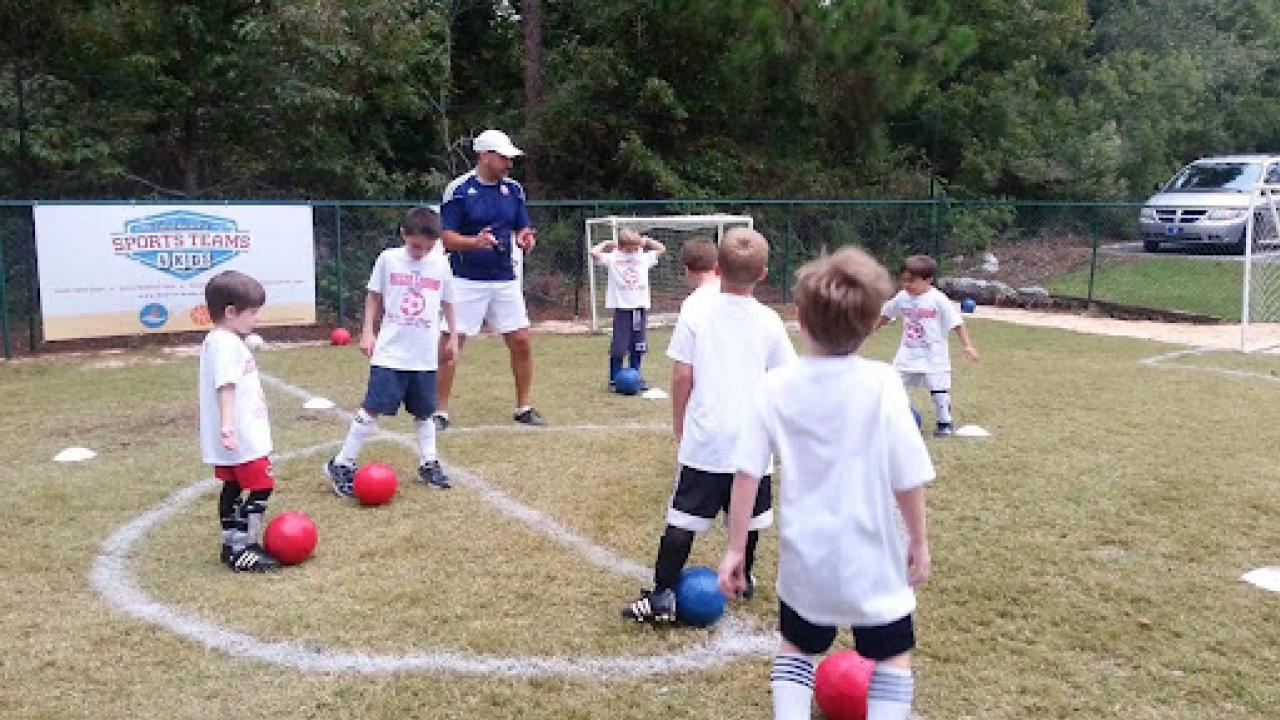
Toddlers become familiar with a regular schedule when they attend soccer sessions. They come, say hello to the coach, do some warm-up exercises, then break the group and do some activities, and end with a wrap-up.
Young children feel safe with familiar routines. They might become more independent as they get more ideas about what to expect.
A child who is first in proximity to a parent can gradually move to the playing area on his/her own. Another may promptly pick up his own ball, answering to the coach directly or assisting with equipment.
Such changes frequently occur gradually. Coaches and parents should give children enough time to get comfortable and not enforce separation when it is not needed.
A good Soccer Academy fosters a positive learning atmosphere where young children develop independence and yet maintain security and comfort in knowing adults are there to help.
Here is a list of questions for parents to ask when considering a toddler soccer program.
Not all soccer programs are geared toward early childhood development. Before signing their child up for the group, parents should look at the structure, the coaching >
A good toddler program will consist of:
Short, varied activities
Age-appropriate equipment
Patient and encouraging coaches
Clear safety boundaries
All children are included in opportunities
Good attention to enjoyment and play.
Sensitive support to children with shyness or reluctance to join in.
What Parents Should Look for in a Toddler Soccer Program
When choosing the best soccer academy in Sydney for a toddler, it should not be the most competitive program. It will be the one who knows how children of these early years learn, and will design sessions to meet their physical and emotional needs.
Super Best Friends is introducing kids to soccer with fun and friendly movement, as well as positive coaching/low level challenges. The intention is to support little players to be active while learning skills that can assist them in the game and beyond.
Final Thoughts
Toddler soccer has the potential to help develop several areas in early childhood. It gets them moving, exercises their coordination, enhances listening, and gives opportunities for social interaction.
Successful programs do not push youngsters to act like older players. They develop an approach that allows children to make comfortable progress through the sport of soccer, through the use of games, imagination,n and encouragement.
Super Best Friends is a toddler soccer Sydney family introduction to soccer. Supportive coaching, along with activities that are appropriate for their age, helps young children to grow into confident, healthily-moving, fun-participating individuals.
Frequently Asked Questions
At what age does a small child start to play soccer?
Many basic soccer activities can be begun at the toddler age. Appropriateness of starting age will depend on the program and the child's readiness to join a group.
Want a way for a toddler to get into soccer without having gone through an earlier program?
No. Toddler programs are typically targeted at beginning players and gradually build up movement and ball skills.
So, what is the best attire for toddler soccer practice?
Sports clothes, appropriate footwear, and weather-appropriate clothing (usually comfortable and/or comfortable to wear) are generally recommended. Please refer to the individual Academy requirements.
What if the kids don't do all of the activities?
Toddlers look, lose interest, and take breaks--that's normal. Patient coaches will give kids time to warm up and encourage them to play without pressure.
Is it competitive for toddlers playing soccer?
A ‘toddler’ programe that is development-based should have its focus on play, movement, and confidence with no emphasis on scores, rankings, or formal competition.