A bill book can look professional and still be inconvenient to use.
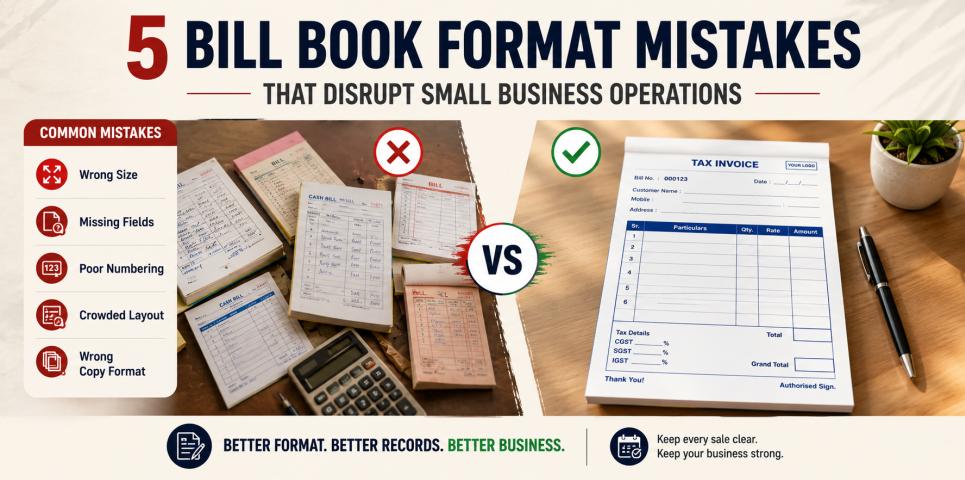
Too little writing space, the wrong number of copies, incorrect business information or an unsuitable size can create problems only after hundreds of books have already been printed.
That is why small businesses should treat bill book printing as a workflow decision rather than simply a design decision.
Before approving your next print order, check these five practical areas.
1. Think About How the Bill Book Will Actually Be Used
Start with the person who prepares the bills every day.
A retailer handling short counter transactions may need a different layout from a wholesaler entering several products on every invoice. A service business may require more room for customer information and service descriptions, while a field-sales team may value portability.
The important question is not simply, “Which bill book looks better?”
Ask instead: What needs to be written on every transaction, and how much space does that require?
A good practice is to print or view one sample layout at actual size and ask the person who handles billing to complete a sample invoice. This can reveal spacing and usability issues before the full print quantity is produced.
2. Choose the Size According to the Amount of Information
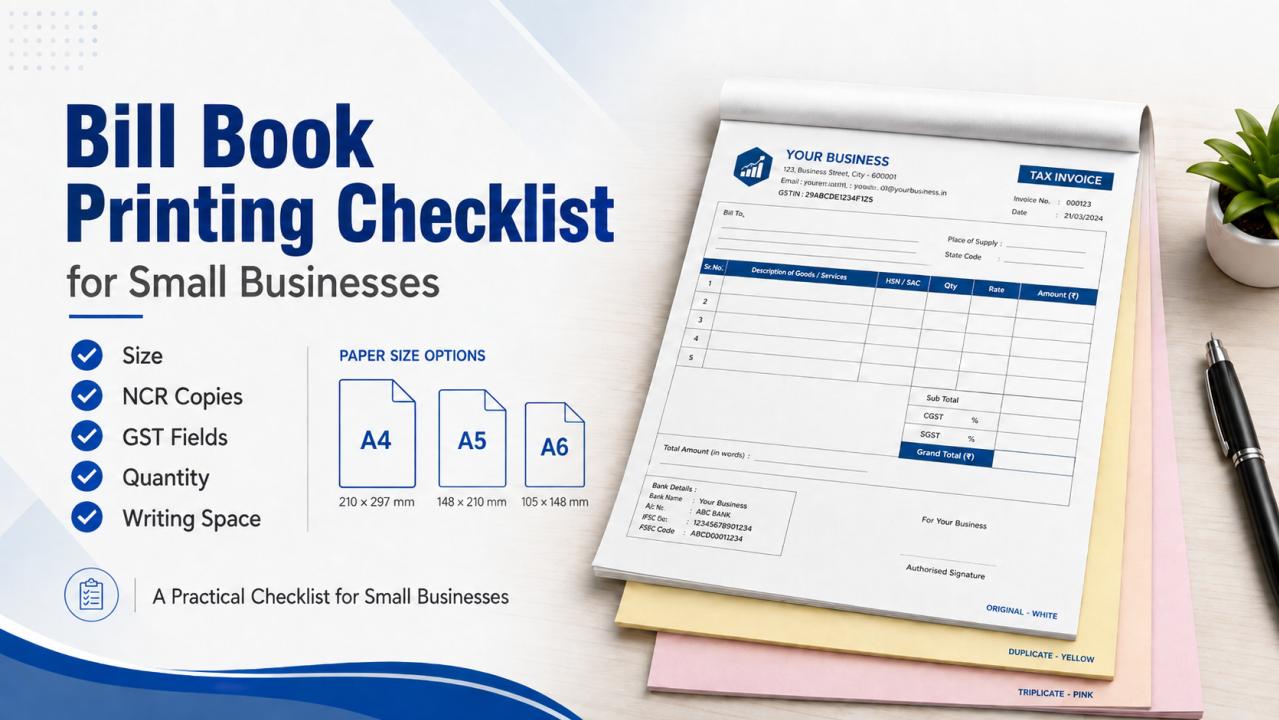
A4, A5 and A6 formats can each serve different business requirements.
A4 provides more room for detailed invoices and businesses that regularly enter several items or longer descriptions.
A5 can offer a useful balance between writing space and compact handling for everyday billing.
A6 may be more appropriate for short receipts, cash memos or transactions requiring only limited information.
Choosing a smaller format only to reduce size is not always practical if employees have to squeeze information into narrow fields.
At the same time, a large format can be unnecessary for businesses issuing very simple bills.
The right size is the one that matches the amount of information typically recorded during a real transaction.
3. Decide How Many Physical Copies You Really Need
Businesses should also decide whether each transaction requires one, two or three physical records.
A single-copy format can work where only one paper record is required.
A duplicate format can be useful when one copy goes to the customer and another remains with the business.
Triplicate formats may make sense where another department, delivery process or internal system genuinely needs a third paper record.
Multi-copy formats commonly use NCR or carbonless paper, allowing written information on the top sheet to transfer to corresponding sheets underneath.
For businesses comparing bill book sizes, NCR structures, GST-related fields, design choices and pricing considerations, this detailed bill book guide provides additional information on the different options.
This should be the main contextual backlink in the article.
4. Verify Business and Invoice Information Before Printing
One incorrect detail can be repeated across an entire print run.
Before approval, carefully check the business name, address, contact information, GSTIN where applicable, invoice-number area, date field and other transaction information required for the way the business operates.
Where GST-related information is involved, businesses should verify the invoice particulars applicable to their specific transactions instead of assuming that one standard template is suitable for every situation.
The layout also needs enough room for descriptions, quantities, rates, applicable tax information and totals where these are required.
This accuracy check is more important than adding decorative design elements.
5. Avoid Ordering More Bill Books Than You Can Realistically Use
Bulk printing may reduce the effective cost per book, but the lowest unit price is not always the best decision.
Business information can change. A company may update its address, phone number, branding, GST-related information or internal billing format.
If a very large stock has already been printed, even a small change can make the remaining books outdated.
Estimate how frequently the bill books are used and how stable the printed information is before selecting the quantity.
A business using books quickly may benefit from a larger order. A business with changing details may prefer a more controlled quantity even when the per-book price is slightly higher.
Keep Design Secondary to Usability
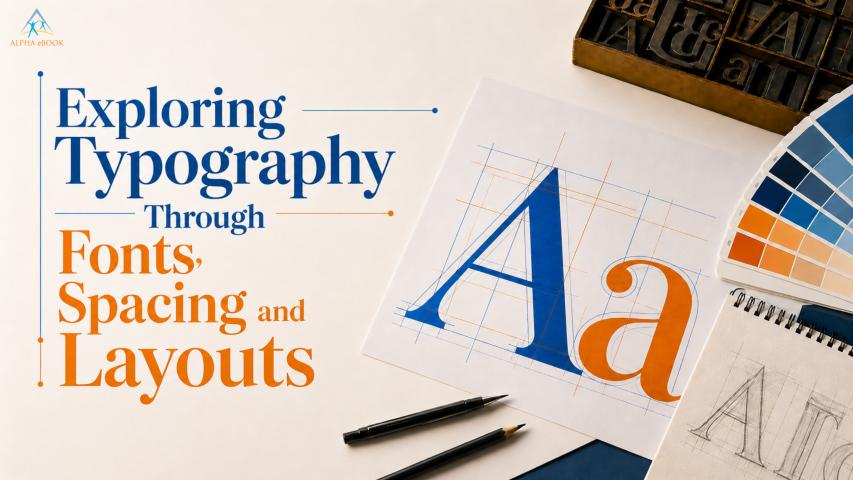
Branding still matters. A clean logo, readable typography and consistent business identity can make an invoice look more professional.
However, design should never reduce the space required for actual billing.
A large header or oversized logo may look attractive on a screen but leave employees with too little space to write customer names, descriptions or amounts.
The strongest bill book layouts usually make frequently used information easy to locate, write and read.
Final Thoughts
The best bill book is not necessarily the biggest, most colourful or most elaborate option.
It is the format that fits the business's real billing workflow.
Before placing a bill book printing order, test the layout with an actual sample transaction. Check whether there is enough writing space, whether the required number of copies is correct and whether every important business detail has been verified.
Making these decisions before production can help reduce avoidable reprints and create a bill book that employees can comfortably use in everyday business.