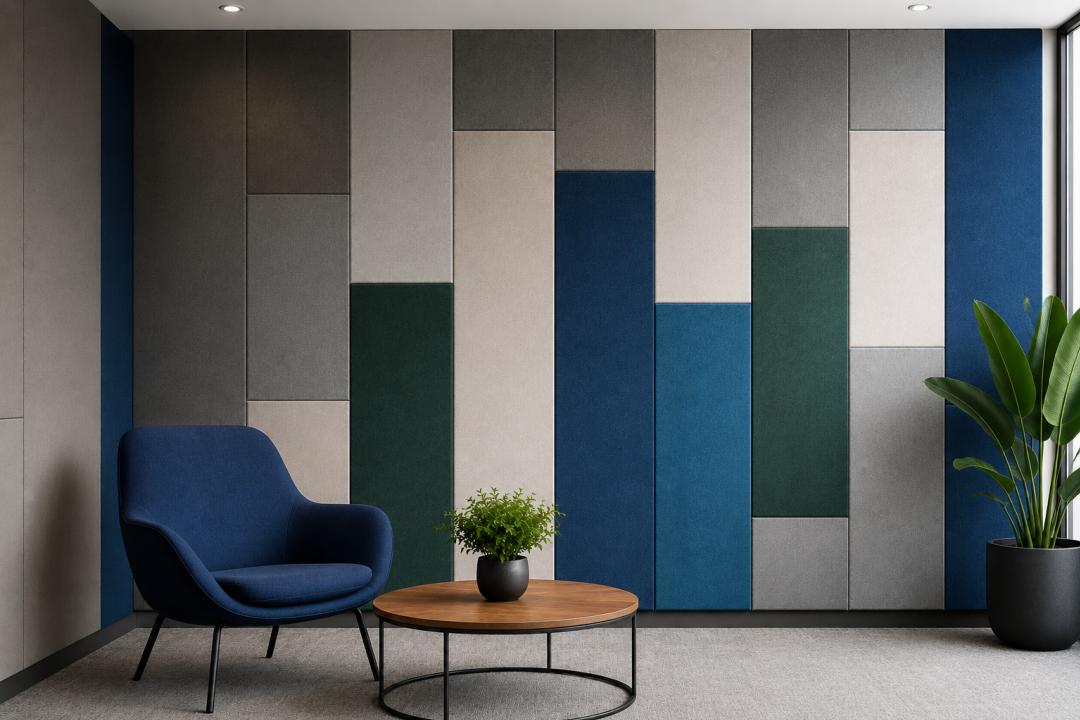
Quick Summary: Cut-out patterns on acoustic PET panels aren't just decorative. They control how much sound actually gets absorbed. Go too sparse, and the panel looks great but underperforms. Go too aggressive, and you weaken the structure. Most PET acoustic panels hold their acoustic performance well between 15 and 35 percent open area, depending on thickness and design intent.
Introduction
Acoustic panels have come a long way from plain grey foam squares. Now you see them cut into geometric shapes, waves, hexagons, all sorts of patterns that actually look like part of the design instead of an afterthought. A lot of this shift happened because of PET polyester acoustic panels.
They're made from recycled plastic bottles, pressed into dense felt like boards, and they take cutting really well. Laser cutters and CNC machines can carve almost any shape into them without falling apart. That opened up a whole new world for designers.
But here's the catch nobody talks about enough. Every cut you make changes how the panel performs acoustically. Cut too little, and you lose the visual appeal people want. Cut too much, and the panel stops doing its actual job. So where's the sweet spot?
Why Cut-outs Affect Sound Absorption
A solid, uncut PET panel absorbs sound purely through its felt like structure. Sound waves enter the material, get trapped in tiny fiber gaps, and lose energy through friction. That's the basic mechanism behind most acoustic PET panels.
Cut-outs change this in two ways. First, they remove material, which means less surface area to trap sound. Second, and this part surprises people, cut-outs can actually help absorption in certain designs by creating more edges and depth variation for sound waves to interact with.
It's a balancing act. A few well placed cuts can add texture without hurting performance much. Too many, spaced too widely apart, and you start losing the density needed to actually absorb anything meaningful.
The Role of Open Area Percentage
Open area percentage refers to how much of the panel's surface is actually cut away versus solid material. This number matters more than the shape of the cuts themselves.
Testing across various polyester acoustic board products shows a fairly consistent pattern. Panels with 15 to 35 percent open area tend to hold onto most of their original absorption rating. Below that range, performance stays close to a solid panel, since there's barely any material removed. Above 35 percent, absorption starts dropping noticeably because there simply isn't enough felt left to trap sound properly.
This range isn't fixed in stone. It shifts a bit depending on panel thickness, density, and how the cuts are distributed across the surface.
Thickness Changes the Equation
Thicker PET acoustic panels can handle a higher cut-out percentage before performance drops off. That's because there's more material depth to compensate for what gets removed. A 24mm panel with 30 percent open area might still perform close to a solid 12mm panel, simply because there's more mass doing the absorbing.
Thin panels are more sensitive. Even a moderate cut-out percentage can noticeably reduce how well a thin board absorbs sound, since there wasn't much material to begin with. If you're working with thinner acoustic PET panels and want intricate patterns, it's worth compensating with denser material or adding a backing layer.
Pattern Distribution Matters too
It's not just about how much you cut, but where you cut it. Evenly spaced, smaller cut-outs tend to preserve performance better than a few large, concentrated openings. Large gaps create weak spots where sound just passes straight through without interacting with the material much.
Designers working with PET polyester acoustic panels often spread smaller perforations or shapes across the whole surface instead of clustering intricate patterns in one section. This keeps absorption fairly consistent across the entire panel rather than having strong and weak zones.
Symmetrical, repeating patterns also tend to perform more predictably. Random or highly irregular cuts can create unpredictable dead spots that are harder to test and account for during design.
Read to know more about PET acoustic panels here: The Future of Acoustic Comfort with Polyester Fibre Acoustic Panel Innovations
Structural Strength also Takes a Hit
Performance isn't the only thing at risk with aggressive cutting. Structural integrity matters too, especially for panels being mounted vertically or used in high-traffic areas.
Push past 40 percent open area on most polyester acoustic board products, and the panel starts becoming fragile. Edges can chip, corners can bend, and the whole thing becomes harder to handle during installation. This is a practical concern as much as an acoustic one.
Manufacturers usually test their products at various cut percentages before finalizing designs, balancing how a pattern looks against how well it holds up structurally and acoustically over years of use.
Finding the Sweet Spot for Your Space
If you want intricate, eye catching patterns, staying closer to the 15 to 20 percent range keeps performance strong while still giving you a distinctive look. This works well for offices, retail spaces, or hospitality projects where design matters just as much as function.
For spaces where sound control is the priority, like studios or conference rooms, sticking under 15 percent open area, or skipping cut-outs entirely, gives you the best absorption. Simpler surface textures or subtle grooves can still add visual interest without sacrificing much performance.
Somewhere between those two priorities, the 20 to 35 percent range works as a reasonable middle ground. You get a noticeable pattern without gutting the panel's core function.
Where PET Acoustic Panels Get Used
Offices: Balancing branding, design, and noise control in open layouts.
Restaurants and hospitality spaces: Where pattern and texture add to the atmosphere.
Auditoriums and conference rooms: Where absorption performance takes priority over intricate design.
Retail stores: Using cut patterns as part of the overall visual identity.
Schools and libraries: Managing noise while keeping a warm, approachable look.
Each setting calls for a different balance between design and function, but the underlying math around cut percentage stays roughly the same.
Getting it Right before You Order
Choosing a cut-out percentage isn't something to guess on. Acoustic PET panels can look stunning with intricate patterns, but pushing the design too far quietly ruins the exact thing you bought them for in the first place. Understanding how open area, thickness, and pattern distribution interact helps you get a panel that looks good and actually works.
Before finalizing any design, it's worth asking for absorption data at the specific cut percentage you're considering, not just the rating for a solid panel. Numbers change once material gets removed, and assuming otherwise leads to disappointing results after installation.
Ready to Design Panels that Actually Perform?
Talk to Tranquil Global about acoustic PET panels engineered to balance design and performance. From PET acoustic panels to custom polyester acoustic board patterns, get something that looks sharp and sounds even better.
FAQs
1. What cut-out percentage is safest for acoustic PET panels?
Generally, staying between 15 and 35 percent open area preserves most of the original absorption performance without weakening the panel.
2. Do thicker panels allow for more aggressive cutting?
Yes. Thicker PET acoustic panels can handle a higher cut-out percentage since there's more material depth to compensate for what's removed.
3. Does cut-out pattern shape affect sound absorption?
It can. Evenly distributed smaller cuts tend to perform more consistently than a few large, concentrated openings.
4. At what point does cutting affect structural strength?
Past around 40 percent open area, most polyester acoustic board products start becoming fragile and harder to handle during installation.
5. Can I get intricate designs without losing performance?
Yes, if you stay within the 15 to 20 percent range or compensate with a thicker or denser panel underneath the design.
6. Should I always ask for absorption data before ordering custom panels?
Yes. Ratings for solid panels don't apply once cuts are added, so it's important to request performance data for your specific pattern and percentage.