Key Takeaways
- Dubai routes almost every commercial shoot through one authority, the Dubai Film and TV Commission, while Saudi Arabia splits approval across GCAM, the Saudi Film Commission, and GACA for drones.
- Both markets require a locally registered production partner before an international crew can apply. Neither accepts a direct application from a foreign production company.
- Dubai approvals typically clear in 2 to 5 working days for standard shoots. Saudi Arabia runs longer, often 1 to 3 weeks, with 4 to 6 weeks recommended for anything involving heritage sites, drones, or multiple cities.
- Drone filming needs separate clearance in both countries. Dubai requires GCAA and ITC approval on top of the DFTC permit. Saudi Arabia requires GACA approval on top of GCAM.
- Private property filming in Dubai often needs a direct NOC from the landowner, including specific approvals for areas managed by Emaar, Nakheel, or DIFC. Saudi Arabia treats private location filming as a separate permit category with its own paperwork.
- Producers who plan the market decision around permit speed alone miss the bigger cost driver: how many separate approvals a project actually needs once location, drone, and crew nationality are factored in.
Introduction
Most producers pick a filming market based on the skyline. They should be picking it based on the paperwork.
This article is for production managers, brand marketing teams, and international crews comparing Dubai and Saudi Arabia for an upcoming shoot, and trying to work out which permit process will actually cost them less time on the calendar.
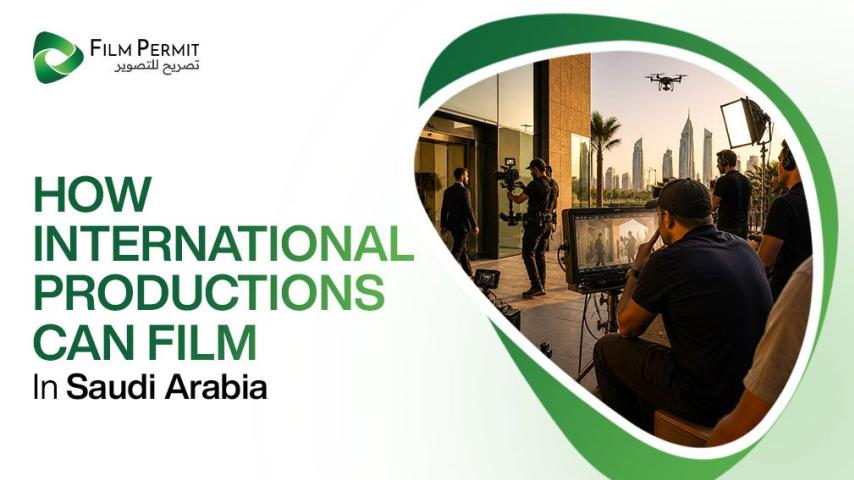
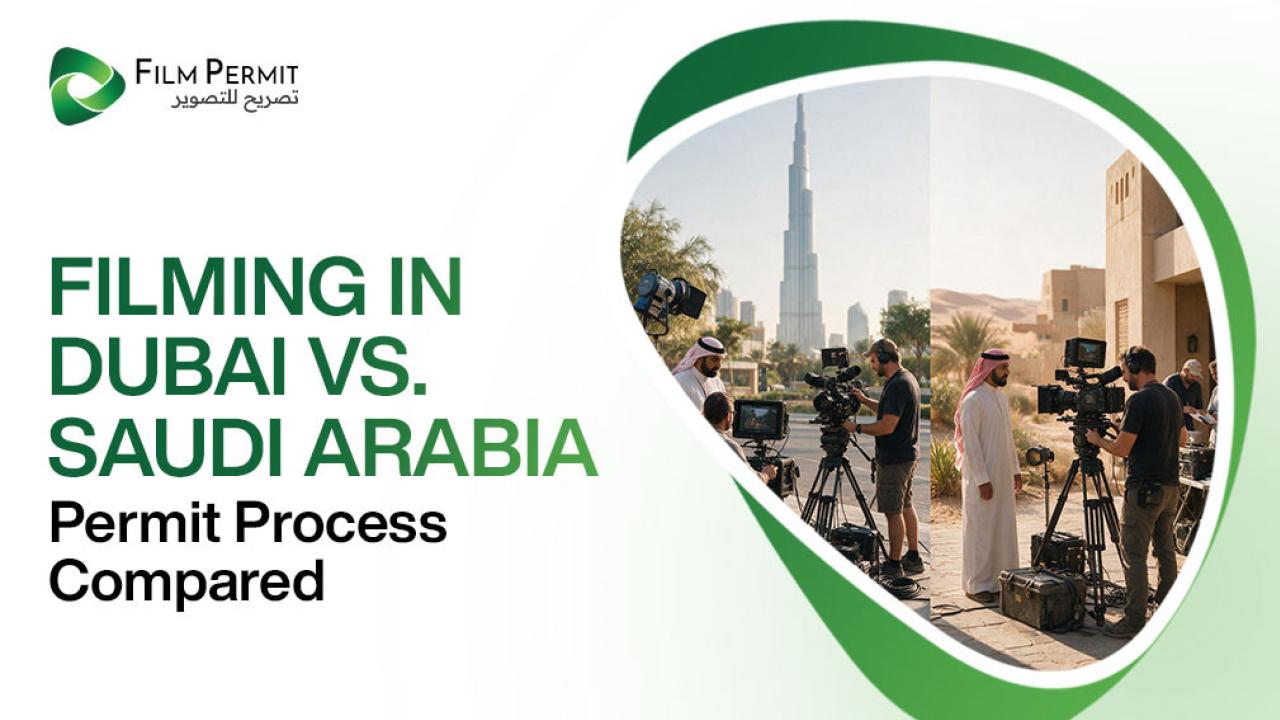
The short answer is that Dubai is generally faster for a single-location commercial shoot because one authority, the Dubai Film and TV Commission, coordinates most of the approval chain.
Saudi Arabia is generally slower on paper because filming sits across the General Commission for Audiovisual Media, the Saudi Film Commission, and, for aerial work, the General Authority of Civil Aviation. That said, complexity closes the gap fast.
The moment a production needs a drone, a private estate, or a multi-city schedule, both countries require the same number of separate approvals, and the "faster" market advantage narrows to a few days.
The Real Difference Is Not Speed, It Is How Many Doors You Have to Knock On
Producers usually ask the wrong first question. They ask which country approves permits faster, when the question that actually predicts a shoot schedule is how many separate authorities the project needs to satisfy.
Dubai built a hub-and-spoke model. The Dubai Film and TV Commission acts as the entry point for almost every commercial production, and from there the DFTC either issues the approval directly or routes the request to the Roads and Transport Authority, the Municipality, or a private landowner. A crew filming a straightforward brand video on a public street in Dubai deals with one primary authority and possibly one secondary approval.
The rule in Dubai is simple on paper: every commercial shoot in a public space needs at least one permit. What catches producers off guard is how fast that number climbs once a drone or a private landmark enters the shot list.
Saudi Arabia distributes authority across three separate bodies, and none of them fully substitutes for the other two:
- GCAM (General Commission for Audiovisual Media) handles script and content review for commercial productions.
- The Saudi Film Commission coordinates location access and production support.
- GACA (General Authority of Civil Aviation) governs anything in the air.
This means a Saudi shoot that involves aerial footage is, by definition, a three-authority process before a single private location gets added to the list.
Neither structure is inherently worse. Dubai's model moves faster when the shoot is simple. Saudi Arabia's model reflects a market that opened to commercial filmmaking more recently and is still consolidating its permit pathways under Vision 2030. Understanding which structure applies to your specific shoot matters more than knowing which country has the shorter average approval time.
That structural difference is also why a permit timeline you found for one project rarely transfers to the next one, even in the same city.
What Dubai Requires Before You Can Even Apply
The first surprise for most international teams is that they cannot apply directly.
Only a UAE-based production company registered with the Dubai Film and TV Commission can submit a filming application. International productions, agencies, and brands need to commission a local production partner before the process starts, not after location scouting wraps.
Once that partner is in place, the standard application requires:
- A completed project form with production details
- Passport and visa copies for every crew member
- A script or shoot synopsis
- Confirmed location and date details
- An equipment list for customs purposes, if gear is entering the country
Standard DFTC approvals for public and government-adjacent locations typically clear in 2 to 3 working days once documentation is complete, with some sources citing up to 5 working days depending on the season and the location's sensitivity.
Private venues run on a separate track entirely:
- Malls, hotels, restaurants, and residential properties require a direct no-objection certificate negotiated with the property owner, alongside the government approval rather than instead of it.
- Properties managed by Emaar or Nakheel add their own NOC requirement on top of the standard DFTC and landowner approvals.
- The Dubai International Financial Centre operates as a fully separate jurisdiction with its own authority to satisfy.
The practical effect: a brand shoot at a public beach in Dubai can be a two-day approval. The same brand shoot with a scene inside Dubai Mall and a rooftop drone shot can stretch to two weeks once Emaar's NOC, the mall's internal booking process, and GCAA drone clearance are all factored in.
Speed in Dubai is real, but it is conditional on the shot list staying simple.
What Saudi Arabia Requires Before You Can Even Apply
Saudi Arabia asks for the same starting commitment as Dubai: a locally registered partner before an international crew can move forward.
International productions work through a locally registered company in the Kingdom, which then submits documentation to GCAM for content and script approval and coordinates with the Saudi Film Commission for location access. Required paperwork mirrors Dubai's list in substance:
- Passport copies for every international crew member
- Iqama or visa documentation proving legal work status
- A script or production brief
- A full crew list with nationalities and roles
- An equipment inventory for customs clearance through ATA Carnet or temporary import documentation
GCAM script approval also checks content against local cultural guidelines before location permits move forward.
Where Saudi Arabia diverges from Dubai is timeline and location categorization:
- Straightforward commercial permits often move in one to two weeks.
- Productions involving heritage zones, government-adjacent sites, or multiple cities are commonly advised to apply four to six weeks ahead, since Arabic-translated documentation and additional municipal sign-off can extend the process past the initial GCAM review.
- Private location filming, covering villas, desert camps, and privately owned commercial property, runs as its own permit category with separate negotiation and paperwork from the public location permit, similar in structure to Dubai's landowner NOC requirement but processed through a different set of local contacts.
Cost also scales with these same variables: location type and production scale.
Equipment customs clearance is a second point worth planning around. Cameras, lighting, and especially drones must clear Saudi customs with proper declarations before a shoot day can begin, and this runs in parallel with the permit application rather than after it. Productions that ship gear without pre-clearing it commonly lose days waiting at the airport while the permit itself sits fully approved.
The timeline difference between the two countries is real, but it is closer than most producers assume once a project needs more than one location type.
Dubai vs. Saudi Arabia Filming Permits, Side by Side
Reading two separate country guides rarely answers the question a producer actually has, which is what changes when the same project moves from one market to the other.
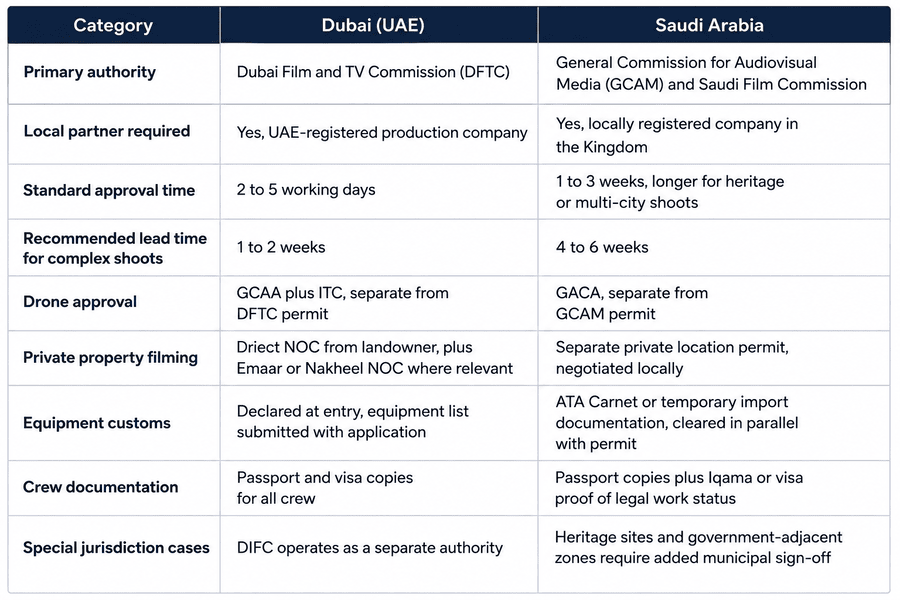
The table makes one thing obvious that individual country guides tend to bury: both markets converge on nearly identical complexity once drones, private property, and international crew are all in play. The gap that looks large on paper for a basic shoot mostly disappears for a real commercial production.
Drone Filming: The Step Both Countries Treat as a Separate Project
Aerial footage is where producers in both countries lose the most time, and it happens for the same underlying reason.
Neither the DFTC permit in Dubai nor the GCAM permit in Saudi Arabia covers airspace:
- Dubai requires separate sign-off from the General Civil Aviation Authority and, depending on the location, the Telecommunications and Digital Government Regulatory Authority. A single drone shoot can need two to four total approvals once the ground permit is included.
- Saudi Arabia requires GACA clearance on top of the GCAM permit. GACA reviews pilot certification, drone registration, and a specific flight plan for each location rather than issuing a blanket aerial approval for the whole production.
"Producers plan the ground permit and treat the drone as an add-on. In both countries, the drone approval is its own application, its own timeline, and often the reason a shoot date moves."
Both countries restrict the same categories of airspace:
- Government buildings and military zones
- Religious sites
- Areas near airports
Flying without the correct permit carries real consequences in both markets, including confiscation of the drone, fines, and in repeat cases, a block on future filming applications.
If your production genuinely needs aerial coverage, treat the drone permit as its own project with its own deadline, not a line item inside the main filming application.
How to Decide Which Market Fits Your Production
The choice between Dubai and Saudi Arabia rarely comes down to which country is easier. It comes down to which country's structure matches the shoot you are actually planning.
- Choose Dubai when: the production is a single-location commercial shoot, the timeline is tight, and the visual you need already exists in the city's built environment: skyline, malls, hotels, or beachfront. The one-authority model rewards simple, well-defined shot lists with genuinely fast turnaround.
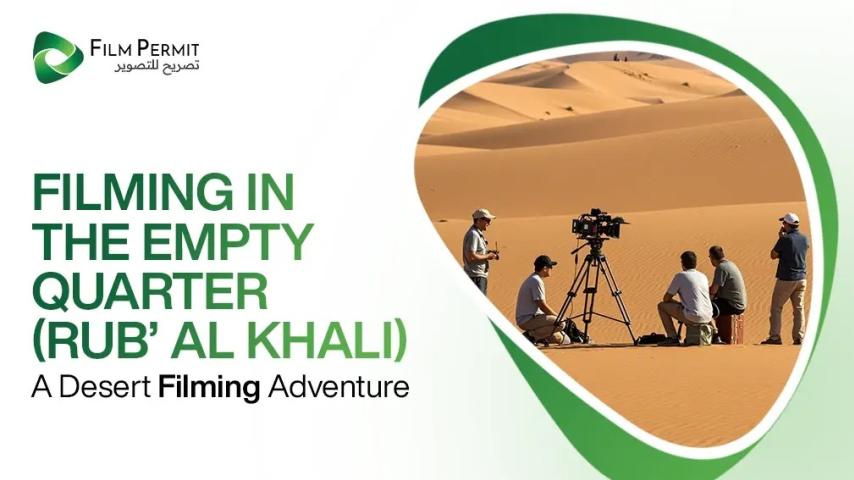
- Choose Saudi Arabia when: the shoot needs landscapes and locations that do not exist anywhere else in the Gulf, such as AlUla's canyons, the Empty Quarter, NEOM, or heritage sites with centuries of history attached. Accept the longer lead time as the cost of a visual no other regional market can offer, and build the schedule around four to six weeks rather than trying to compress it.
- Run multi-country productions when: the brief genuinely needs both. A growing number of UK production teams shoot the urban sequence in Dubai and the landscape sequence in Saudi Arabia within the same production window, which only works when both permit applications start on day one instead of sequentially.
Most international productions that miss this window run into the same avoidable mistakes.
Working with a local partner who manages the entire chain, permits, drone clearance, equipment customs, and crew coordination- closes most of the gap between the two markets regardless of which one you choose. Saudi Film Permit handles that full chain for productions filming in the Kingdom, from GCAM and GACA approvals through to private location access and airport customs clearance for gear.
If your next production is weighing Saudi Arabia against Dubai, talk to our production team before you lock the schedule. Getting the permit timeline right at the brief stage saves more days than any amount of on-set problem-solving later.
Conclusion
The country with the better skyline is not always the country with the better shoot. The one that fits your permit reality is.
Producers who plan around actual authority requirements, not general reputation, are the ones who keep their shoot dates. The rest find out the difference on day one of pre-production, when it is far more expensive to fix.
If you are still scoping the project, our team can map both permit paths against your specific shot list before you commit to either market.