Urine testing is a routine part of many healthcare assessments. From checking for possible urinary tract infections (UTIs) to identifying changes in substances such as protein, glucose or blood, a urine sample can provide useful information about a person's health.
Two common approaches are urine test strips and laboratory urine testing. While both can be used to assess urine, they serve different purposes and provide different levels of information.
Understanding the difference can help healthcare professionals choose the most appropriate approach for the situation.
What Are Urine Test Strips?
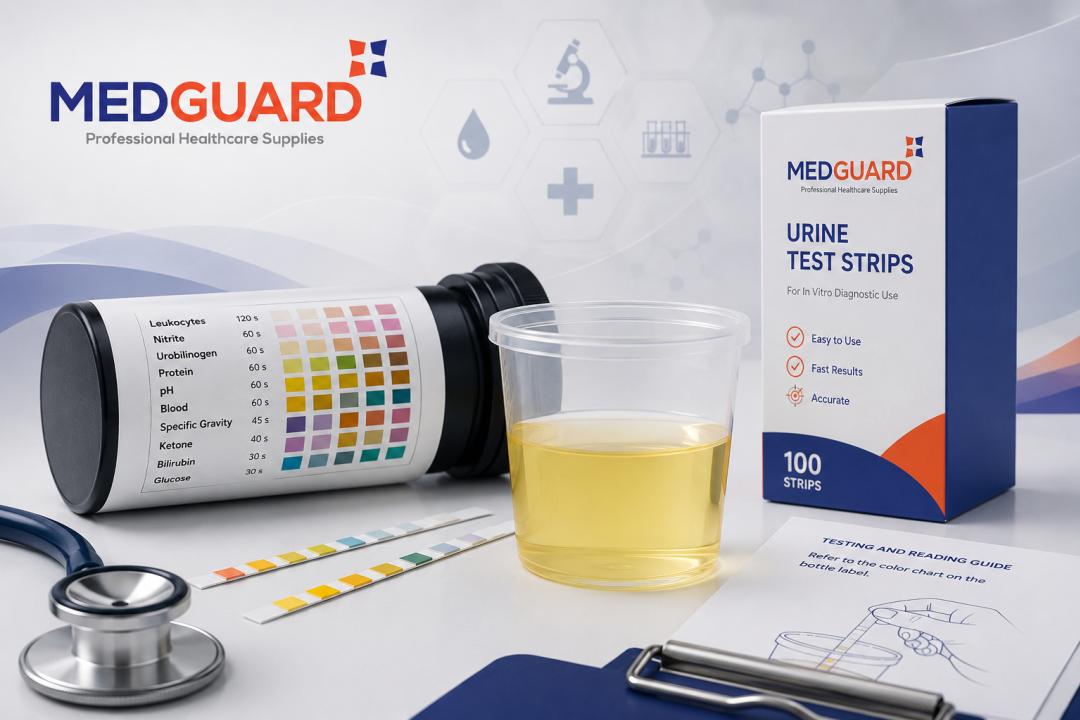
Urine test strips, also known as urine dipsticks, are small strips containing chemical reagent pads. When immersed in a urine sample, the pads react with specific substances and change colour.
Depending on the product, a single urine test strip may check several parameters, including:
- Leukocytes
- Nitrites
- Blood
- Protein
- Glucose
- Ketones
- pH
- Specific gravity
- Bilirubin
- Urobilinogen
The results can generally be read within minutes by comparing the colour of each reagent pad with the manufacturer's reference chart.
This makes urine test strips particularly useful when healthcare professionals need quick initial information without sending a sample to a laboratory.
What Is Laboratory Urine Testing?
Laboratory urine testing involves sending a urine sample to a laboratory for more detailed examination. Depending on the test requested, laboratory analysis may include chemical testing, microscopic examination or microbiological testing.
For example, when a urine culture is required, the sample can be analysed to determine whether bacteria grow and, where appropriate, provide information that can help guide treatment decisions.
Laboratory testing can therefore provide information that is not available from a basic urine dipstick.
Key Differences Between the Two
The main difference is the depth and purpose of testing.
| Urine Test Strips | Laboratory Urine Tests |
|---|---|
| Quick initial assessment | More detailed investigation |
| Results usually available within minutes | Results may take longer |
| Minimal equipment required | Requires laboratory facilities |
| Can test several urine parameters | Can involve specialised testing |
| Convenient for routine screening | Useful when further investigation is needed |
| Suitable for many healthcare environments | Usually requires sample collection and laboratory processing |
Neither method is automatically better in every situation. The appropriate option depends on the reason for testing and the individual's circumstances.
Urine Test Strips for Possible UTIs
Urine dipsticks are often associated with UTI assessment because they can test for leukocytes and nitrites.
Leukocytes may indicate inflammation or an immune response in the urinary tract, while nitrites can indicate the presence of certain bacteria.
However, these findings do not independently confirm a UTI. A person’s symptoms and clinical circumstances also need to be considered.
A negative nitrite result, for example, does not completely rule out infection because not all bacteria produce nitrites.
Where symptoms are persistent, unusual or concerning, further clinical assessment may be appropriate.
When Might Laboratory Testing Be Useful?
Laboratory testing can be useful when a more detailed investigation is needed.
For example, a healthcare professional may consider laboratory analysis when:
- Symptoms are persistent or unclear.
- Initial urine testing does not provide enough information.
- A more detailed assessment is required.
- There is concern about a complicated infection.
- The healthcare professional needs additional information to guide clinical management.
A laboratory urine culture, in particular, can provide information that a standard dipstick cannot.
Advantages of Urine Test Strips
The main benefit of urine test strips is convenience.
They are easy to store and use, require little equipment and can provide multiple results from a single urine sample. This makes them practical in GP practices, community healthcare, nursing homes and other care environments.
They can also help healthcare professionals identify whether further assessment may be warranted without automatically requiring every sample to undergo extensive laboratory testing.
However, correct technique is essential. Test strips should be stored according to the manufacturer's instructions, used before their expiry date and interpreted at the correct time.
Advantages of Laboratory Urine Testing
Laboratory testing offers greater depth. Depending on the investigation, a laboratory can examine urine using methods that provide information beyond the capabilities of a standard dipstick.
This can be particularly valuable when a healthcare professional needs more specific information or when the initial findings and symptoms do not provide a clear picture.
The trade-off is that laboratory testing generally involves additional handling, specialist equipment and more time before results become available.
Can They Be Used Together?
Yes. Urine test strips and laboratory testing do not necessarily compete with each other.
A urine dipstick may provide quick initial information, while laboratory testing can be used when further investigation is considered appropriate.
This approach can be useful because it combines the convenience of point-of-care screening with the additional information available through laboratory analysis.
Choosing the Right Approach in Irish Healthcare Settings
For healthcare professionals across Ireland, the choice between urine test strips and laboratory testing should be guided by the clinical situation rather than convenience alone.
Urine test strips can be valuable for rapid initial assessment, while laboratory testing may be appropriate when more detailed information is required.
In nursing homes, GP practices and community care environments, having reliable urine testing supplies available can support efficient initial assessment and help healthcare professionals identify when additional investigation may be needed.
Medguard Healthcare provides a range of medical and healthcare supplies for healthcare professionals and care environments across Ireland.
Final Thoughts
The key difference between urine test strips and laboratory urine tests is the type and depth of information they provide.
Urine test strips are fast, convenient and suitable for initial screening of several urine parameters. Laboratory testing takes longer but can provide more detailed information when further investigation is required.
Rather than viewing one as a replacement for the other, healthcare professionals can use each method according to the needs of the individual situation. Correct testing technique, appropriate clinical interpretation and professional judgement remain essential whichever approach is used.