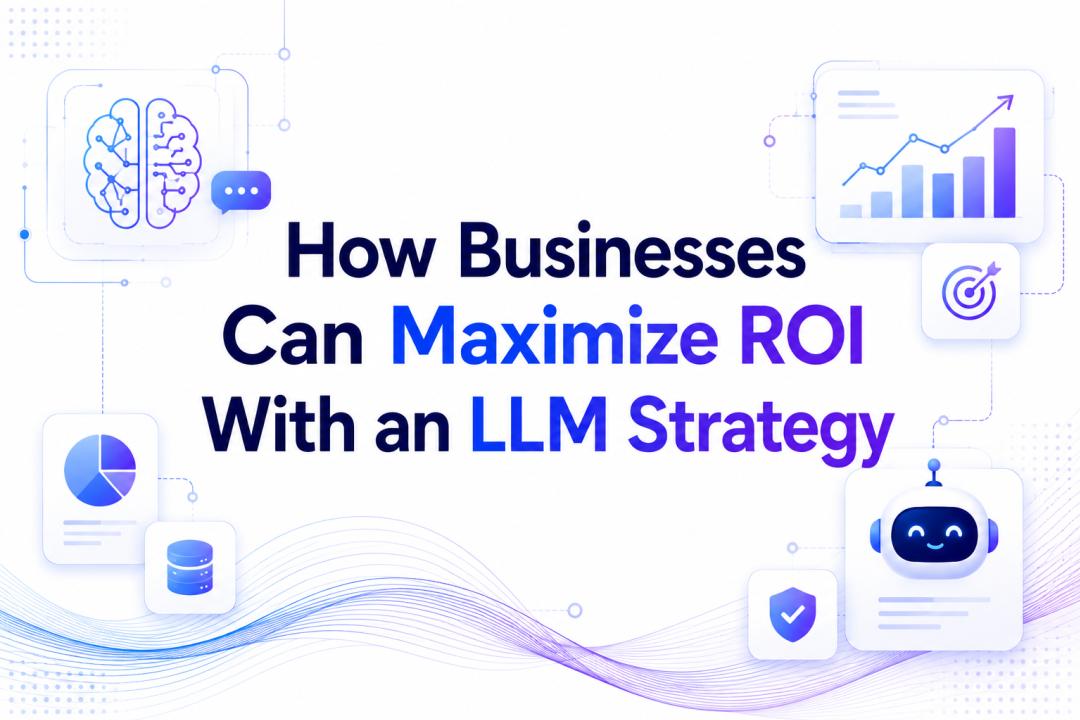
Large language models (LLMs) are increasingly proving their worth in the business world for automating tasks, enhancing customer experiences, and aiding decision-making. But just taking an LLM isn't necessarily a good investment of time. For businesses, there should be a clear LLM strategy aligned with measurable business goals, operational requirements, and future growth.
Start With Clear Business Objectives
The backbone of a successful LLM strategy is to understand what the business would like to accomplish. Companies should not just take an LLM because it is a recent technology, but seek out particular issues where it can make an identifiable contribution.
Common objectives include:
Cutting down on repetitive physical tasks
Improving customer support response times
Increasing employee productivity
Lowering operational costs
Enhancing content and knowledge workflows
Having clear goals helps identify the appropriate use cases and determine if an LLM investment is working. Many organizations partner with providers of large language model development services to help translate these goals into a workable strategy.
Identify High-Value LLM Use Cases
Not all business processes require an LLM. Workflows that can achieve real efficiency or revenue benefit with language-based AI are prime candidates for it.
An LLM might, for instance, be utilized in the area of customer support to describe discussions, create answers, and look up relevant details. Internal groups can utilize it to examine records, produce reports, summarize conferences, or look for information in huge knowledge bases.
By beginning with high-impact use cases, businesses can show value before rolling out the LLM strategy throughout the company.
Choose the Right LLM for the Workload
Each LLM comes with a unique set of features, including speed, context length, and specialization, as well as pricing and performance. Do not select a model based on popularity.
The evaluation should take into account:
The accuracy of the response and/or the quality of the response
API and infrastructure costs
Latency requirements
The protection of data privacy and security
Integration capabilities
Scalability
There are options available to create a smaller model if it is only required to perform simple classification or summarization, or a more powerful model if a more complex reasoning process is needed. When matching the model capabilities to the workload requirements, this will help keep unnecessary spending in check. Businesses without in-house expertise often work with an experienced AI development services provider to evaluate and select the right model.
Connect LLMs to Business Data
But use of an LLM is far more valuable when it can access business information that is accurate and relevant. AI outputs can be more useful and contextual when connected to internal knowledge bases, databases, and documents, or to enterprise systems.
Retrieval-augmented generation (RAG) is one of the techniques that can enable an LLM to access relevant information prior to generating an answer. This can enhance accuracy and decrease the need for stale knowledge in the model.
It is also critical for businesses to have robust data governance in place to ensure that sensitive data is appropriately safeguarded.
Control Costs From the Beginning
As usage rises, so do LLM costs. Cost management should thus be included in the strategy from the outset, not as an add-on.
For companies, increasing cost efficiency can be achieved through:
Utilizing smaller models for simpler tasks
Keeping unnecessary prompts and outputs to a minimum
Caching often-used data to optimize for frequent requests
Monitoring token consumption
Distributing workloads by complexity
By monitoring cost per task, user, or business outcome, it becomes easier to determine the financial viability of AI projects.
Measure ROI With the Right Metrics
The value of LLM ROI isn't just about counting the number of employees or customers adopting an AI application. Businesses require metrics that establish the link between AI usage and financial and operational returns.
Some helpful metrics are: decreased processing time, decreased support costs, increased employee productivity, improved conversion rates, and customer satisfaction.
In the case of an AI assistant that cuts down on average time spent on support by 30%, the organization can estimate the productivity or cost savings gained and then compare that with the investment and operational costs of implementing and utilizing the AI solution.
Build for Security and Scalability
Security, compliance, and future growth are all crucial factors to consider in an effective LLM strategy. Policies should be created for access to data, permissions for users, prompt handling, monitoring, and model usage.
Scalable architecture is also a crucial aspect to consider. With growing adoption, AI systems might face the need to serve a larger user base, integrations, and workloads without causing significant latency or cost. Organizations scaling these systems frequently rely on a trusted artificial intelligence development services partner to manage security, compliance, and growth.
It is also crucial that human oversight be part of critical workflows where AI-generated information might be incorrect, leading to substantial risks for the business.
Continuously Optimize the LLM Strategy
An LLM strategy must not be static, as LLM technology and business needs are constantly changing. Regularly review model performance, user feedback, costs, and business outcomes.
Optimizations like testing a new model, enhancing prompts, tweaking RAG pipelines, updating knowledge sources, and removing low-value use cases can be done continuously.
In conclusion, the key to LLM ROI is to view AI as a business asset and not just a technology product. Businesses that embed LLM use into specific, measurable objectives, ethical data handling, budgetary management, and ongoing optimization have the potential to leverage LLM investments for lasting business value.