Market Overview
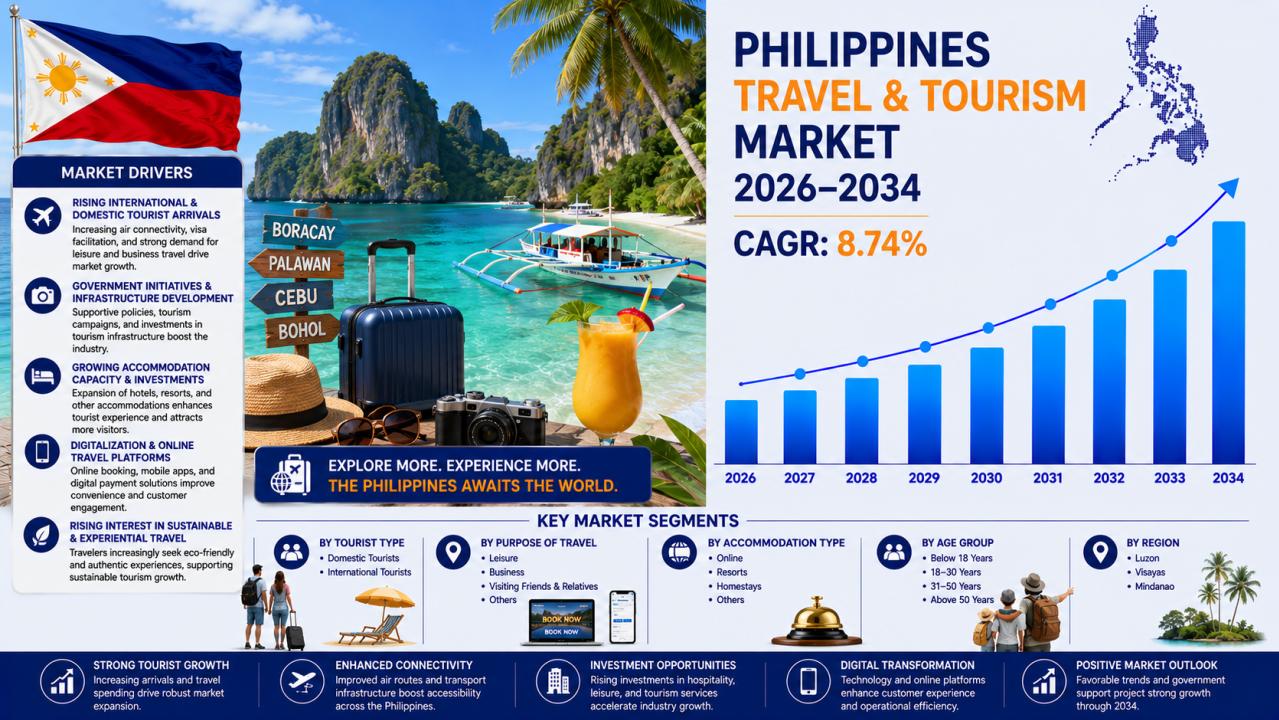
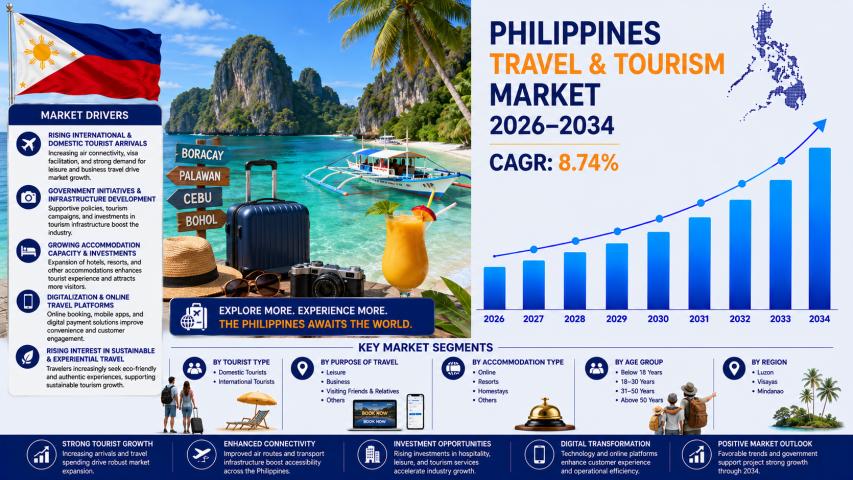
The Philippines travel & tourism market size
reached USD 47.6 Billion in 2025 and is projected to
reach USD 104.3 Billion by 2034, growing at a compound annual
growth rate (CAGR) of 8.83% during 2026-2034. The market is
growing rapidly due to the cultural diversity and natural heritage, strategic
government initiatives, and the rise of eco-tourism and adventure travel in the
Philippines.
Request a Sample Report for In-Depth Market Insights: https://www.imarcgroup.com/philippines-travel-tourism-market/requestsample
Philippines Travel & Tourism Market Summary
- The
Philippines travel & tourism market encompasses a range of types
(domestic, inbound, outbound), service offerings (ticket reservation,
hotel booking, holiday/tour packages), purposes of visit (business,
leisure, education, medical, social), and booking types (travel companies,
travel agencies, online), serving diverse traveler needs.
- These
services are valued for their role in facilitating travel, promoting
cultural exchange, supporting economic growth, and showcasing the
Philippines' rich natural and cultural heritage.
- The
ecosystem includes tourism boards, airlines, hotels, tour operators,
travel agencies, online booking platforms, and travelers.
- Major
segments identified in the market include type (domestic, inbound,
outbound), service offering (ticket reservation, hotel booking,
holiday/tour packages, others), purpose of visit (business, leisure and
recreation, education, medical, social activity, others), booking type
(travel companies, travel agencies, online, others), and region (Luzon,
Visayas, Mindanao).
- The
market is benefiting from rich cultural and natural heritage, strategic
government initiatives, and the rise of eco-tourism and adventure travel.
- The
competitive landscape features a mix of international and local travel
companies, airlines, and online booking platforms, with increasing focus
on digitalization, sustainable tourism, and niche travel experiences.
PORTER'S FIVE FORCES ANALYSIS
- Competitive
Rivalry: High. The market includes international and local travel
companies, airlines, and online platforms competing on price, destination,
and service. Differentiation through unique experiences is key. Business
implication: Companies must invest in niche offerings and
customer experience.
- Supplier
Power: Moderate. Suppliers of airline seats, hotel rooms, and
transport have leverage, but the presence of multiple options and online
aggregators moderates this power. Business implication: Build
strong partnerships and diversify offerings.
- Buyer
Power: High. Travelers have extensive choice and price
transparency through online platforms, with low switching costs. Business
implication: Focus on value, personalization, and loyalty.
- Threat
of Substitutes: Moderate. Alternative travel destinations and
staycation options compete, but the country's unique attractions support
its position. Business implication: Emphasize unique
cultural, ecological, and experiential offerings.
- Threat of New Entrants: Moderate. Online travel agencies and niche tour operators can enter relatively easily, but high barriers exist for infrastructure-heavy segments. Business implication: Build brand and distribution advantages.
MARKET GROWTH DRIVERS
Rich Cultural and Natural Heritage
The Philippines
travel & tourism market possesses a unique culture and is naturally
endowed that never stop deceiving tourists. Such is seen with the Philippines
emerging rapidly as the cruise tourism hub in Asia, with 80,000 cruise
passengers recorded in 2023 alone. Awards are being captured like Asia's Best Cruise
Destination-in-2023 and Best Port of Call-2024 as the country expects cruise
passengers exceeding 100,000 in 2024. The Philippine Port Authority (PPA)
modernizes facilities and adds additional cruise-specific ports in Manila,
Bohol, Palawan, and Boracay. Additionally, its vibrant cultural festivals,
including the Sinulog and Ati-Atihan, highlight the country's rich traditions
and draw both domestic and international visitors. These features make the
Philippines a highly appealing destination for leisure travelers.
Strategic Government Initiatives
The government plays a pivotal role in bolstering the
tourism market through strategic investments and policy frameworks. Programs
such as the "It's More Fun in the Philippines" campaign have
successfully boosted the country's global visibility. Infrastructure
development projects, including improvements to airports and roads, enhance
accessibility to key destinations. In 2024, the Civil Aviation Authority of the
Philippines expanded Laguindingan Airport's terminal, boosting passenger
capacity by 72%. Additionally, the government provides incentives to private
sector stakeholders, encouraging investment in tourism-related ventures. These
initiatives align with the National Tourism Development Plan, which focuses on
sustainable tourism growth, employment generation, and economic development.
Rise of Eco-Tourism and Adventure Travel
The increasing global demand for eco-tourism and adventure
travel significantly benefits the Philippines, given its extensive biodiversity
and range of outdoor activities. Destinations like Palawan and Bohol attract
eco-conscious travelers due to their well-preserved ecosystems. Initiatives
like the Puerto Princesa Underground River National Park promote ecotourism
while preserving delicate ecosystems. This approach positions the Philippines
as a leader in Asia's ecotourism, attracting responsible travelers who
contribute to environmental and social sustainability. Additionally, adventure
activities, such as diving, hiking, and surfing cater to niche markets seeking
active and immersive travel experiences.
PHILIPPINES TRAVEL & TOURISM MARKET SEGMENTATION
Type Insights
- Domestic
- Inbound
- Outbound
Service Offering Insights
- Ticket
Reservation
- Hotel
Booking
- Holiday/Tour
Packages
- Others
Purpose of Visit Insights
- Business
- Leisure
and Recreation
- Education
- Medical
- Social
Activity
- Others
Booking Type Insights
- Travel
Companies
- Travel
Agencies
- Online
- Others
Regional Insights
- Luzon
- Visayas
- Mindanao
COMPETITIVE LANDSCAPE
The Philippines travel & tourism market features a
competitive landscape of international and local travel companies, airlines,
and online booking platforms competing on price, destination, and service.
Market dynamics are characterized by growing demand for sustainable and experiential
travel, digital booking, and niche experiences. Competition is intensifying as
companies invest in digitalization, sustainability, and customer experience,
with differentiation through unique experiences, technology, and service.
Key players mentioned in the report context include:
- Qantas announced
the launch of direct Brisbane-Manila flights in October 2024,
complementing its Sydney-Manila route and competing with Philippine
Airlines. Operated by Airbus A330s, Qantas offers flatbed business class
seats, surpassing Philippine Airlines' older A321 configuration.
- Other
major players include international airlines, hotel chains, tour
operators, and online travel agencies.
REGIONAL ANALYSIS
- Luzon: A
key market driven by Metro Manila's concentration of economic activity,
international airports, and major tourist attractions (e.g., Intramuros,
Banaue Rice Terraces). The region leads in both inbound and domestic
tourism.
- Visayas: A
significant market supported by world-class beach destinations like
Boracay and Cebu, growing cruise tourism, and increasing eco-tourism
activities.
- Mindanao: An
emerging market with growth potential from diverse natural attractions
(e.g., Mount Apo, surfing in Siargao), cultural heritage, and improving
infrastructure.
RECENT INDUSTRY DEVELOPMENTS
August 2026: International visitor arrivals to the
Philippines reached approximately 3.7 million as of July 2026, with the
Department of Tourism attributing the increase partly to more relaxed visa
policies and improving international connectivity. The continued rise in
inbound visitors is supporting demand across hotels, airlines, tour operators,
restaurants and other tourism-related services.
August 2026: The Philippines continued strengthening
tourism ties with China, with government officials highlighting tourism as an
important channel for improving bilateral relations. Tourism cooperation,
destination promotion and stronger travel connections are being emphasized as
the country seeks to attract more Chinese visitors.
August 2026: Tourism infrastructure remained a key
priority as visitor numbers increase. Industry stakeholders emphasized the need
for world-class airports, transportation networks, accommodation facilities
and destination infrastructure to improve visitor experiences and support
sustainable tourism growth.
August 2026: Regional travel demand continued
benefiting the Philippines as an important source market for neighboring
destinations. Malaysia recorded 299,633 visitors from the Philippines
through June 2026, highlighting continued outbound travel activity among
Filipino consumers and the broader recovery of regional tourism flows.
Key Aspects Required for the Philippines Travel & Tourism Market
- Market
Performance: USD 47.6 Billion in 2025, with a projected
trajectory to USD 104.3 Billion by 2034.
- Market
Outlook: An 8.83% CAGR through 2034 indicates robust growth
across types, service offerings, and purposes of visit, driven by cultural
heritage, government initiatives, and eco-tourism.
- Growth
Drivers: Rich cultural and natural heritage; strategic government
initiatives; rise of eco-tourism and adventure travel; cruise tourism
expansion; and infrastructure development.
- Competitive
Landscape: A competitive market with international and local
players. Differentiation occurs through unique experiences,
sustainability, digitalization, and customer service.
- Value
Chain Analysis: From destination marketing and travel planning
through booking, transport, and accommodation to on-the-ground experiences
and post-trip engagement, with technology and sustainability trends
shaping market dynamics.
- Industry
Trends: Rich cultural and natural heritage; strategic government
initiatives; rise of eco-tourism and adventure travel; digital booking
platform adoption; and cruise tourism expansion.
- Strategic
Recommendations: Invest in sustainable and eco-tourism
initiatives; develop niche adventure and experiential travel packages;
enhance digital and online booking capabilities; target cruise tourism and
regional markets; leverage government infrastructure and promotional
programs; and focus on authentic cultural experiences.
Note: If you need any specific information that is not currently covered within the scope of the report, we will provide the same as a part of customization.
Speak to an analyst: https://www.imarcgroup.com/request?type=report&id=28727&flag=C
Report Format, Delivery, and Customization Details
- Report
Format Mode: PDF and Excel (Editable version in PPT/Word format
available on special request)
- Report
Delivery Mode: Online Delivery, Physical Delivery
- Report
Delivery Time: report delivered over email within 24 to 48 hours.
If requested by the client, a physical copy will be delivered within three
to ten days.
- Report
Confirmation Mode: Yes, via email
- Report
Customization Mode: Yes, via Email / Call
- Report
Table of Content: Yes
- Report
List of Figures: Yes
- Report
Methodology Mode: Yes
- Request
For Sample Report: Yes
About Us
IMARC Group is a global management consulting firm that
helps the world's most ambitious changemakers to create a lasting impact. The
company provides a comprehensive suite of market entry and expansion services.
IMARC offerings include thorough market assessment, feasibility studies,
company incorporation assistance, factory setup support, regulatory approvals
and licensing navigation, branding, marketing and sales strategies, competitive
landscape and benchmarking analyses, pricing and cost research, and procurement
research.
Contact Us
IMARC Group
134 N 4th St., Brooklyn, NY 11249, USA
Email: sales@imarcgroup.com
Tel No: (D) +91 120 433 0800
United States: +1-201-971-6302