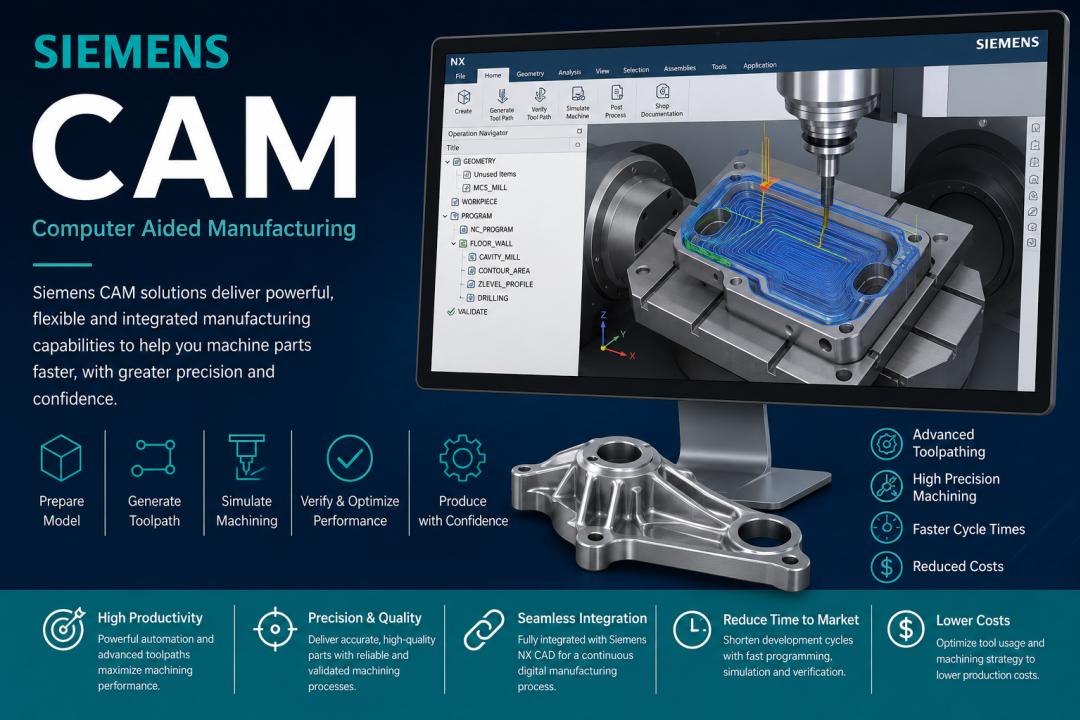
SIEMENS CAM is used by manufacturing engineers and CNC programmers to prepare machining operations, create toolpaths, simulate cutting processes, and generate NC programs. Siemens NX CAM supports a wide range of manufacturing applications, from standard milling and turning to complex multi-axis machining. It can work directly with 3D product geometry, helping teams connect design information with CNC production.
CNC Programming and Toolpath Creation
One of the main functions of SIEMENS CAM is CNC programming. Engineers can define machining operations based on component geometry, cutting tools, machine capabilities, workpiece material, and production requirements.
For example, consider a steel component requiring facing, pocketing, drilling, and contour milling. A programmer can create these operations within the manufacturing environment and generate toolpaths based on the selected cutting conditions.
Feature-based machining can reduce repetitive programming work for suitable components. Common features such as holes, pockets, and other machining elements can be recognised and associated with appropriate operations. This can be useful for manufacturers producing families of similar parts.
Process templates can also help programmers reuse established machining methods. Instead of setting up every operation from the beginning, teams can use proven processes and adjust them according to the specific component.
5-Axis Machining and Simulation
Some components cannot be machined efficiently with three-axis operations alone. Aerospace parts, moulds, dies, turbine components, and complex industrial products may require multiple tool orientations.
SIEMENS CAM supports multi-axis machining strategies, including 3+2 and simultaneous 5-axis operations. These tools allow programmers to control tool orientation while maintaining suitable cutting conditions around complex surfaces.
Machining simulation is another important part of CNC programming. Before a program is sent to the physical machine, programmers can simulate tool movements and material removal. This can help identify possible collisions, clearance problems, incorrect movements, and unsuitable machining sequences.
Virtual verification is particularly useful when working with expensive workpieces or complicated machine configurations. Finding an issue during simulation is generally preferable to discovering it after machining has started.
CAD/CAM Integration
The connection between CAD and CAM is important when product designs change frequently. Siemens NX provides an integrated environment where manufacturing teams can work from product geometry and prepare machining operations using the same design information.
If a component is modified after programming has already started, associative relationships can help identify affected manufacturing operations. The exact amount of automatic updating depends on the type of design change and manufacturing process, but maintaining a connection between design and manufacturing data can reduce manual rework.
Postprocessing is also essential because CNC machines use different controllers and configurations. SIEMENS CAM provides postprocessing capabilities for converting toolpath information into NC programs suitable for specific machines.
SIEMENS CAM for Indian Manufacturers
Indian manufacturing companies across automotive, aerospace, tooling, heavy engineering, and precision machining often work with a mix of conventional and advanced CNC equipment. CAM software needs to support the actual machines, controllers, cutting tools, materials, and production methods used by the company.
For a tooling company, the priority may be complex 3-axis and 5-axis surface machining. An automotive supplier producing repeated components may place greater importance on templates, feature recognition, and consistent programming methods.
Training also has a direct effect on CAM productivity. Programmers need to understand tool selection, feeds and speeds, machining strategies, workholding, machine limitations, and verification methods. Software features are useful only when the team knows how to apply them correctly.
Companies should therefore evaluate SIEMENS CAM using actual production components. A pilot project can show how efficiently the system handles existing CAD geometry, toolpath creation, simulation, postprocessing, and machine requirements.
C J tech provides information and guidance for Indian engineering and manufacturing companies evaluating Siemens manufacturing solutions. SIEMENS CAM can be considered by organisations looking for an integrated approach to CNC programming, machining simulation, and production preparation.
Contact C J tech to discuss SIEMENS CAM and determine how its capabilities can fit your CNC programming and manufacturing workflow.