A startup launch rarely needs one perfect video. It needs a small set of assets that can test the opening message, demonstrate the product, support a sales conversation, and keep the campaign moving after launch day. That changes the useful question behind a Seedance 2.0 vs wan 3.0 comparison. Instead of asking which model wins in general, ask which production job each workflow should handle.
The practical split is simple: use short, reference-led generations to test modular ideas, then use a longer timeline when the story must hold together as one piece. The current SeeVido interface for Seedance 2.0 shows a 5-second, 720p, 16:9 workflow with a start frame, making it a useful route to consider for compact launch clips. A longer narrative needs a different plan.
Start with one product promise, not twelve unrelated prompts
The fastest way to waste a small creative budget is to generate many clips before deciding what the campaign must prove. Every output may look polished, yet the collection can still feel like twelve different products.
Write one product promise first. It should connect a customer problem, a visible product action, and a believable result. For example:
A small ecommerce team can turn raw product information into a ready-to-review campaign brief without rebuilding the same context in every tool.
Before generation, also lock four visual decisions:
- The product shape, interface colors, and key screen or physical detail
- The main user or character, if a person appears repeatedly
- The camera direction and general lighting >
- The elements that must remain editable later, such as captions or prices
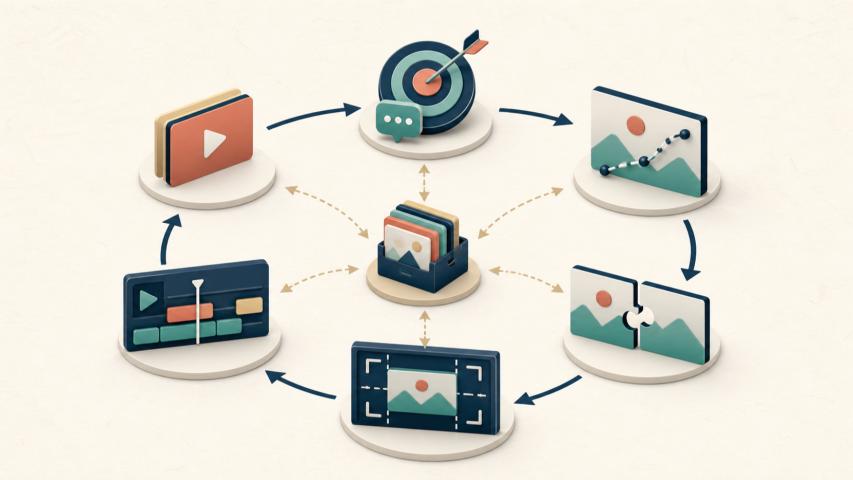
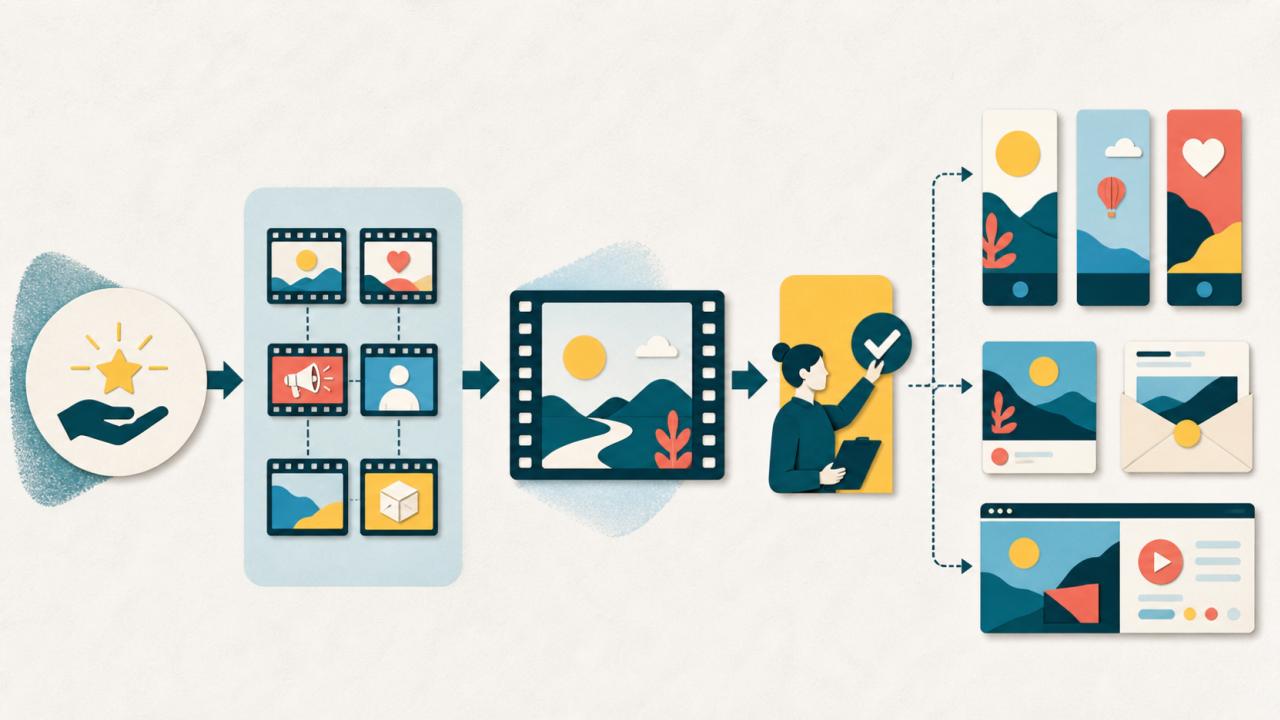
Build the 12-asset launch map before choosing a model
The asset count is a planning device, not a promise that every startup needs the same volume. Twelve is large enough to support a launch funnel and small enough for one person to review carefully.
Six modular test clips
Create three opening hooks and three proof moments.
The hooks should approach the same problem from different angles:
- A visible frustration before the product appears
- A surprising product action in the first moment
- A clean before-and-after contrast
The proof clips should show different reasons to believe:
- The product completing its core task
- A detail that reduces effort or uncertainty
- The result in a realistic customer context
These clips are deliberately narrow. If the third hook fails, the team should be able to replace it without reopening the entire launch narrative.
Three audience-specific cuts
Turn the strongest hook and proof into three short combinations:
- A founder-oriented cut focused on speed and focus
- A user-oriented cut focused on the immediate task
- A buyer-oriented cut focused on confidence and adoption
The product promise stays fixed while the order, emphasis, and closing frame change.
One narrative master and two distribution cuts
Use the approved material to create the remaining assets:
- One 30-second narrative master with a beginning, proof sequence, and close
- One vertical social cut built around the strongest opening
- One homepage or sales cut that reaches the product proof quickly
The map stops the team from spending time on attractive footage that has no role in the launch.
Use short generations to learn which creative idea deserves expansion
Short clips keep the cost of a wrong idea contained. A five-second job can isolate one action, camera move, or proof point, so a missed brief does not force the team to rewrite a complete story.
For this part of the plan, organize each job as a compact brief:
- Invariant: the product, person, and visual >
- Variable: the hook, action, framing, or audience emphasis being tested
- Exit frame: the final pose or composition that can connect to another clip
- Pass condition: the one thing that must be true before the clip moves forward
Use a long timeline only after the message hierarchy is stable
A 30-second video needs more than six clips placed together. The viewer must understand what matters first, which proof deserves time, and where the story should end.
A lean timeline can use four beats:
- 0–5 seconds: state or show the problem
- 5–15 seconds: demonstrate the core product action
- 15–25 seconds: add proof, context, or a second benefit
- 25–30 seconds: finish with a stable product image and next step
The current SeeVido Wan 3.0 page describes 5–30 second generation, flexible aspect ratios, text and multimodal reference workflows, and generated audio when the selected workflow supports it. Those controls make a longer directed sequence a reasonable production route to evaluate after the hook and proof have already been chosen.
Add a review gate before repurposing anything
Use a lightweight gate with five questions:
- Product fidelity: Does the item or interface still look like the approved reference?
- Message clarity: Can a viewer explain the one promise after watching once?
- Continuity: Do the person, wardrobe, props, and camera direction remain coherent?
- Editability: Can captions, pricing, and calls to action be added without covering the proof?
- Channel fit: Will the important action survive the intended crop and autoplay behavior?
An asset should pass all five before it becomes a source for more cuts. This gate is intentionally qualitative. Without a real campaign test, it would be misleading to attach invented conversion scores or performance forecasts.
Measure the launch system, not the number of generated files
Track four simple values:
- Approved assets: outputs that passed the review gate
- Accepted seconds: footage the editor can actually use
- Retry scope: how much footage must be regenerated to fix a failure
- Message coverage: which hook, proof, audience, and channel combinations are ready
These values reveal the operational trade-off between modular and long-form generation. Short jobs can reduce retry scope, while a longer sequence can make pacing and audio easier to judge as a whole. Neither advantage creates an automatic winner; the right choice depends on the risk the team is trying to control.
Schedule the assets as a learning sequence
Do not publish all twelve assets at once. Release them in an order that turns the campaign into a learning loop.
Start with the three hooks in the same channel and comparable placement. Move the clearest hook into the audience-specific cuts. Use the strongest pairing to guide the 30-second master. Then adapt that approved story for the homepage, sales outreach, and vertical social placement.
Save the prompt, reference files, generation mode, aspect ratio, date, review decision, and final destination with every approved asset. That record makes the next launch faster because the team can reuse decisions instead of rediscovering them.
Frequently asked questions
Should both models receive exactly the same prompt?
No. Keep the product promise, visual invariants, and pass conditions consistent, then adapt the execution brief to each workflow. Comparable intent matters more than identical text.
Does a startup really need twelve separate videos?
No. Several assets are edits or combinations of approved source material. A smaller launch can stop after six test clips, one master, and one distribution cut.
Which workflow should a startup test first?
Start with short modular clips when the message, product action, or visual identity is still changing. Test a longer timeline when the core hook and proof are stable and the campaign needs a coherent narrative or audio flow.
Can this plan predict campaign ROI?
No. It improves production discipline and makes creative choices easier to trace. ROI still depends on the offer, audience, placement, media spend, landing experience, and real campaign results.
Conclusion
The useful Seedance 2.0 vs wan 3.0 decision is not a permanent model ranking. It is a production allocation decision: use short, controlled clips to validate the message, then invest in a longer sequence when the story is ready to hold together.
For teams that have already approved their hook and proof, the current wan 3.0 workflow is a practical option to evaluate for the 30-second narrative master. Keep the review gate and asset history outside the model, and the launch system can survive the next tool change.