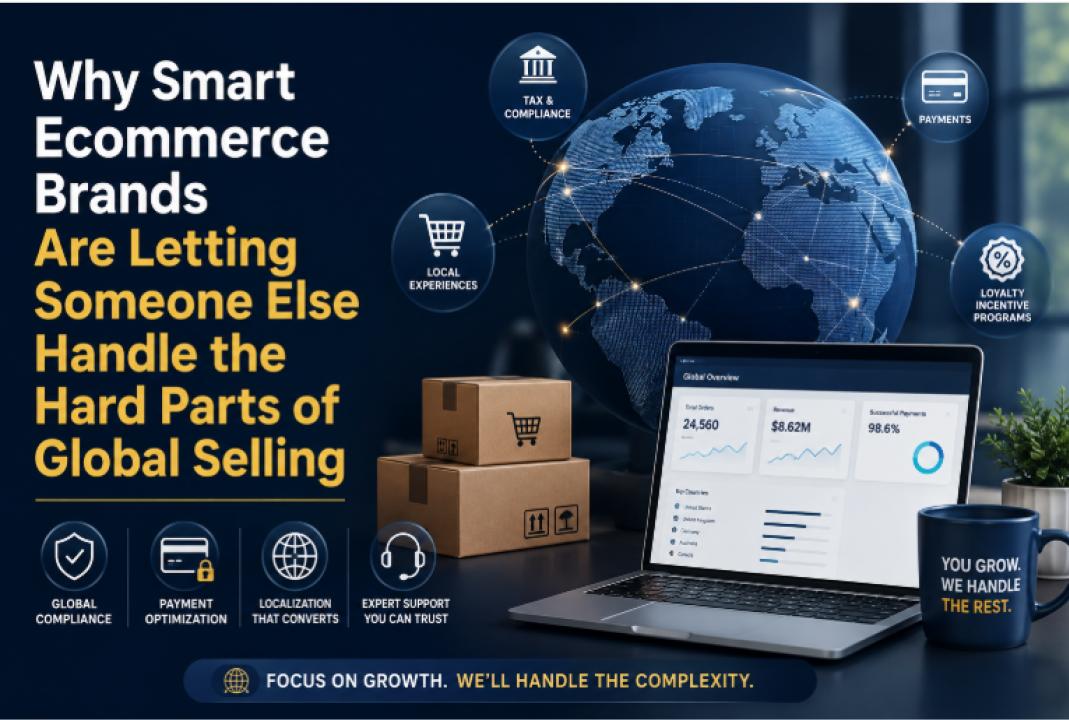
You've done the hard work. Built a product people want. Figured out your marketing. Started seeing real traction. And now you're looking at international markets thinking — this is the next big move.
Then reality sets in.
Germany wants VAT. Brazil has its own payment ecosystem that barely overlaps with what you're already using. Japan's customers expect a completely different checkout experience. And somewhere between figuring all of that out, you still have a business to run.
This is the moment where global expansion either accelerates or stalls. And for most growing brands, the difference comes down to one decision: trying to handle cross-border complexity in-house, or finding a smarter way to offload it.
The Problem With Selling Globally Is Rarely the Product
Most ecommerce founders assume the hardest part of going global is building demand in a new market. But demand is often the easy part.
The hard part is the infrastructure underneath it. Tax registration thresholds that differ country by country. Payment authorization rates that tank when transactions are flagged as cross-border. Local payment methods that customers prefer but your current stack doesn't support. Chargeback rules that change depending on which jurisdiction the transaction happened in.
Over 150 countries now require businesses to collect and remit VAT or GST on digital goods and services. Each one has its own filing deadlines, rates, and registration rules. If you're selling into 15 or 20 markets, you could be managing 20 different compliance obligations at the same time — all while trying to actually grow.
That's not a growth strategy. That's running two businesses at once.
What a Merchant of Record Actually Does
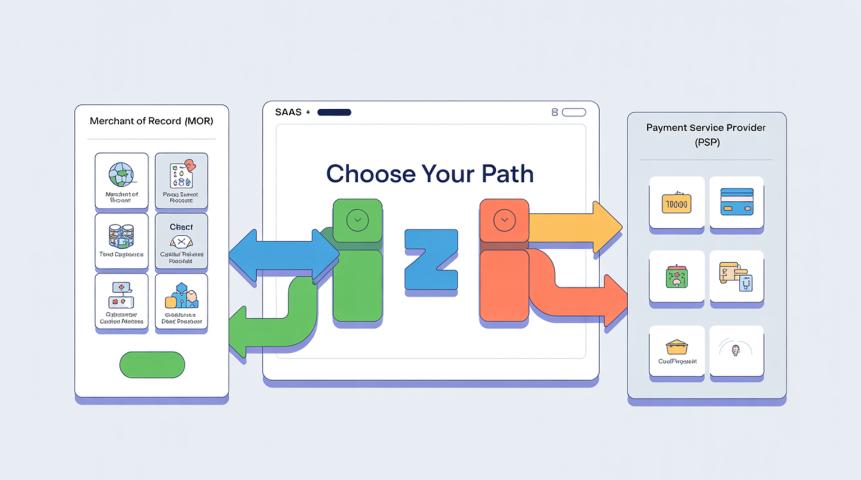
A Merchant of Record, or MoR, is the legal entity that takes responsibility for processing a customer's payment. That sounds technical, but the practical impact is significant.
When you partner with an MoR, everything tied to the transaction sits with them rather than with you. Tax collection, regulatory compliance, chargeback management, refunds — the MoR owns it. Your customer still shops on your website and experiences your brand. But behind the scenes, the MoR is the one appearing on the bank statement and carrying the legal weight of the sale.
For an ecommerce merchant of record arrangement to work well, the provider essentially becomes your payment and compliance infrastructure in every market you enter. You don't need to register for tax in each new country. You don't need to build relationships with local payment processors. You don't need a specialist on your team whose entire job is tracking cross-border regulatory changes.
You hand that complexity to a provider whose entire business is built around solving it, and you get back to focusing on your actual product.
Where the Real Financial Impact Shows Up
It's easy to understand the compliance value of the MoR model. What surprises a lot of businesses is how significantly it affects revenue.
Authorization rates are the hidden lever most brands miss. When a transaction is processed as a cross-border payment, issuing banks treat it with far more suspicion. Fraud scores go up. Declines increase. Customers who fully intended to complete a purchase walk away because their card was flagged unnecessarily.
When an MoR routes transactions through local acquiring — meaning the payment is processed through an in-country bank rather than internationally — that suspicion disappears. Authorization rates improve, often by 10 to 15 percentage points depending on the region. For a business doing meaningful international volume, that's not a rounding error. That's recovered revenue that was previously being left on the table with every failed transaction.
Payment method coverage changes conversion rates. In the Netherlands, a large portion of customers prefer iDEAL over credit cards. In Brazil, Pix and Boleto are dominant. Across Southeast Asia, digital wallets lead the market. If your checkout only offers card payments, you're losing customers in these regions not because they don't want your product — but because you're not letting them pay the way they prefer.
An MoR gives you access to a wide range of alternative payment methods without building those integrations yourself. That breadth directly affects whether customers in new markets can actually complete a purchase.
The Compliance Side Is Bigger Than Most People Expect
Let's talk about what it actually costs to manage tax compliance across multiple international markets without an MoR.
For mid-market businesses, the internal cost of handling this manually can run into hundreds of thousands of dollars annually once you factor in legal fees, accounting resources, and the time your finance team spends managing filings and reconciliations. And that's before factoring in penalties for errors — which, in some jurisdictions, can be substantial.
The MoR handles all of it. They calculate the correct tax rate in each market, collect it from the customer at checkout, remit it to the relevant authority, and give you consolidated reporting. You don't file returns in every country you sell into. You receive clean data and let the provider handle the complexity underneath it.
For businesses that are scaling fast and entering new markets regularly, this alone can justify the model.
Who Gets the Most Out of This Model
The MoR approach delivers the strongest returns for businesses that are either already operating across multiple markets or have a clear plan to expand into them soon.
Ecommerce brands selling physical or digital goods internationally are the most obvious fit. So are SaaS companies with global subscriber bases and recurring billing, which adds another layer of complexity around how tax is calculated and remitted. Digital content platforms, gaming companies, and subscription businesses of any kind dealing with cross-border customers will find that the model removes significant friction.
If your business is primarily domestic and you're not planning international expansion, the MoR model may add more overhead than it removes. But if global markets are part of your growth story — even six or twelve months from now — putting this infrastructure in place earlier rather than later pays dividends.
What to Actually Evaluate When Choosing a Provider
Not every MoR provider operates at the same level. The differences matter, and they show up in ways that directly affect your business outcomes.
Local acquiring coverage tells you how many markets the provider can genuinely support with improved payment performance — not just process payments in, but route them optimally. Payment method breadth tells you whether customers in your specific target markets can pay the way they prefer. Tax compliance infrastructure tells you how much manual work still ends up on your team even after you've signed on.
Beyond the technical side, look for a provider with genuine experience in your vertical and in the specific markets you're targeting. Pricing transparency matters too. As you scale, unit economics shift, and unexpected fees can quietly erode the margin improvements you were counting on.
Conclusion
Global expansion should feel like an opportunity, not a compliance project with a side of revenue growth. The businesses that scale internationally with the least friction are almost always the ones that build the right payment and compliance foundation before they need it desperately. A well-planned approach also makes it easier to support initiatives such as Loyalty Incentive Programs across different markets without adding unnecessary complexity.
The MoR model exists to let you move fast across borders without the legal and operational exposure that typically comes with it. For ecommerce brands and SaaS companies serious about international growth, it's less a nice-to-have and more the infrastructure that makes everything else possible. The brands setting this up now are the ones that will expand in months rather than years when the opportunity arrives.