How AI + ERP Can Simplify Multi-Country Business Operations
A business owner managing operations across three countries starts the morning checking currency fluctuations, reviewing separate sales reports, and following up with teams using different systems. The finance team tracks invoices in one platform, inventory teams maintain spreadsheets, and each country office handles tax requirements differently. By the time the numbers are combined into a single report, decisions are already delayed.
This is a common challenge for companies expanding internationally. Growth creates opportunities, but it also creates operational complexity. Different currencies, regulations, languages, suppliers, customers, and reporting requirements can quickly turn simple processes into time-consuming tasks.
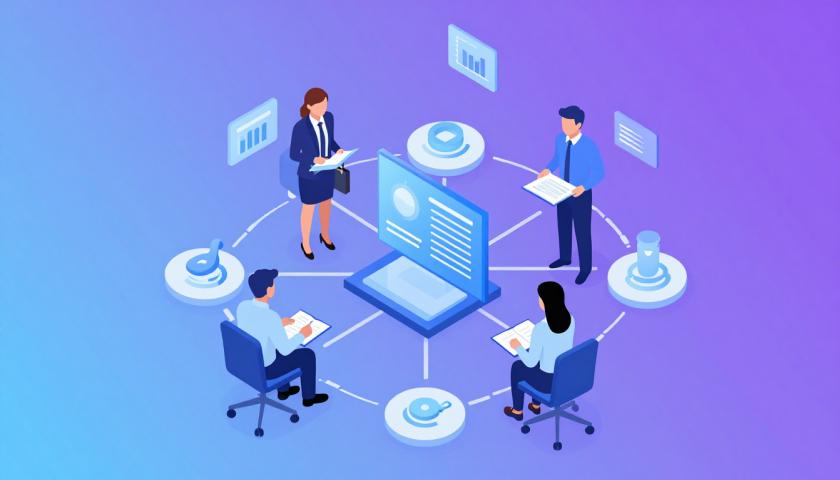
Combining an ERP system with AI helps businesses bring these moving parts together. An ERP creates one connected system for finance, sales, inventory, HR, and operations, while AI helps analyze information, identify patterns, automate repetitive tasks, and support better decisions.
For businesses operating across borders, the goal is not to replace managers with technology. The goal is to give decision-makers accurate information faster and reduce the manual work that slows international operations.
Managing Multiple Currencies and Financial Reporting
One of the first challenges companies face when entering new markets is financial management. A business operating in the United States, Europe, and the Middle East may deal with several currencies, different payment methods, and separate accounting processes.
Without a centralized system, teams often rely on spreadsheets to convert currencies and combine reports from different locations. This creates room for errors and makes it difficult to understand the company’s actual financial position.
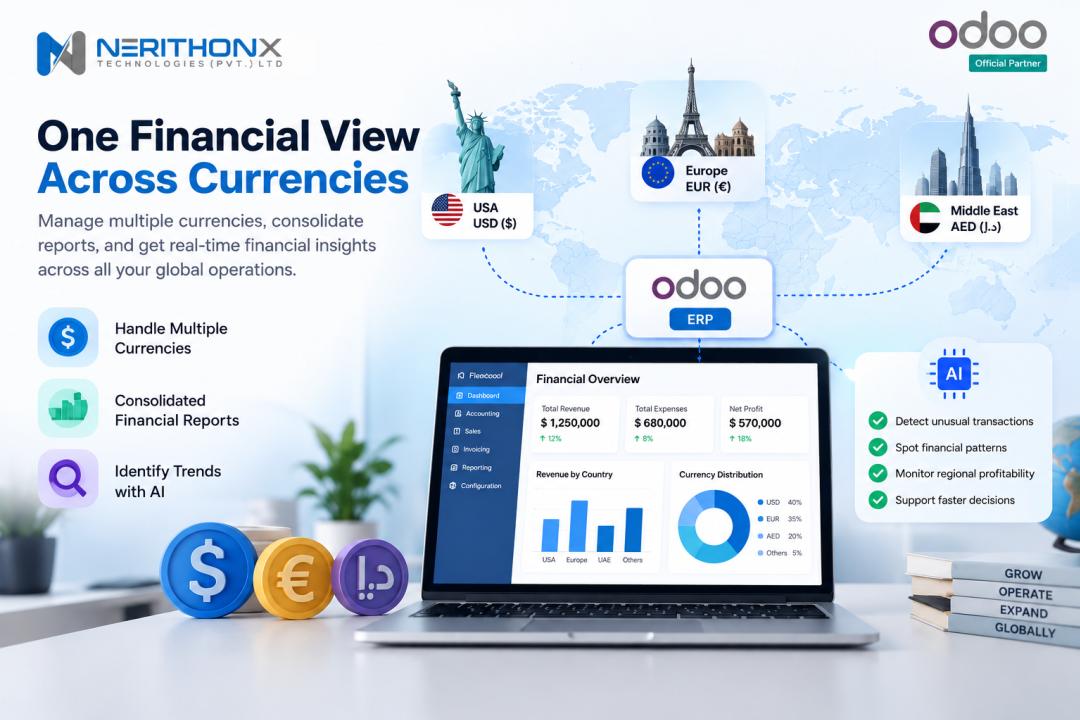
An ERP system like Odoo helps businesses manage multiple currencies within a single platform. Transactions can be recorded in local currencies while allowing headquarters to view consolidated financial reports in a standard reporting currency.
AI adds another layer of support by helping identify financial patterns and unusual activity. For example, an AI-powered system can highlight unexpected changes in expenses, unusual payment trends, or shifts in regional profitability. Instead of manually reviewing thousands of transactions, finance teams can focus on the areas that require attention.
The technology does not decide where a company should invest or cut costs. It provides the information managers need to make those decisions faster.
Staying Compliant Across Different Countries
Expanding into a new country means adapting to different tax rules, reporting requirements, and business regulations. A process that works in one market may not work in another.
For example, invoice formats, tax calculations, and required financial documents can vary significantly between countries. Businesses that manage these differences manually often depend heavily on local teams and external advisors, increasing the risk of missed deadlines or incorrect reporting.
ERP systems help by supporting country-specific configurations, including localized accounting rules, tax structures, and reporting formats. Instead of maintaining separate systems for every market, businesses can manage regional requirements within one connected platform.
AI can support compliance processes by monitoring data and creating alerts. A system can identify missing information, flag unusual transactions, or remind teams about important compliance deadlines based on predefined rules.
However, businesses still need human expertise. Regulations change frequently, and technology works best when combined with proper legal and financial guidance. The role of AI is to reduce administrative pressure, not replace professional judgment.
Coordinating Inventory, Sales, and Supply Chains Across Regions
Managing inventory across multiple countries becomes complicated as businesses grow. A company may have warehouses in different regions, suppliers in several countries, and customers expecting faster delivery times.
Without accurate visibility, businesses may overstock products in one market while facing shortages in another. Sales teams may promise delivery dates without knowing current inventory levels. Operations teams may struggle to understand where products are moving and where delays are happening.
An ERP system connects sales, inventory, purchasing, and supply chain activities in one environment. When a customer places an order in one country, teams can access updated information about available stock, supplier timelines, and fulfillment options.
AI improves this process by analyzing historical data and identifying patterns. For example, AI-driven forecasting can help predict that demand for a product may increase in one region during a specific season. Businesses can then prepare inventory earlier instead of reacting after shortages occur.
This is especially valuable for companies managing different markets, where customer behavior can vary significantly from country to country.
Creating One View of the Business
Many international companies struggle with fragmented information. Each country office may have its own processes, software tools, and reporting methods. Local teams may understand their own operations well, but leadership lacks a complete view of the entire organization.
This makes strategic decisions more difficult. Executives may spend days collecting reports before answering basic questions:
Which market is growing fastest?
Which products generate the highest margins?
Where are operational costs increasing?
Which region needs more investment?
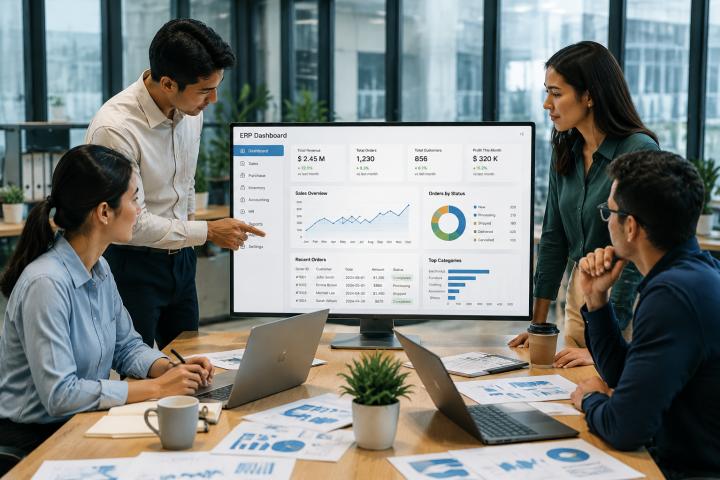
An ERP system creates a centralized source of business information. Sales, finance, inventory, purchasing, and customer data can be connected across locations.
AI helps transform this data into useful insights. Instead of only showing historical numbers, AI tools can identify trends, summarize performance changes, and highlight areas that deserve attention.
For example, a business leader could quickly discover that sales are increasing in one country but profitability is declining because of rising logistics costs. The system does not make the decision, but it helps leaders find the problem earlier.
Using AI for Smarter Regional Decisions
Different markets behave differently. Customer preferences, buying patterns, seasonal demand, and operational challenges can vary between countries.
Traditional reporting often tells businesses what happened last month or last quarter. AI helps businesses understand patterns and prepare for what may happen next.
For example, an AI-powered ERP system can analyze previous sales data to forecast demand by region. A company selling products across Asia, Europe, and North America may discover that certain products perform better in specific markets during different periods.
AI can also support tasks such as document processing, customer inquiry classification, and identifying operational exceptions. These small improvements can save teams significant time when repeated across multiple countries.
The important point is that AI works best as a decision-support tool. Business leaders still provide strategy, context, and experience. AI simply helps them work with better information.
Multi-Country ERP Implementation Requires Planning
While AI and ERP can solve many international business challenges, implementation is not automatic. A multi-country setup requires careful planning around business processes, local regulations, data migration, user training, and system configuration.
Every company has different workflows. A manufacturing business expanding internationally will have different requirements from a retail company or a professional services firm.
This is where experienced implementation partners become valuable. A partner like Nerithonx helps businesses understand their operational needs, configure ERP solutions such as Odoo, and build systems that match their expansion plans.
The objective is not simply installing software. It is creating a business foundation that can support growth across multiple markets without adding unnecessary complexity.
Turning International Growth Into a Manageable Operation
Expanding into new countries should create growth opportunities, not operational challenges caused by disconnected systems and manual processes.
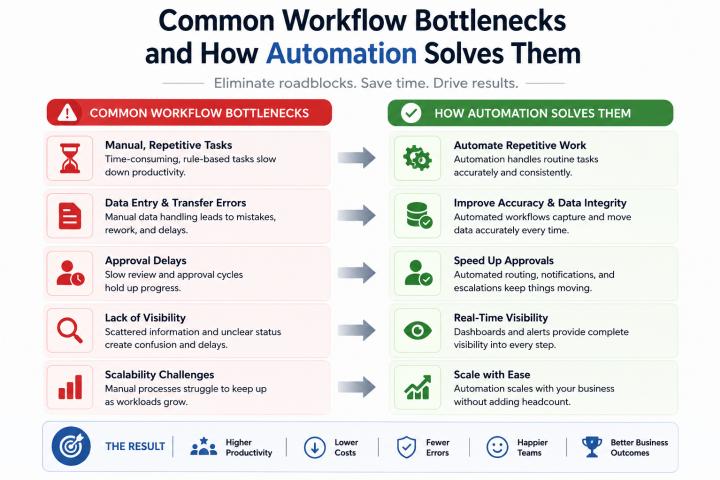
AI-powered ERP solutions help businesses simplify multi-country operations by improving reporting, automating repetitive tasks, and providing better visibility across finance, inventory, sales, and compliance. Businesses can explore solutions like Nerithonx to build a scalable system designed for international growth.
The right approach starts with identifying operational gaps and implementing technology that