Physical AI in Automotive Market Growth
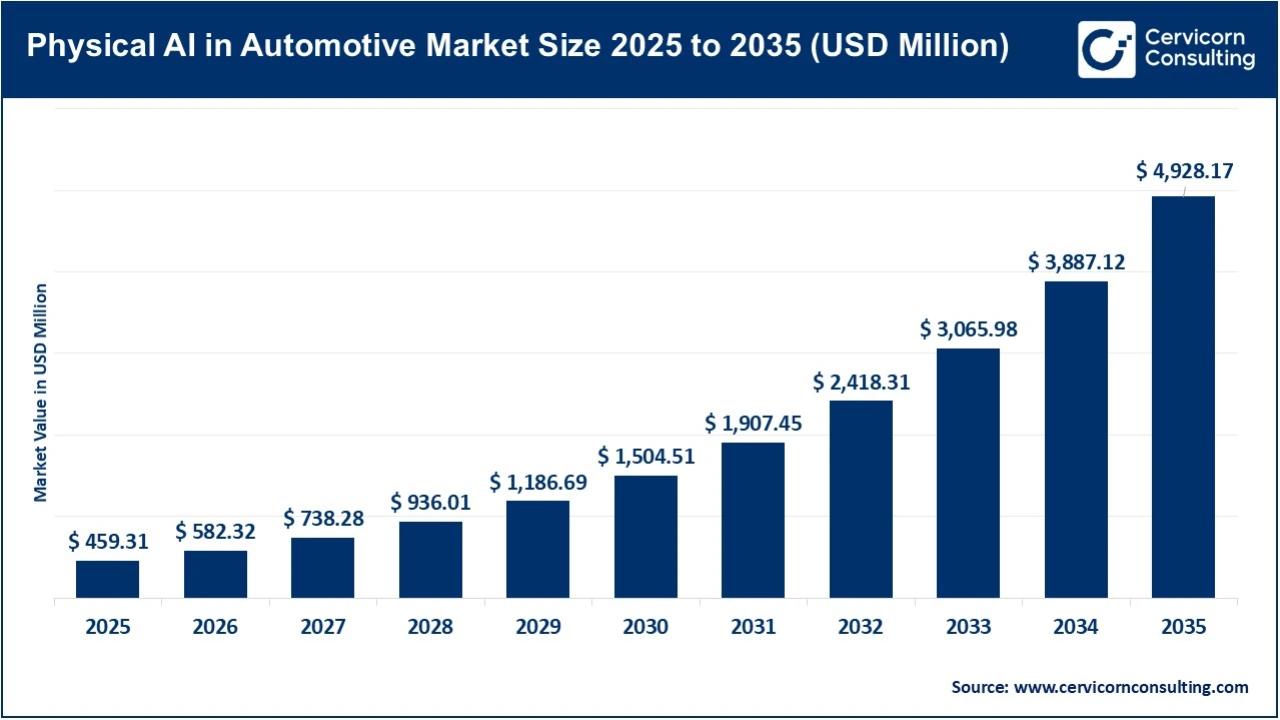
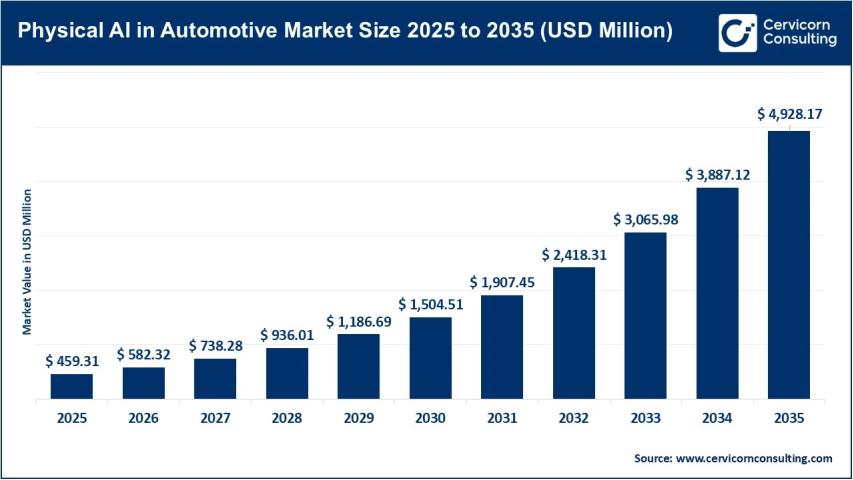
The global physical AI in automotive market was
valued at USD 459.31 million in 2025 and is projected to reach USD
4,928.17 million by 2035, expanding at a 26.8% CAGR from 2026 to 2035.
Growing deployment of AI-powered autonomous driving, intelligent sensing,
software-defined vehicles, and AI-enabled manufacturing is supporting market
expansion.
Autonomous driving adoption
The increasing adoption of autonomous driving and
advanced driver assistance systems (ADAS) is a major market driver.
Globally, 60.2% of new vehicles sold in 2024 were equipped with ADAS or
autonomous features, rising to an estimated 71.4% in 2026. AI-powered
perception, sensor fusion, and real-time decision-making are increasing demand
for Physical AI technologies.
Software-defined vehicles
The transition toward software-defined vehicles (SDVs)
is accelerating Physical AI adoption. Centralized computing, over-the-air
updates, AI-enabled control systems, digital twins, and predictive maintenance
are enabling vehicles to become increasingly software-driven while creating
opportunities for AI-powered automotive platforms.
Get a Free Sample: https://www.cervicornconsulting.com/sample/2987
Hardware leadership
Hardware held the largest component share at 54.6% in
2025, driven by demand for AI processors, cameras, LiDAR, radar, ultrasonic
sensors, and edge computing platforms. Meanwhile, software is expected to
experience faster growth as automakers increasingly rely on AI algorithms,
continuous software updates, autonomous driving models, and digital twins.
Computer vision dominance
Computer vision accounted for 39.8% of the technology
segment in 2025, supported by applications including autonomous driving,
ADAS, intelligent parking, lane detection, traffic-sign recognition, and
obstacle identification. Reinforcement learning and control systems are
expected to grow rapidly as automakers seek more adaptive autonomous driving
and vehicle-control capabilities.
Edge AI deployment
On-vehicle (Edge AI) captured 61.5% of the deployment
segment in 2025 because safety-critical automotive applications require
low-latency, real-time decision-making. Hybrid deployment is expected to grow
rapidly by combining onboard processing with cloud-based model training, fleet
learning, software updates, predictive analytics, and digital-twin simulations.
OEM opportunity
Automotive OEMs represented 47.9% of the end-user segment
in 2025, reflecting significant investments in autonomous driving
platforms, AI-enabled safety systems, software-defined architectures, and
intelligent cockpit technologies. Mobility-as-a-Service providers are expected
to experience strong growth as robotaxis, autonomous ride-hailing, and
intelligent fleet operations expand.
North America leadership
North America dominated the market with a 36.8% share in
2025, with its market valued at USD 169.03 million and projected to
reach approximately USD 1,813.57 million by 2035. Autonomous driving
capabilities, AI semiconductor innovation, software-defined vehicles, robotics,
and intelligent manufacturing are supporting regional growth.
Asia-Pacific growth
The Asia-Pacific market was valued at USD 128.15 million
in 2025 and is projected to reach approximately USD 1,374.96 million by
2035. The region's large automotive manufacturing base, growing EV
adoption, autonomous driving investments, AI-enabled factories, robotics, and
smart transportation infrastructure are supporting Physical AI expansion.
Market opportunities
AI-powered smart manufacturing, robotics, connected
mobility, autonomous delivery vehicles, and robotaxi services are creating
new opportunities. Physical AI can support production quality, predictive
maintenance, autonomous navigation, route optimization, passenger safety, and
fleet efficiency, while digital twins can help manufacturers simulate
production processes.
Market challenges
High development and integration costs remain a key
restraint because Physical AI requires substantial investment in processors,
sensors, LiDAR, radar, computing platforms, software, testing, and validation.
Safety and regulatory requirements, cybersecurity, data privacy, limited
high-quality training data, and shortages of AI and robotics talent also
present challenges.
Competitive landscape
The market includes NVIDIA Corporation, Tesla, Mobileye
Global, Alphabet (Waymo), Qualcomm Technologies, Intel, Robert Bosch,
Continental, Aptiv, Valeo, ZF Friedrichshafen, and Hyundai Mobis, among
others. Recent developments highlighted on the market page include expanded
autonomous-driving platform adoption, robotaxi commercialization, AI-powered
driver monitoring, and partnerships focused on autonomous vehicles.
Explore market opportunities
With the Physical AI in automotive market projected to reach
USD 4,928.17 million by 2035, detailed market intelligence can help
automotive OEMs, Tier-1 suppliers, technology providers, investors, and
mobility companies assess growth opportunities, technology trends, regional
markets, competitive developments, and emerging applications.
Explore the Physical AI in Automotive Market Report: https://www.cervicornconsulting.com/physical-ai-in-automotive-market