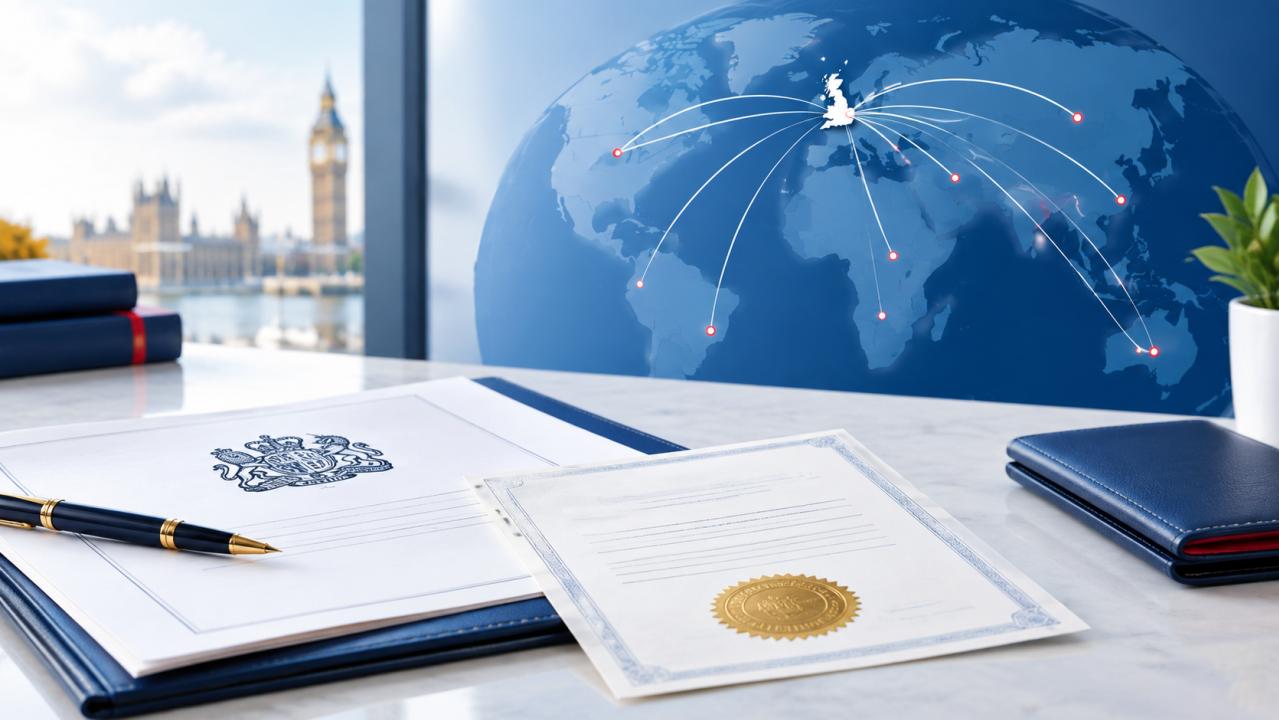
When you need to use a UK document overseas, the receiving authority may ask you to prove that the document is genuine and officially issued. This can apply to personal, educational, business and legal documents. Depending on the country where the document will be used, apostille legalisation may be required before the document can be accepted.
The Hague Convention of 5 October 1961 simplified the process for public documents exchanged between participating countries. The Convention has 130 contracting parties, although individual countries can have specific requirements that should be checked before submitting documents.
If you are preparing UK documents for use abroad, understanding the requirements of your destination country can help you avoid delays. Below are 10 countries where UK documents may require an apostille.
1. Australia
Australia is one of the countries where a UK-issued public document may need an apostille when it is being presented to an Australian authority.
Documents such as birth certificates, marriage certificates, educational certificates, powers of attorney and certain business documents may need authentication depending on the purpose for which they are being submitted.
For example, someone moving from the UK to Australia for employment may be asked to provide certified educational or professional documents. A person dealing with family or legal matters may also need to provide an authenticated civil document.
The exact requirements can depend on the Australian authority receiving the document, so it is important to confirm what is required before starting the process.
2. Canada
Canada is another destination where UK documents may need an apostille. Canada is a contracting party to the Hague Apostille Convention, making the apostille system relevant to qualifying documents exchanged between the two countries.
UK documents may be needed in Canada for immigration, education, employment, business, marriage or legal purposes.
For example, a UK university certificate could be requested when applying for a course or professional opportunity. Similarly, a birth or marriage certificate could be required for a personal or immigration-related application.
It is worth checking whether the Canadian organisation specifically requires an apostille, as requirements can vary according to the document and its intended use.
3. France
France is a common destination for people moving, studying, working or doing business from the UK. UK public documents may need authentication before they can be accepted by a French authority.
Documents that may be requested include birth certificates, marriage certificates, court documents, educational records and powers of attorney.
A person purchasing property or dealing with legal affairs in France may also be asked to provide UK documents that have been appropriately authenticated.
Because document requirements can differ depending on the French authority involved, applicants should confirm whether an apostille, certified copy, translation or additional procedure is required.
4. Germany
Germany may also require appropriately authenticated UK documents for certain official purposes.
For example, someone moving to Germany for employment may need to provide educational or professional documentation. People getting married, dealing with inheritance matters or completing business transactions may also need UK-issued documents.
A UK document may first need to meet the requirements of the UK Legalisation Office before an apostille can be issued. GOV.UK explains that the Legalisation Office checks signatures, stamps or seals against its records before attaching an apostille to qualifying documents.
The receiving German authority should always be contacted before applying, particularly if the document also needs to be translated into German.
5. Italy
Italy is another country where UK documents may require authentication for official use.
British citizens and residents may encounter document requirements when dealing with marriage, property, education, employment, inheritance or other administrative matters in Italy.
For instance, a UK birth certificate might be required as part of a personal application, while a university certificate could be needed for education or employment purposes.
Some Italian authorities may also require an official translation in addition to authentication. Therefore, applicants should check the complete requirements before sending their documents for processing.
6. Spain
Spain is a popular destination for UK citizens, students, professionals and businesses. UK documents used in Spain may need to be authenticated depending on the purpose and the authority requesting them.
Common examples can include birth certificates, marriage certificates, divorce documents, academic certificates and powers of attorney.
A UK document being used for a property transaction may have different requirements from a document being submitted for marriage or residency purposes. This is why it is important to establish the requirements for the specific application rather than assuming that every document follows exactly the same procedure.
If a translation is required, applicants should also confirm whether the receiving Spanish authority specifies a particular type of translator or translation.
7. Portugal
Portugal may also require UK public documents to be authenticated before they are accepted for official purposes.
People moving to Portugal may need UK documents for residency, employment, education, marriage, property transactions or other administrative matters.
For example, a birth or marriage certificate may be required for a personal application, while a power of attorney could be needed when someone is handling a legal or property matter on behalf of another person.
Checking the requirements in advance can help applicants determine whether their document needs certification, an apostille and translation as part of the apostille legalisation process.
8. Netherlands
The Netherlands is another Hague Convention country where an apostille can be used for qualifying public documents.
UK documents may be requested for employment, education, marriage, immigration, business and legal purposes. The type of document and the authority receiving it will determine what preparation is necessary.
For example, a UK academic certificate may be requested by an educational institution or employer, while a civil-status document could be needed for a personal or administrative procedure.
Applicants should make sure that the document is suitable for legalisation before submitting it. Certain documents issued by courts, public registries and government departments can be eligible for legalisation subject to the applicable requirements.
9. South Africa
South Africa is another destination where UK documents may require authentication for official use.
People may need UK documents when dealing with employment, education, immigration, marriage, legal proceedings or business activities.
A professional qualification, birth certificate or legal document may need to be prepared before being presented to the relevant South African authority.
As with other countries, applicants should not assume that an apostille is automatically required for every document. The receiving authority should confirm the exact requirements, including whether certification or translation is also necessary.
Professional assistance with apostille legalisation can be useful when you need to understand which preparation steps apply to a particular UK document.
10. Japan
Japan is also a contracting party to the Hague Apostille Convention, making the apostille process relevant to qualifying public documents from countries participating in the Convention.
UK documents may be required in Japan for education, employment, business, marriage or other official purposes.
For example, an individual moving to Japan for work could be asked for educational or professional documents. A person dealing with a legal or family matter may need to provide UK civil documents.
Where documents are not in the language required by the receiving authority, a translation may also be necessary. Applicants should therefore check the requirements of the specific Japanese authority before arranging authentication.
What Documents May Need an Apostille?
The requirements depend on the destination country and the purpose of the document. However, commonly requested UK documents can include:
- Birth certificates
- Marriage certificates
- Divorce certificates
- Death certificates
- University degrees and academic certificates
- Police certificates
- Powers of attorney
- Court documents
- Business documents
- Certificates issued by government departments
- Certain professional documents
Documents from courts, public registries and government departments can be eligible for legalisation, provided they meet the relevant requirements.
It is also important to remember that not every document follows the same process. Some documents may require certification or notarisation before they can be submitted for legalisation.
How the UK Apostille Process Works
The first step is to identify exactly what the overseas authority requires. This is important because an apostille may not be the only requirement.
For qualifying UK documents, the Legalisation Office checks whether the relevant signatures, stamps or seals match its records. If they do, the office attaches an apostille to the document.
If the destination country is not a member of the Hague Convention, the procedure can be different. Documents for non-Hague countries may require UK legalisation followed by certification at the relevant embassy and, in some cases, approval by the Ministry of Foreign Affairs in the destination country.
This is why checking the destination country's requirements before beginning the process is essential. Understanding the complete apostille legalisation procedure can help you prepare the correct documents and avoid unnecessary delays.
Things to Check Before Applying
Before sending your UK document for authentication, consider these points:
- Confirm the destination country. Requirements vary between countries.
- Check the receiving authority. Find out exactly what they require.
- Check the document type. Different documents can have different procedures.
- Confirm whether certification is needed. Some documents may need additional preparation.
- Check translation requirements. A translated document may be required depending on the destination.
- Check the document's condition. Damaged or unsuitable documents may cause problems.
- Allow enough processing time. Processing times can vary depending on the service and document.
- Check return arrangements. Make sure your documents can be returned to the correct address.
Processing times can vary depending on the service selected and the circumstances of the application. Applicants should check the latest official guidance before submitting their documents.
Get Help Preparing Your UK Documents
Preparing documents for use overseas can involve several stages, particularly when certification, legalisation or translation is required. Understanding the destination country's requirements before starting can help reduce unnecessary delays.
If you need support with UK document preparation, apostilles, certification, translations or related legalisation services, Legalisation4you can help you understand the process and arrange the appropriate service for your documents. Visit now for more information
Frequently Asked Questions
1. What is an apostille?
An apostille is an official certificate attached to a qualifying public document to authenticate the signature, stamp or seal on that document for use in another country participating in the Hague Apostille Convention.
2. Do all UK documents need an apostille?
No. Whether a document needs an apostille depends on the destination country, the type of document and the requirements of the organisation or authority receiving it.
3. Can a UK birth certificate be apostilled?
Certain UK public documents, including documents from public registries, may be eligible for legalisation. However, the exact requirements should be checked before applying.
4. Is an apostille the same as embassy attestation?
Not necessarily. An apostille is associated with the Hague Apostille Convention. Countries outside the Convention may use a different legalisation procedure involving the relevant embassy or other authorities.
5. Do I need a translation as well?
Possibly. The destination country's authority may require a translation depending on the document and the purpose for which it is being submitted. Always confirm the translation requirements before arranging your documents.
6. How long does UK document legalisation take?
Processing times depend on the service selected and the circumstances of the application. Applicants should check the latest GOV.UK guidance for current processing times before applying.
7. Can documents issued outside the UK be legalised in the UK?
Generally, documents issued outside the UK cannot be legalised through the UK Legalisation Office. They should normally be legalised in the country where they were issued.