When you're searching for help with artificial intelligence, you'll probably come across two types of providers: an artificial intelligence company and an AI development company. While they sound similar, they're actually quite different, and choosing the wrong one could cost you time and money.
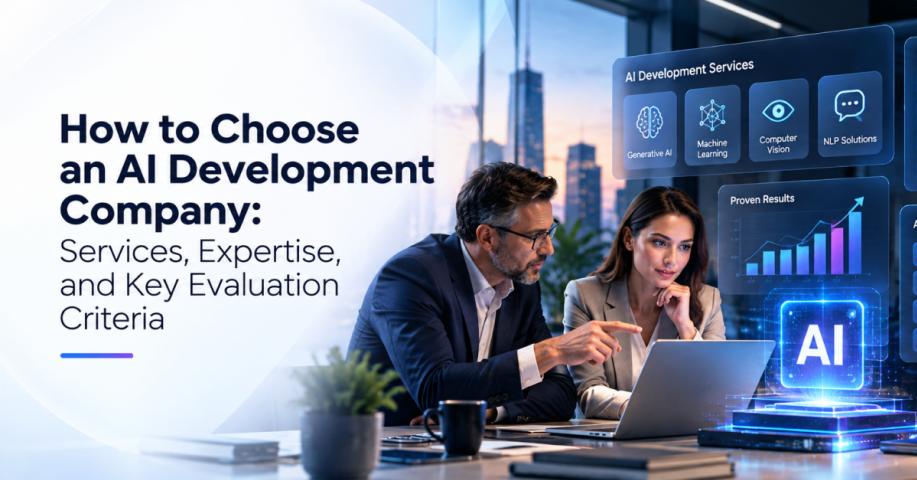
The confusion is real. Both claim to be "AI experts," but one focuses on strategy and building plans, while the other specializes in actually building and implementing AI solutions. Understanding this difference is crucial before you invest in AI. That's why we've created this guide to help you figure out which path is right for your business. Let's talk about AI development services and how to choose the right partner for your transformation journey.
What's the Real Difference Between AI Companies and AI Development Companies?
Here's the simple truth: these two types of companies solve different problems.
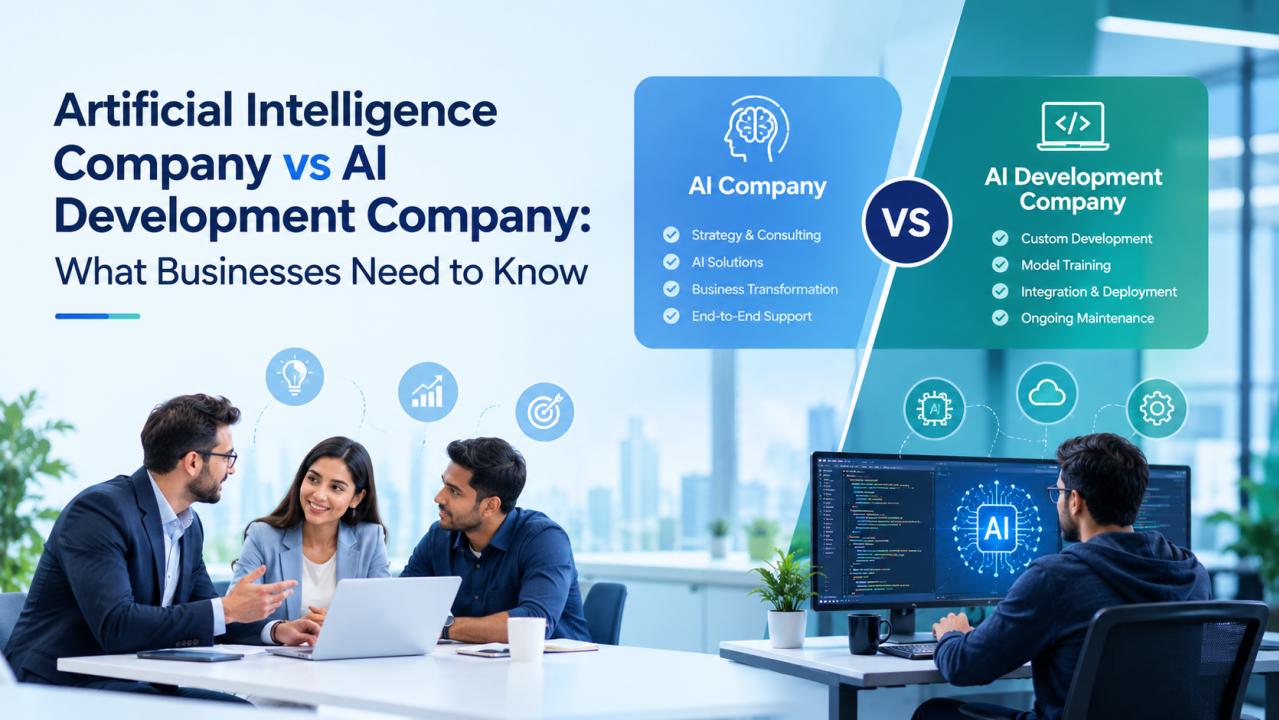
An artificial intelligence company is typically a consulting or advisory firm. Their main job is to help you figure out where AI fits in your business. They analyze your workflows, identify opportunities, create roadmaps, and recommend solutions. They're the strategists, the ones who help you understand what you should do with AI. They might bring in other teams to actually build solutions, or they might partner with implementation teams.
An AI development company, on the other hand, is the builder. They take your requirements and create custom AI solutions from scratch. They write code, train models, integrate systems, and handle all the technical heavy lifting. They're the engineers who make the strategy come to life. Their focus is on how to build it and making sure it actually works in your production environment.
Think of it this way: a strategy company helps you decide you need a house. A development company is the team that actually builds the house, picks the materials, and makes sure the foundation is solid.
Why does this matter? Because each one requires different skills, brings different value, and fits different stages of your AI journey. Mixing them up could mean paying for the wrong service or expecting results that one type of company simply can't deliver.
What does an AI Company typically do?
An artificial intelligence services provider usually offers strategy consulting, use-case identification, vendor selection, and implementation oversight. They might also offer pre-built solutions or partner with larger platforms. They're great if you need guidance on where to start and which tools to use.
What does an AI Development Company typically do?
An artificial intelligence development company focuses on custom coding, model training, system integration, and deployment. They build solutions tailored specifically to your data and business logic. They also provide ongoing support, optimization, and maintenance after launch. This is where the technical expertise really shines.
The key difference? One tells you what to do. The other does it. And sometimes you need both, but for different phases of your project.
Expertise Depth & Specialization
Not all AI providers are created equal. The depth of expertise matters a lot.
What kind of specialization should you look for?
When you're evaluating any AI development company, check what they're actually good at:
- Machine Learning expertise: Can they build custom ML models? Do they understand supervised, unsupervised, and reinforcement learning?
- Emerging tech skills: Do they work with Large Language Models (LLMs), Generative AI, or multi-agent systems?
- Domain knowledge: Have they built AI solutions in your specific industry? Healthcare, fintech, retail, and manufacturing each have unique requirements.
- Technology stack: Are they proficient in Python, TensorFlow, PyTorch, and other relevant tools?
- Specialized capabilities: Do they have expertise in Computer Vision, Natural Language Processing, or AI Agents?
Consulting firms vs. Development teams
Consulting companies often have broad knowledge across many industries but might lack deep technical expertise in specific technologies. Development companies tend to specialize; they go deep in their chosen areas. One company might be legendary in computer vision but new to NLP. Another might excel with Large Language Models but not healthcare-specific AI.
The overlap
Here's where it gets interesting: some of the best providers do both. They'll consult with you and build solutions. They can walk you through strategy and execute the technical implementation. Look for companies that can scale from advisory to hands-on development. That's often the sweet spot.
Why is custom development more expensive?
When an AI development company builds something from scratch, they're doing all the engineering work: data preparation, model training, testing, integration, deployment, and optimization. That takes time and highly skilled people. A pre-built solution from a consulting firm is cheaper upfront because the work is already done; you're just configuring it.
But here's the catch: pre-built solutions might not fit your exact needs. You might be paying for features you don't use or missing features you do need. Custom development costs more but often delivers better ROI because it's built for your specific problem.
Timeline expectations
A consulting company might deploy solutions in weeks. A development company usually needs months. Why? Because they're building something new, training models on your data, and making sure it integrates with your existing systems. That's not slow; it's thorough. And it usually results in a better solution.
Long-term costs
Here's what people miss: post-launch costs. A development company typically includes maintenance, monitoring, and optimization. As your data changes or your business evolves, they adjust the models. Consulting companies might hand you off to someone else for ongoing support, which means additional costs.
How to Choose the Right Partner?
So which one do you need? Here's how to figure it out:
Step 1: Define your AI goals: Are you just exploring where AI fits? You might need consulting first. Do you have a clear idea of what you want to build? You're ready for development.
Step 2: Assess your internal resources: Do you have AI expertise in-house? A development company can work well. Are you building AI knowledge from scratch? Consulting can help you understand what you need.
Step 3: Look at their portfolio: Ask for case studies in your industry. Ask how long they spent on similar projects. Ask what challenges they faced. Real experience matters.
Step 4: Evaluate their support commitment: What happens after launch? Do they stick around to optimize and maintain? Or do they hand you off? Post-launch support can make or break your AI success.
Step 5: Check their technology stack: Make sure they're using modern tools and frameworks. Python, TensorFlow, PyTorch, cloud platforms these matter. Outdated tech means outdated solutions.
Step 6: Verify their track record in your vertical: Healthcare AI is different from e-commerce AI is different from manufacturing AI. Find someone who gets your industry, not just AI in general.
Step 7: Ask about flexibility and scalability: Will they adapt their approach as your needs change? Or do they have one-size-fits-all solutions? Custom AI agent development capabilities are increasingly important. Can they build intelligent agents that learn and adapt?
Red flags to watch for:
- They promise "AI solutions" without asking detailed questions about your specific problem
- They have no case studies in your industry
- They use outdated technologies
- They offer no post-launch support
- They won't explain their approach in plain language
- They're vague about timelines and costs
Risk Management & Compliance Matter More Than You Think
Before you sign any contract, let's talk about risks. AI solutions deal with your data, your customers, and your reputation. Get this wrong, and it's costly.
- Data security and privacy: Your AI model is only as good as the data it's trained on. Is it secure? Who has access? A good AI development company has strict security protocols, encryption, and data governance practices. Make sure they follow industry standards for your data.
- Compliance requirements: Depending on your industry, you might need to follow GDPR, HIPAA, or other regulations. Your AI solution has to comply too. Does your provider understand your industry's rules? Can they document how your AI solution meets compliance requirements?
- Ethical AI and bias mitigation: AI models can inherit biases from training data. A real partner will test for bias, document their approach, and help you build responsible AI. This isn't just ethics; it's risk management. A biased AI model can damage your brand and open you to legal issues.
- Vendor lock-in: Can you move to a different provider later? Will they lock you into their proprietary technology? Ask about data portability and whether your model can run on other platforms. You want flexibility.
- Service level agreements (SLAs): What's the uptime guarantee? What's the response time if something breaks? Get these in writing. Vague promises aren't good enough.
- Intellectual property ownership: Who owns the AI model you're paying for? Can you use it after the contract ends? Make sure this is crystal clear before you start.
Conclusion
So, which should you choose: an artificial intelligence company or an AI development company?
The honest answer: it depends on where you are in your AI journey. Starting out? You might need an artificial intelligence company to help you understand your options and build a roadmap. Have a clear vision and ready to build? An AI development company is your pick. And sometimes, the smartest move is partnering with a provider who can do both.
The key is understanding what you actually need. Strategy without execution is just ideas. Execution without strategy is building the wrong thing. The best outcomes happen when you have clarity on what you're doing and how you're going to do it.
At Mobisoft Infotech, we work as a true AI development company combining strategic insight with deep technical execution. We don't just tell you what to do; we build it, deploy it, optimize it, and support it for the long term. Whether you need AI business consulting to get started or full-scale custom development, we're here to help your business succeed with AI.
Ready to transform your business with AI? Let's talk about your specific needs and how we can help you succeed.