A successful mobile app is more than a well-designed interface. It needs the right product strategy, technology architecture, integrations, security, testing, and ongoing support. That is why businesses evaluating mobile app development services should look beyond coding and consider the complete development lifecycle, from initial discovery to post-launch optimization.
Whether you are building a customer-facing app, an internal enterprise application, a marketplace, or a connected digital product, the development approach should align with your business goals, target users, technical requirements, and long-term growth plans.
What Are Mobile App Development Services?
Mobile app development services cover the end-to-end process of planning, designing, building, testing, launching, and maintaining applications for smartphones, tablets, and other connected devices.
A professional development engagement can include:
Product strategy and technical consulting
Business and user research
UI/UX design
Native iOS and Android development
Cross-platform application development
Backend and API development
Third-party API integrations
Cloud infrastructure
Quality assurance and security testing
App Store and Google Play deployment
Post-launch maintenance and optimization
The exact combination depends on your product. For example, a fintech application may require stronger security and compliance controls, while a logistics app may prioritize real-time location tracking, APIs, notifications, and offline functionality.
What Services Are Included in Mobile App Development?
1. App Strategy and Product Discovery
Development should begin before writing code. A discovery phase helps define the problem your application will solve, who will use it, which features are essential, and how success will be measured.
This stage can include:
Business and competitor analysis
User personas and journeys
Feature prioritization
MVP definition
Technology recommendations
Technical feasibility assessment
Product roadmap development
A clear strategy reduces unnecessary development and creates a stronger foundation for future scaling.
2. UI/UX Design
Users judge an application through its experience. UI/UX services transform product requirements into intuitive user journeys, wireframes, prototypes, and production-ready interfaces.
The process typically covers information architecture, interaction design, visual design, accessibility, design systems, and usability validation.
For consumer applications, the focus may be frictionless onboarding and engagement. Enterprise applications may prioritize workflow efficiency, role-based experiences, and data visibility.
3. Native App Development
Native development involves building specifically for a mobile operating system.
For iOS, teams commonly use technologies such as Swift and SwiftUI. Android applications can be built with Kotlin and modern Android development tools.
Native development can be appropriate when an application requires deep platform integration, advanced device capabilities, specialized performance, or highly platform-specific experiences.
It also gives development teams direct access to platform APIs and device capabilities.
4. Cross-Platform App Development
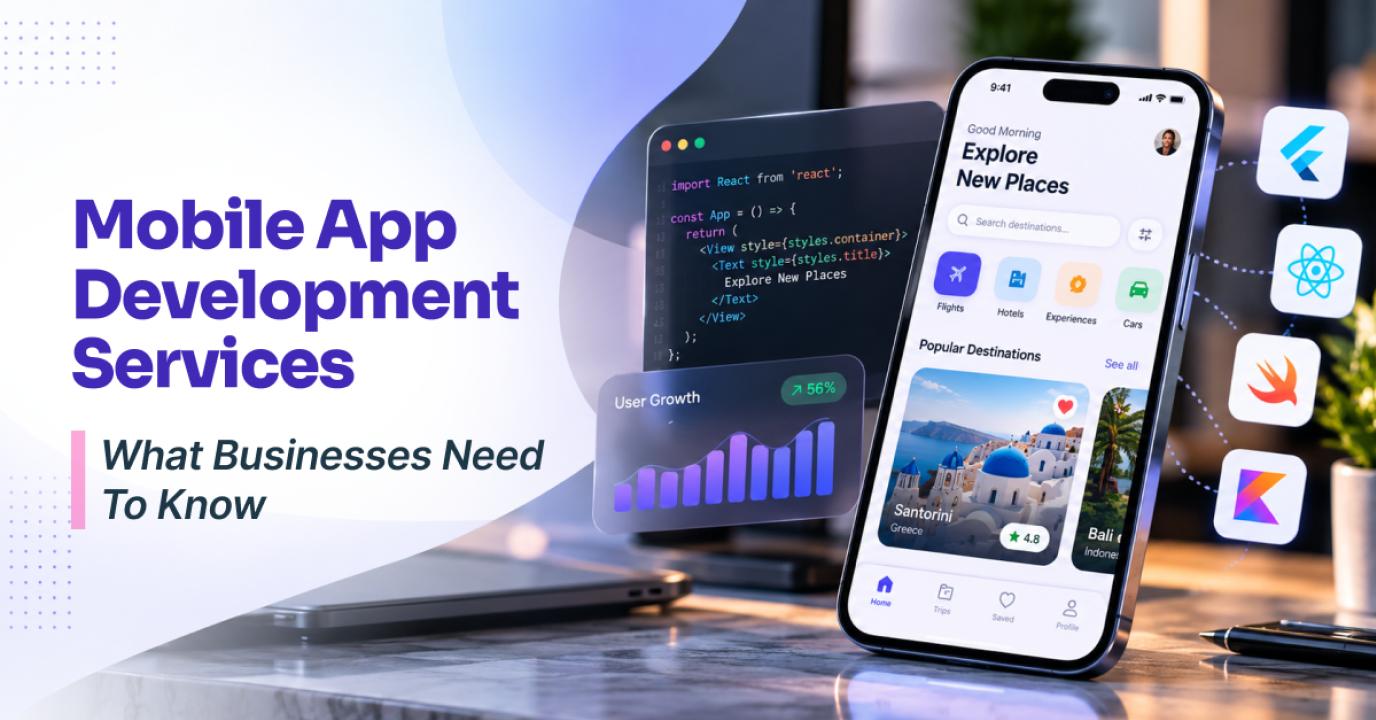
Businesses that want to support multiple platforms can consider cross-platform development. Frameworks such as Flutter and React Native allow teams to share significant portions of application code across platforms.
A well-planned cross-platform approach can simplify development and maintenance while helping businesses reach iOS and Android users efficiently. However, technology selection should depend on the application's requirements rather than simply choosing the framework with the shortest development cycle.
For businesses evaluating cross-platform app development services, important considerations include:
Required device capabilities
Application complexity
Performance requirements
Existing technical expertise
Native module requirements
Long-term maintenance
Platform-specific UX requirements
The right framework should support the product's current needs while leaving room for future features and platform changes.
5. Backend Development and API Integration
The mobile application is only one part of the product. Most modern apps rely on backend systems to manage authentication, business logic, databases, payments, notifications, analytics, and integrations.
Backend development may include REST or GraphQL APIs, databases, authentication, cloud infrastructure, microservices, event-driven systems, and third-party integrations.
API integration can connect an app with services such as payment gateways, CRM platforms, maps, identity providers, analytics platforms, communication services, and enterprise systems.
For complex products, businesses may also work with a provider offering custom software development services to build or modernize the backend systems supporting the mobile experience.
6. Quality Assurance and Security Testing
Testing should run throughout development rather than being left until the final release.
QA teams can validate:
Functional behavior
UI consistency
API responses
Performance
Device compatibility
Network conditions
Accessibility
Security
Regression issues
Security testing is equally important. Applications should protect sensitive information through appropriate authentication, authorization, encryption, secure API communication, and secure data handling.
For applications handling financial, healthcare, personal, or enterprise data, security requirements should be incorporated into architecture and development from the beginning rather than treated as a final-stage checklist.
Final Thoughts
Modern mobile applications require much more than development expertise. Businesses need a connected process that covers strategy, UX, architecture, development, integrations, QA, deployment, security, and continuous improvement.
The right approach depends on your product goals and technical requirements. Native development can provide deep platform integration, while cross-platform technologies can support multiple platforms from a shared codebase. Backend architecture, APIs, security, and post-launch support are equally important to long-term success.
By evaluating mobile app development solutions as a complete lifecycle rather than a one-time coding project, you can build an application that is easier to scale, maintain, and improve as your business grows.