Market Overview
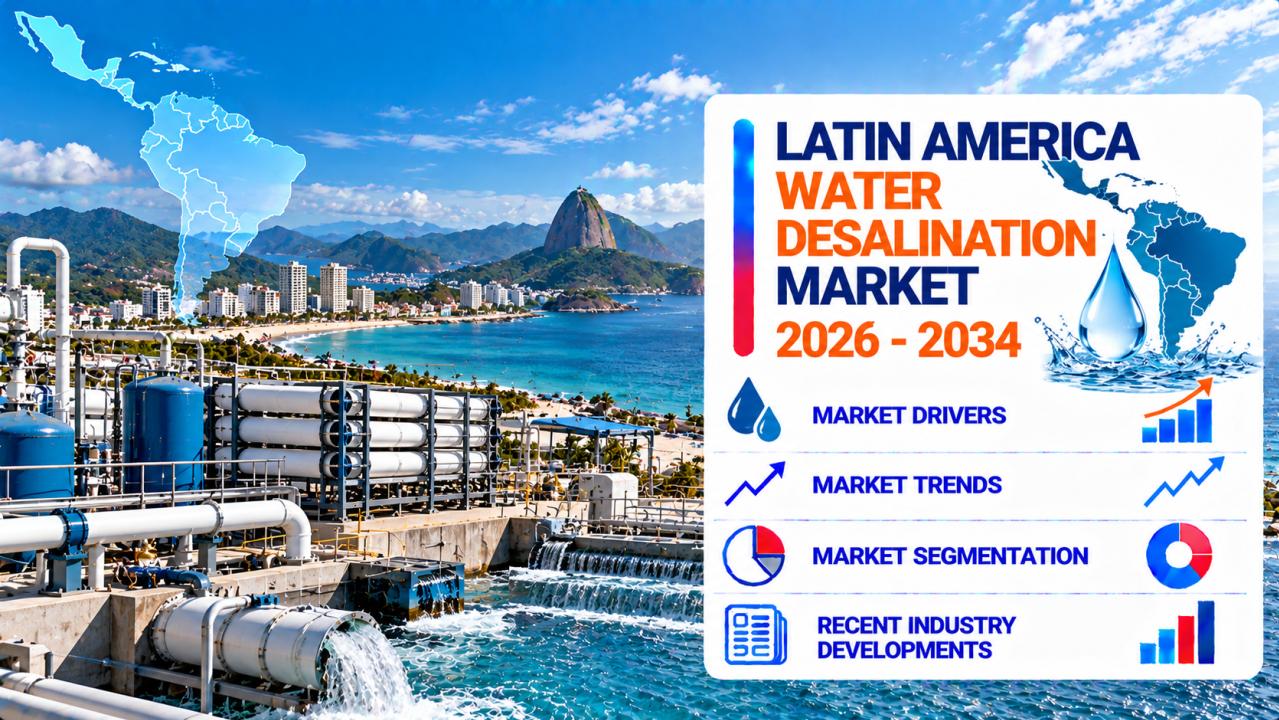
The Latin America water desalination market size reached USD
1.7 Billion in 2025 and is projected to reach USD 3.4 Billion by 2034,
growing at a compound annual growth rate (CAGR) of 7.72% from 2026 to
2034. The market is growing rapidly due to increasing water demand driven by
population growth and urbanization, significant advancements in desalination
technology improving efficiency and reducing costs, and government initiatives
promoting sustainable water management and investment in infrastructure.
Request a Sample Report for In-Depth Market Insights: https://www.imarcgroup.com/latin-america-water-desalination-market/requestsample
Latin America Water Desalination Market Summary
- The
Latin America water desalination market encompasses a range of
technologies, including Reverse Osmosis (RO), Multi-Stage Flash (MSF),
Multi-Effect Distillation (MED), and others, sourced from sea water,
brackish water, wastewater, and other sources, serving municipal,
industrial, and other applications.
- These
technologies are valued for their role in converting seawater and brackish
water into potable water, addressing freshwater shortages in coastal and
inland areas, supporting industrial operations, and enhancing regional
water security.
- The
ecosystem includes desalination technology providers, engineering and
construction firms, membrane manufacturers, energy recovery device
suppliers, project developers, governments, and industrial end users
across Brazil, Mexico, Argentina, Colombia, Chile, Peru, and other
countries.
- Major
segments identified in the market include technology (Reverse Osmosis,
Multi-Stage Flash, Multi-Effect Distillation, others), source (sea water,
brackish water, wastewater, others), application (municipal, industrial,
others), and country (Brazil, Mexico, Argentina, Colombia, Chile, Peru,
Others).
- The
market is benefiting from growing water demand, technological advancements
in desalination, government initiatives and investments, international
collaboration, and the integration of renewable energy systems to power
desalination plants.
- According
to industry reports, the agriculture sector in Chile represents around 72%
of freshwater consumption and the mining sector around 4%,
highlighting the significant demand for alternative water sources in
water-scarce regions.
Porter's Five Forces Analysis
- Competitive
Rivalry: Moderate, with international desalination technology
providers, regional engineering firms, and emerging project developers
competing on price, technology efficiency, and project delivery. Business
implication: Companies must differentiate through technological
innovation, cost efficiency, and project execution capabilities.
- Supplier
Power (Membrane and Equipment Suppliers): Moderate. Suppliers of
membranes, energy recovery devices, and specialized components have some
leverage, but the presence of multiple suppliers and the ability of large
project developers to negotiate contracts moderates this power. Business
implication: Project developers should maintain diverse supplier
relationships and invest in advanced technologies.
- Buyer
Power (Municipalities and Industrial Users): High. Municipalities and
industrial users have extensive choice across technology providers,
project structures, and financing options, with growing awareness of
costs, efficiency, and sustainability. Business implication:
Providers must focus on cost competitiveness, reliability, and value-added
services to build loyalty.
- Threat
of Substitutes: Moderate. Traditional water sources, water recycling,
and water conservation measures compete, but the growing scarcity of
freshwater resources and the reliability of desalination support its
position. Business implication: The industry should emphasize water
security, reliability, and sustainability benefits.
- Threat of New Entrants: Moderate. Higher barriers for established players (capital requirements, regulatory approvals, technical expertise), but lower barriers for niche and innovative technology entrants. Business implication: Established players should build defensible positions through technology, project pipelines, and strategic partnerships.
Market Growth Drivers
Growing Water Demand
One of the major factors propelling the Latin America water
desalination market growth includes the increasing demand for fresh water,
driven by rapid population growth, urbanization, and agricultural expansion,
which place significant pressure on the region's limited freshwater resources.
Countries such as Mexico, Chile, and Brazil face growing concerns over water
scarcity, especially in arid and semi-arid regions. The agricultural sector,
which consumes a significant portion of available freshwater, is one of the
main contributors to this rising demand. According to industry reports, the
agriculture sector in Chile represents around 72% of freshwater
consumption and the mining sector around 4%. Additionally, expanding
industrial activities, especially in mining, energy, and manufacturing, further
intensify the need for reliable water sources. Desalination offers a viable
solution to this growing demand by converting seawater and brackish water into
potable water, addressing the freshwater shortages in coastal and inland areas.
Technological Advancements in Desalination
Developments in desalination technology are also influencing
the Latin America water desalination market outlook. Advanced desalination
processes like reverse osmosis are becoming increasingly cost-effective and
energy-efficient, more affordable and replicable for broad implementation.
Breakthroughs in membrane technology, energy recovery devices, and hybrid
desalination processes are strongly lowering the costs of operation of
desalination plants and power consumption. This technological advancement is
allowing nations in the region to develop desalination plans on a massive
scale, thus making it an economical solution for meeting long-term water
requirements. For example, Chile has 24 desalination facilities with a
combined output capacity of over 8,500 liters per second (l/s) , with 75%
of them being utilized by the mining sector. In addition to this, implementing
renewable energy systems such as wind and solar power to operate desalination
plants is assisting in curbing the ecological footprint of such systems and
aligning it with the regional sustainability targets.
Government Initiatives and Investments
Regulatory bodies in Latin America understand the
significance of sustainable water management and are adopting policies and
investments to favor desalination projects. Governments are promoting public
and private investments in desalination facilities in nations such as Chile and
Mexico, where water scarcity is severe. These efforts involve tax incentives,
subsidies, and public-private partnerships to speed up the development of
desalination plants and provide assured access to water. Moreover, international
investment and regional collaboration also serve an important role to finance
desalination initiatives because Latin American nations aim to improve their
water security amid population increases and climate change. According to the
United Nations, in 2023, Latin America and the Caribbean country
representatives endorsed the Regional Water Action Agenda that defines
the priority areas to secure the availability and sustainable management of
water and sanitation for everyone.
Integration of Renewable Energy with Desalination
The integration of renewable energy systems such as wind and
solar power to operate desalination plants is a growing trend in the Latin
America water desalination market. This integration is helping to curb the
ecological footprint of desalination systems and align them with regional
sustainability targets. Renewable-powered desalination is particularly
attractive in remote and arid regions where grid connection is limited or
expensive, and where abundant solar or wind resources can be harnessed to power
desalination operations. This trend is expected to drive further investment in
desalination projects across the region, particularly in mining and municipal
applications.
Latin America Water Desalination Market Segmentation
Technology Insights:
- Reverse
Osmosis (RO)
- Multi-Stage
Flash (MSF)
- Multi-Effect
Distillation (MED)
- Others
Source Insights:
- Sea
Water
- Brackish
Water
- Wastewater
- Others
Application Insights:
- Municipal
- Industrial
- Others
Country Insights:
- Brazil
- Mexico
- Argentina
- Colombia
- Chile
- Peru
- Others
Competitive Landscape
The Latin America water desalination market features a
competitive landscape encompassing international desalination technology
providers, regional engineering and construction firms, and emerging project
developers. Market participants differentiate through investment in technology,
project delivery, and cost efficiency. The market is characterized by growing
demand for desalinated water, increasing government support, and expanding
industrial applications. Competition is intensifying as companies invest in
advanced membrane technology, energy recovery systems, and renewable-powered
desalination solutions to capture growing demand across municipal and
industrial segments. The competitive analysis includes market structure, key
player positioning, top winning strategies, competitive dashboard, and company
evaluation quadrant, with detailed profiles of all major companies provided in
the report.
Key players mentioned in the report context include:
- Patria
Investments, a leading Latin American alternative investment firm,
owns two adjacent water assets that received $883 Billion in senior
secured financings from Natixis Corporate & Investment Banking
(Natixis CIB) in January 2024. This project is the first multiclient
desalination plant, thereby helping industrial clients reduce reliance on
continental water and addressing Chile's growing water scarcity.
- Oneka
Technologies, a Canada-based company, successfully tested its
wave-powered desalination project on Chile's central coast of Algarrobo in
April 2023, addressing the country's growing water shortages. Aligned with
the Canada-Chile environmental cooperation agreement, Oneka also announced
the launch of its subsidiary in Chile at a government-attended event.
- Leading
international desalination technology providers and regional engineering
firms are focusing on technology innovation, project delivery, and
strategic partnerships to capture growing demand across municipal and
industrial segments in Latin America.
Regional Analysis
- Chile:
The leading market for water desalination in Latin America, driven by
severe water scarcity in mining regions, strong government support for
desalination projects, and significant investment from mining companies.
Chile has 24 desalination facilities with a combined output
capacity of over 8,500 liters per second (l/s) , with 75% of
them being utilized by the mining sector. The country has attracted
significant international investment, including projects by Patria
Investments and Oneka Technologies.
- Mexico:
A significant market driven by water scarcity in northern regions, growing
industrial demand, and government initiatives promoting desalination. The
country has significant potential for desalination development,
particularly in coastal and arid regions.
- Brazil:
A growing market with expansion driven by water scarcity in northeastern
regions, growing industrial demand, and increasing investment in
desalination infrastructure. The country has significant potential for
desalination development, particularly in coastal and semi-arid areas.
- Argentina:
A growing market driven by water scarcity in certain regions, growing
agricultural and industrial demand, and increasing awareness of
desalination as a viable water source.
- Colombia:
A growing market with expansion driven by water scarcity in coastal
regions, growing industrial demand, and increasing investment in water
infrastructure.
- Peru:
An emerging market with growing water desalination demand, supported by
mining sector demand, improving infrastructure, and increasing awareness
of desalination benefits.
- Others:
Emerging markets including Ecuador, Uruguay, and others with varying water
desalination demand dynamics based on local water resources, industrial
activity, and government policies.
Recent Industry Developments
September 2026: Mexico began construction of the Rosarito desalination plant in Baja California, designed to process more than 2,000 liters of seawater per second. With investment exceeding MXN 15 billion, the project is expected to increase water availability by up to 45% for Tijuana, Playas de Rosarito and Ensenada.
August 2026: Cox announced development of the first phase of a major desalination plant in Mexico with capacity of 2,200 liters per second, producing approximately 190 million liters of drinking water daily. The project’s eventual capacity of 4,400 liters per second could serve nearly 2 million residents in the region.
September 2026: Chile’s Northern District desalination project continued construction progress, advancing infrastructure designed to supply desalinated seawater to major Codelco mining operations. The project includes a 160-kilometer underground aqueduct, a 250,000-cubic-meter reservoir, pumping stations and reverse-osmosis treatment infrastructure to strengthen industrial water security.
June 2026: Chile and Peru accelerated desalination development discussions, with industry stakeholders highlighting mining, municipal supply and industrial demand. More than 300 delegates participated in Desalination Latin America 2026 in Santiago, where projects involving Chilean mining and coastal Peruvian water supply were discussed alongside renewable-powered desalination and brine-recovery technologies.
May 2026: Chile enacted a new Desalination Law establishing a dedicated regulatory framework for seawater infrastructure. The legislation introduces a specific maritime concession for desalination projects and aims to provide greater regulatory certainty for investment, particularly as Chile addresses increasing water scarcity and expands desalinated-water use across municipal and industrial applications.
Key Aspects Required for the Latin America Water Desalination Market
- Market
Performance: USD 1.7 Billion in 2025, with a projected trajectory to
USD 3.4 Billion by 2034.
- Market
Outlook: A 7.72% CAGR through 2034 indicates steady growth across
technologies, sources, applications, and countries, driven by water
demand, technological advancements, government initiatives, and renewable
energy integration.
- Growth
Drivers: Growing water demand driven by population growth and
urbanization; technological advancements in desalination; government
initiatives and investments; integration of renewable energy with
desalination; increasing industrial demand, particularly from mining; and
regional collaboration on water security.
- Competitive
Landscape: A moderately competitive market with international
desalination technology providers, regional engineering firms, and
emerging project developers. Differentiation occurs through technological
innovation, cost efficiency, and project execution capabilities.
- Value
Chain Analysis: From water source assessment and project development
through engineering, procurement, and construction to operation and
maintenance of desalination plants, with digitalization and sustainability
trends shaping market dynamics.
- Industry
Trends: Growing adoption of reverse osmosis technology; increasing
integration of renewable energy with desalination; expansion of
multiclient and industrial desalination projects; growing investment from
international financiers; and increasing focus on sustainable water
management.
- Strategic
Recommendations: Invest in advanced desalination technologies; expand
renewable-powered desalination capabilities; develop public-private
partnerships; leverage government incentives and international financing;
and focus on mining and municipal applications.
Note: If you need any specific information that is not
currently covered within the scope of the report, we will provide the same as a
part of customization.
Speak to an analyst: https://www.imarcgroup.com/request?type=report&id=30264&flag=C
Report Format, Delivery, and Customization Details
- Report
Format Mode: PDF and Excel (Editable version in PPT/Word format
available on special request)
- Report
Delivery Mode: Online Delivery, Physical Delivery
- Report
Delivery Time: The report is delivered over email within 24 to 48
hours. If requested by the client, a physical copy will be delivered
within three to ten days.
- Report
Confirmation Mode: Yes, via email
- Report
Customization Mode: Yes, via Email / Call
- Report
Table of Content: Yes
- Report
List of Figures: Yes
- Report
Methodology Mode: Yes
- Request
For Sample Report: Yes