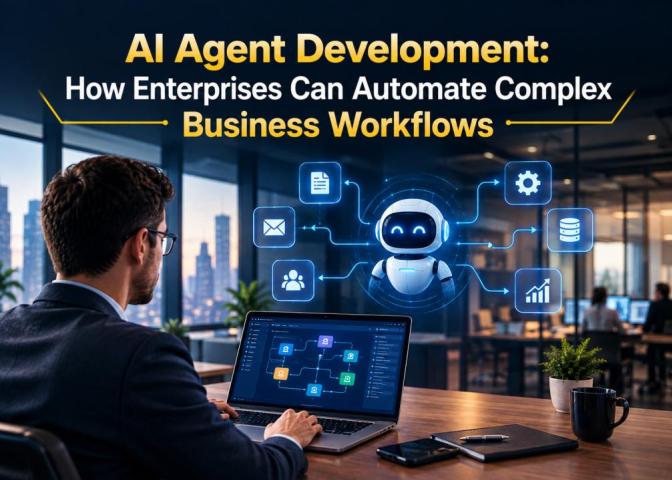
Enterprise workflows are becoming harder to manage as teams work across CRMs, ERPs, knowledge bases, communication tools, and business applications. Traditional automation can handle predefined rules, but it often struggles when a process requires judgment, context, or decisions based on changing information. AI agent implementation offers a different approach by enabling intelligent systems to understand tasks, make decisions, use business tools, and complete multi-step workflows. Businesses can work with an experienced AI Agent Development company to identify suitable use cases and build agents around their operational requirements.
What Are AI Agents in Enterprise Workflows?
AI agents are software systems designed to pursue a defined goal by interpreting information, reasoning about the next step, and taking actions through connected tools and systems.
Unlike conventional automation, which typically follows a fixed sequence of rules, AI agents can respond to changing conditions within a workflow. For example, an agent handling a procurement process could review a purchase request, retrieve relevant supplier information, check business policies, identify missing details, and route the request for approval.
This makes enterprise AI agents particularly useful for workflows that involve multiple systems, unstructured information, exceptions, or repeated decision-making.
An effective agent does not simply generate a response. It needs access to the right information, clearly defined permissions, reliable tools, and appropriate controls so it can perform actions safely.
Why Enterprises Are Moving Toward AI Agent Workflow Automation
Many enterprise processes contain repetitive tasks that still require employees to move information between systems and make routine decisions manually.
Consider a customer support workflow. A traditional automation may route a ticket based on predefined keywords. An AI agent can potentially interpret the customer's request, retrieve relevant account information, check previous interactions, determine the appropriate next action, and escalate the issue when human intervention is required.
This capability makes AI agent workflow automation relevant to areas such as:
Customer support and service operations
Sales qualification and lead management
IT service management
Finance and invoice processing
Employee onboarding
Procurement and vendor management
Document processing and knowledge management
Supply chain and operational workflows
The objective is not to remove people from every process. Instead, AI agents can handle appropriate operational steps while people retain control over decisions that require expertise, approval, or accountability. For customer-facing workflows that primarily involve conversations, FAQs, lead qualification, or support requests, businesses can also complement agentic workflows with AI chatbot services.
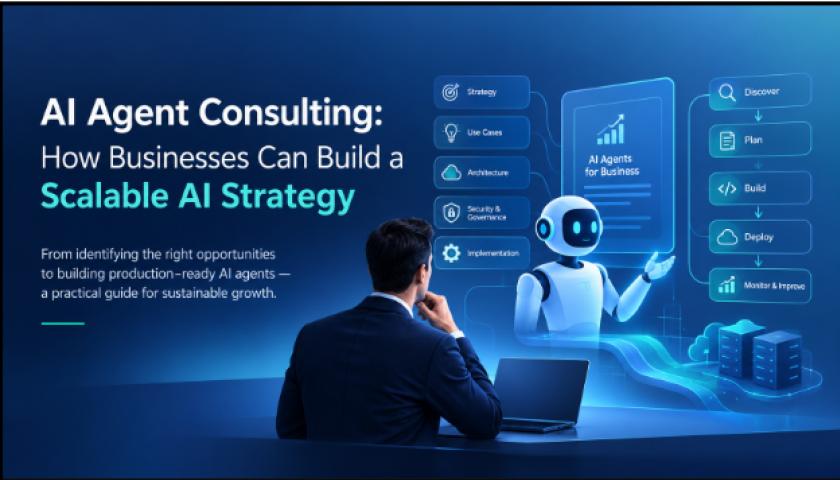
How to Implement AI Agents in Enterprise Workflows
Successful implementation requires more than selecting an AI model. Enterprises need to understand the workflow, define the agent's responsibilities, connect the required systems, and establish controls before moving into production.
1. Identify the Right Workflow
Start with the business process rather than the technology.
Map the workflow from beginning to end. Identify repetitive tasks, decision points, exceptions, manual data entry, system handoffs, and areas where employees spend significant time gathering information.
A good initial use case typically has a clearly defined objective, accessible data, measurable outcomes, and enough workflow volume to justify automation.
Avoid starting with an overly broad goal such as "automate customer operations." Instead, define a specific workflow such as ticket classification, customer onboarding, invoice validation, or internal knowledge retrieval.
2. Define the Agent's Role and Objectives
Once you select the workflow, establish exactly what the agent should and should not do.
Define:
The business objective
Tasks the agent can perform
Systems and tools it can access
Decisions it can make independently
Actions requiring human approval
Conditions that trigger escalation
Expected response and completion times
Clear boundaries are essential for enterprise deployments. An agent should not receive unrestricted access simply because it needs to interact with multiple systems.
3. Prepare Enterprise Data and Knowledge
AI agents need reliable context to make useful decisions.
Identify the information sources required by the workflow, such as CRM records, ERP data, internal documents, policies, databases, knowledge bases, or APIs.
Data should be structured, permission-controlled, and accessible through appropriate interfaces. For document-heavy workflows, retrieval-based approaches can help agents access relevant information without requiring every piece of business knowledge to be embedded directly into a model.
Data quality also matters. Outdated policies, duplicate records, incomplete customer information, or inconsistent terminology can reduce the reliability of agent-driven workflows.
4. Plan AI Agent Integration With Existing Systems
Enterprise workflows rarely operate inside a single application. This makes AI agent integration a critical implementation stage.
The agent may need to interact with CRM platforms, ERP systems, ticketing tools, databases, APIs, communication platforms, or internal applications.
Design these integrations around clearly defined tools and permissions. Each action should have an identifiable purpose and controlled access.
For example, an agent might read customer information from a CRM, check order details through an API, generate a response, and create a support ticket. Separating these capabilities into controlled tools makes the workflow easier to monitor and manage.
5. Build Human-in-the-Loop Controls
Not every decision should be fully autonomous.
Create approval and escalation mechanisms for sensitive or high-impact actions. An agent might prepare a refund recommendation but require an employee to approve the transaction. Similarly, it could identify a compliance issue and route the case to the appropriate specialist.
Human oversight is particularly important when workflows involve financial transactions, sensitive information, regulatory requirements, or decisions with significant business consequences.
6. Test Before Enterprise AI Agent Deployment
Testing should cover more than whether the agent produces a correct response.
Evaluate how it behaves when information is incomplete, conflicting, unexpected, or unavailable. Test incorrect inputs, failed API calls, permission restrictions, ambiguous requests, and unusual workflow conditions.
Measure factors such as:
Task completion accuracy
Tool-use accuracy
Response quality
Escalation accuracy
Failure rates
Latency
Cost per workflow
Human intervention rates
Start with a controlled pilot before expanding the agent to larger volumes or more business-critical workflows.
7. Monitor and Optimize After Launch
AI agent deployment is not the final step. Enterprise agents need continuous monitoring because business processes, data, models, integrations, and user behavior change over time.
Track workflow outcomes rather than focusing only on model-level metrics. Determine whether the agent is actually reducing manual effort, improving resolution times, increasing process consistency, or reducing operational bottlenecks.
Use production feedback to refine prompts, tools, retrieval strategies, workflows, escalation rules, and evaluation criteria.
Key Considerations for Enterprise AI Automation
Enterprise AI automation requires a strong foundation across technology, governance, and operations.
Security: Control what information agents can access and which actions they can perform.
Data governance: Establish rules for sensitive, confidential, and regulated information.
Observability: Maintain logs and monitoring for agent decisions, tool calls, failures, and workflow outcomes.
Scalability: Design infrastructure and integrations that can support increasing workflow volume.
Reliability: Define fallback mechanisms for unavailable systems, uncertain outputs, and failed actions.
Cost management: Monitor model usage, infrastructure costs, and the overall cost of completing each workflow.
Governance: Establish ownership, approval policies, testing procedures, and ongoing evaluation.
An enterprise AI program should also align agent initiatives with broader business objectives. A structured AI strategy consulting approach can help organizations assess AI readiness, prioritize use cases, define implementation roadmaps, and establish governance before scaling deployments.
AI Agents vs. Traditional Automation
Traditional automation remains valuable for predictable, rule-based processes. If a workflow always follows the same sequence and conditions, conventional automation may be sufficient.
AI agents become more useful when workflows require interpretation, contextual reasoning, dynamic decisions, or interaction with multiple systems.
In practice, enterprises do not necessarily need to choose between the two. A workflow can combine deterministic automation with AI agents. Rules can handle predictable steps, while agents manage tasks that require contextual reasoning or flexible decision-making.
This hybrid approach can provide greater control while still benefiting from agentic capabilities.
Best Practices for Scaling AI Agents Across the Enterprise
Once an initial workflow demonstrates value, enterprises can expand carefully.
Start by creating reusable components for authentication, monitoring, tool access, evaluation, and governance. Establish consistent standards for agent development and deployment so every new workflow does not require an entirely separate architecture.
Prioritize use cases based on business value, feasibility, data readiness, and risk. Keep human oversight where it provides meaningful control, and continuously evaluate agents against real business outcomes.
Most importantly, treat AI agents as operational systems rather than standalone AI experiments. Their success depends on the surrounding data, integrations, workflows, security controls, and people.
Conclusion
Implementing AI agents in enterprise workflows requires a structured approach. Start with a well-defined business process, establish the agent's responsibilities, connect trusted enterprise data and systems, introduce human oversight, test real-world scenarios, and continuously monitor performance.
When implemented correctly, AI agents can extend automation beyond fixed rules and support complex workflows that require contextual understanding and multi-step decision-making. The key is to scale based on measurable business outcomes while maintaining security, governance, and human control.