Businesses today use mobile applications to sell products, serve customers, manage operations, and create digital experiences across multiple touchpoints. But building an app that works well at launch is only part of the challenge. Businesses also need applications that can handle growing users, changing requirements, third-party integrations, and increasingly complex workflows. This is where mobile app development solutions become important, helping businesses plan the complete mobile ecosystem around users, business processes, backend infrastructure, integrations, security, and long-term scalability.
What Are Mobile App Development Solutions?
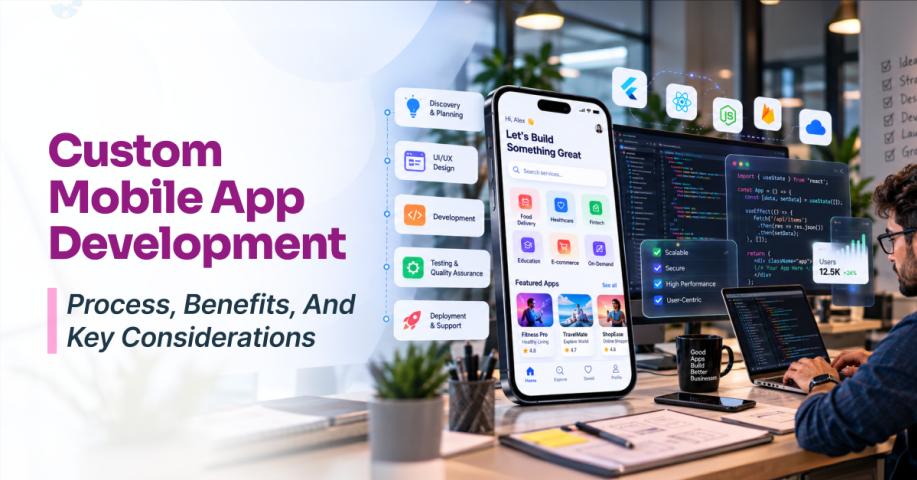
Mobile app development solutions cover the complete process of planning, designing, developing, integrating, testing, deploying, and maintaining mobile applications.
The right solution depends on the business model, users, workflows, integrations, and expected scale. A customer-facing retail app may need product catalogs, payments, order tracking, and personalization, while an enterprise application may require employee authentication, role-based access, internal workflows, and business system integrations.
A scalable approach treats the application as part of a larger technology environment rather than simply a collection of screens and features.
Typical components include:
Business and technical requirement analysis
Product and UX strategy
UI/UX design
Native or cross-platform development
Backend and API development
Database and cloud infrastructure
Third-party integrations
Authentication and security
Quality assurance and performance testing
App Store and Google Play deployment
Analytics, monitoring, and maintenance
Different Business Requirements Need Different Mobile Solutions
There is no single architecture or feature set that works for every organization. The right approach depends on industry requirements, user expectations, integrations, compliance needs, and business goals.
Customer-Facing Mobile Applications
Customer-facing apps simplify interactions between businesses and their customers. Examples include retail, banking, travel, loyalty, subscription, and customer service applications.
These apps typically prioritize intuitive navigation, fast performance, personalization, notifications, secure authentication, and seamless transactions. The goal is not simply to move an existing website onto mobile but to create mobile-specific experiences that make important customer journeys faster and easier.
Enterprise Mobile Applications
Enterprise applications support employees, managers, partners, and internal processes. They may include employee management, field service, CRM workflows, inventory management, dashboards, approval workflows, document management, and internal communication.
Businesses implementing these applications often need to connect mobile workflows with existing enterprise systems. Enterprise mobility solutions can support broader mobile strategies that connect employees, business applications, data, and operational processes.
E-Commerce Applications
E-commerce applications need to support the complete purchasing journey, from product discovery to payment and post-purchase support.
A scalable e-commerce app may include:
Product catalogs and search
Personalized recommendations
Shopping carts and payments
Order management and tracking
Customer reviews
Push notifications
Customer support
The backend must also handle traffic spikes during promotions, seasonal sales, and other high-demand periods.
Healthcare Applications
Healthcare applications require strong attention to usability, privacy, security, and data management. Depending on the use case, they may support appointment scheduling, telehealth consultations, patient portals, prescription management, health records, provider communication, remote monitoring, and payments.
These applications may also need to integrate with existing healthcare systems and APIs. The architecture therefore needs to account for interoperability, access control, data protection, and reliable performance.
Transportation and Logistics Applications
Transportation applications often combine real-time data, location services, payments, and operational workflows. Examples include ride-hailing, fleet management, driver applications, shipment tracking, route management, and delivery platforms.
These use cases require reliable location handling, real-time updates, notifications, mapping integrations, and backend systems capable of processing large volumes of operational data.
On-Demand Service Applications
On-demand platforms connect customers with service providers through mobile applications. Food delivery, home services, maintenance, beauty, grocery delivery, and local transportation are common examples.
These platforms often require separate experiences for customers, service providers, and administrators. The backend must coordinate bookings, availability, payments, notifications, locations, and status updates across different users.
How Businesses Build Scalable Mobile Applications
Scalability should be considered from the beginning rather than treated as a post-launch improvement.
1. Start With Business and User Requirements
The first step is defining what the application needs to accomplish. Businesses should identify target users, core problems, primary workflows, required integrations, revenue models, expected user volume, security requirements, and future expansion plans.
This helps prevent unnecessary features from increasing development complexity and cost.
2. Choose the Right Application Architecture
Architecture determines how easily an application can evolve. Depending on the project, businesses may consider native development, cross-platform development, cloud-based backends, modular architectures, or microservices.
The right choice depends on performance requirements, device capabilities, development resources, integrations, and long-term maintenance needs.
3. Build a Strong Backend and API Layer
A mobile application is only as reliable as the systems supporting it. Complex applications may connect with CRM and ERP platforms, payment gateways, cloud services, analytics platforms, mapping services, authentication providers, and communication APIs.
For applications with complex business logic and integrations, custom software development services can support backend architecture, APIs, databases, and supporting systems required to connect the mobile experience with the broader technology ecosystem.
A well-designed API layer also makes it easier to introduce new features and connect additional platforms as the business grows.
4. Design for Security From the Start
Security should be incorporated throughout the development lifecycle rather than added just before launch. Key considerations include:
Secure authentication
Role-based access control
Data encryption
Secure API communication
Session management
Input validation
Secure storage
Vulnerability testing
Monitoring and logging
Security requirements should reflect the industry and the type of information handled by the application.
5. Build Around Real User Journeys
A scalable app also needs to remain easy to use as functionality expands. Instead of designing screens independently, teams should map complete user journeys.
For example, an e-commerce journey could move from Search → Product → Cart → Payment → Order Tracking → Support. Each stage should be optimized for speed, clarity, and minimal friction.
6. Test for Performance and Real-World Conditions
Testing should cover more than whether individual features work. Teams should evaluate application performance, API response times, network interruptions, device compatibility, concurrent users, security vulnerabilities, payment workflows, notifications, location functionality, and backend load.
Performance testing is particularly important for applications expected to handle large user volumes or transaction-heavy workflows.
Native vs. Cross-Platform Development
Businesses often need to decide whether to build separate native applications or use a cross-platform framework.
Native development can provide deeper access to platform-specific capabilities and may suit applications with demanding performance or device requirements. Cross-platform development allows businesses to share more of the codebase across platforms, potentially simplifying development and maintenance.
The right approach depends on functionality, target platforms, performance expectations, available resources, and the long-term product roadmap.
How AI and Cloud Technologies Are Shaping Mobile Applications
Modern mobile applications increasingly rely on cloud infrastructure and intelligent capabilities. Cloud platforms can provide scalable infrastructure, databases, storage, APIs, monitoring, and other backend capabilities.
AI can add capabilities such as:
Personalized recommendations
Conversational assistance
Predictive analytics
Intelligent search
Fraud detection
Automated customer support
Workflow automation
However, AI should be introduced based on a clear business use case rather than simply because the technology is available.
What Makes a Mobile Application Scalable?
Scalability is more than supporting a larger number of users. A scalable application should accommodate increasing traffic, more transactions, additional features, new user roles, new markets, larger datasets, and evolving business processes.
For example, an application initially designed for 10,000 users may require a significantly different infrastructure strategy if the business expects to reach several million users. Planning for growth early can reduce expensive architectural changes later.
How to Choose a Mobile App Development Partner
Choosing a development partner involves more than reviewing portfolios. Businesses should evaluate:
Experience with similar application types
Technical and architectural expertise
UI/UX capabilities
Backend and integration experience
Security practices
Quality assurance processes
Cloud and DevOps capabilities
Post-launch maintenance
Communication and project management
A capable mobile app development company should be able to understand business requirements, translate them into a technical strategy, and support the product beyond the initial launch.
Final Thoughts
Building a scalable mobile application requires more than developing a collection of mobile screens. Businesses need to consider the complete ecosystem, including user experience, application architecture, backend systems, APIs, integrations, security, infrastructure, and ongoing maintenance.
Customer-facing applications, enterprise platforms, e-commerce products, healthcare systems, transportation applications, and on-demand services all have different technical requirements.
By starting with clear business objectives and designing the mobile ecosystem around long-term growth, businesses can create applications that are easier to scale, integrate, maintain, and evolve as their requirements change.