Introduction
The Union Public Service Commission (UPSC) Civil Services Examination is one of India's most competitive examinations. Choosing the right optional subject can make a significant difference in a candidate's preparation strategy. Sociology is a popular optional subject because it offers a systematic understanding of society, social relationships, institutions, and social change. Understanding the sociology optional syllabus UPSC is the first step toward building an effective study plan and improving performance in the Mains examination.
The Sociology optional subject is particularly useful for candidates interested in understanding social issues, including inequality, caste, gender, education, religion, and rural and urban development. Its concepts can also support preparation for General Studies papers and essay writing.
Understanding the UPSC Sociology Optional Syllabus
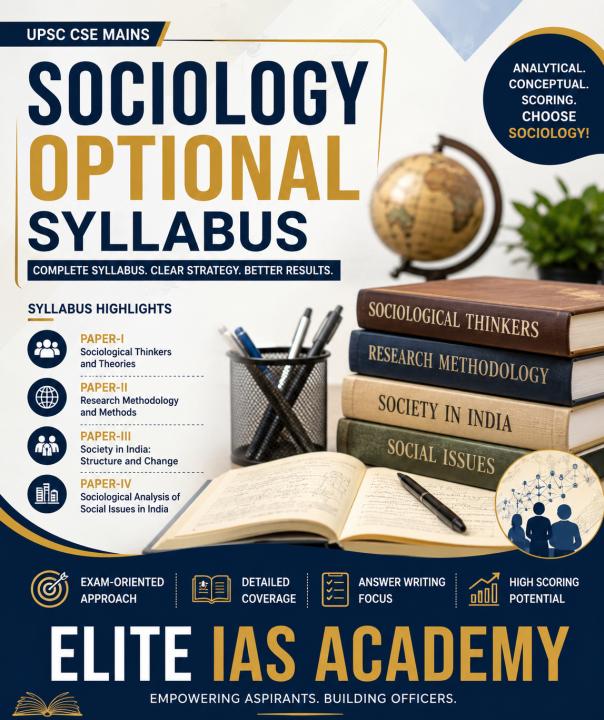
Sociology optional carries 500 marks in the UPSC Civil Services Mains examination, divided equally between Paper I and Paper II, with 250 marks each. Both papers require conceptual clarity, analytical thinking, and the ability to apply sociological theories to real-world situations.
The syllabus combines fundamental sociological concepts with the study of Indian society. Candidates should understand both the theoretical foundations of sociology and their practical relevance to contemporary social issues.
Paper I: Fundamentals of Sociology
Paper I focuses on the basic concepts, theories, and methods used to study society. It helps candidates develop a strong theoretical foundation before moving on to Indian society in Paper II.
1. Sociology: The Discipline
This section introduces sociology as a discipline, including its relationship with other social sciences. Candidates study the emergence of sociology, the development of modern society, and the relationship between sociology and common sense.
2. Sociology as Science
This topic covers scientific methods, objectivity, research methodology, and different approaches to sociological investigation. Candidates should understand the challenges of studying human behaviour scientifically.
3. Research Methods and Analysis
Research methodology is an important part of the syllabus. It includes qualitative and quantitative methods, surveys, interviews, participant observation, sampling, and the interpretation of sociological data.
4. Sociological Thinkers
Candidates must study the major contributions of influential sociologists, including Karl Marx, Émile Durkheim, Max Weber, Talcott Parsons, Robert K. Merton, and George Herbert Mead.
Understanding their theories, key concepts, and applications is essential. For example, Marx's theory of class conflict and Weber's analysis of authority can help candidates explain social inequality and power structures.
5. Stratification and Mobility
This section examines social inequality, class, status, power, social mobility, and theories of stratification. Candidates should understand how social hierarchies develop and how they influence opportunities and life chances.
6. Work, Economic Life, and Politics
The syllabus explores the relationship between society, the economy, and political institutions. Topics include the division of labour, industrialisation, political parties, pressure groups, and the sociological understanding of power.
7. Religion, Kinship, and Social Change
Candidates study religion as a social institution, family and marriage, kinship systems, and processes of social change. These areas provide insights into how traditions, beliefs, and relationships shape society.
Paper II: Indian Society and Social Change
Paper II applies sociological perspectives to Indian society. It is particularly relevant for candidates who want to connect theoretical knowledge with current social developments and historical processes.
1. Perspectives on Indian Society
Candidates study major approaches to understanding Indian society, including the Indological, structural-functional, and Marxist perspectives. Important sociologists associated with the study of Indian society should also be covered.
2. Social Structure of Indian Society
This section includes caste, class, tribes, kinship, family, and religion in India. Candidates should understand how these institutions influence identity, social relationships, and access to resources.
3. Social Changes in India
The syllabus examines colonialism, industrialisation, urbanisation, modernisation, and globalisation. Candidates should explore how these processes have transformed Indian institutions, communities, and social values.
4. Rural and Agrarian Social Structure
This topic covers village communities, land relations, agrarian classes, and changes in rural society. Issues such as migration, agricultural transformation, and rural development can help illustrate these concepts.
5. Caste, Class, and Social Inequality
Caste remains a significant subject in the study of Indian society. Candidates should understand caste systems, social mobility, caste-based inequalities, and movements seeking social justice. Class relations and economic inequality should also be examined.
6. Social Movements
The syllabus includes peasant, tribal, women's, Dalit, and other social movements. Candidates should understand their origins, objectives, leadership, and effects on Indian society.
7. Population and Social Problems
Topics include population growth, demographic change, poverty, unemployment, illiteracy, gender inequality, and other social challenges. Candidates should connect sociological explanations with relevant examples and policy developments.
How to Prepare for the Sociology Optional Syllabus UPSC
A structured preparation strategy can make the syllabus easier to manage.
1. Read the official syllabus carefully. Divide Paper I and Paper II into individual topics and use the syllabus as a checklist throughout preparation.
2. Build conceptual clarity. Begin with introductory sociology resources before studying advanced theories. Focus on understanding concepts instead of memorising definitions.
3. Study sociological thinkers systematically. Prepare concise notes on each thinker's major theories, concepts, criticisms, and practical applications.
4. Connect theory with contemporary examples. Use relevant examples from Indian society, government reports, social developments, and reputable publications to strengthen answers.
5. Practise previous years' questions. Analyse UPSC Mains questions to understand recurring themes, question patterns, and the depth of analysis expected.
6. Develop answer-writing skills. Practise structured answers with a clear introduction, relevant sociological concepts, supporting examples, balanced analysis, and a concise conclusion.
7. Revise regularly. Create short notes, comparison charts, and topic-wise summaries to improve recall and reduce the burden of revision before the examination.
Common Mistakes to Avoid
Candidates sometimes treat Sociology as a subject based entirely on general knowledge. However, high-quality answers require the appropriate use of sociological concepts and thinkers. Avoid writing purely descriptive answers without analysis.
Another common mistake is neglecting Paper II or preparing it only through current affairs. Indian society topics require a strong understanding of sociological perspectives, historical developments, and social structures. Regular revision and answer-writing practice are equally important for both papers.
Conclusion
The sociology optional syllabus UPSC provides a comprehensive framework for understanding society, social institutions, inequality, and social transformation. Paper I establishes the theoretical foundation, while Paper II focuses on the structure and development of Indian society.
Candidates can approach the subject effectively by understanding the syllabus, studying important thinkers, connecting theories with contemporary examples, and practising previous years' questions. With consistent revision and disciplined answer writing, Sociology can become a well-organised and rewarding optional subject for the UPSC Civil Services Mains examination.