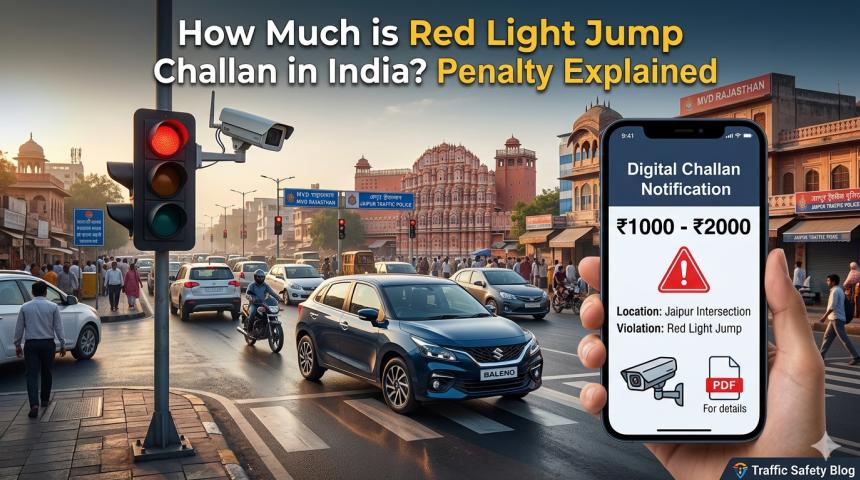

You can drive past a camera in Jaipur on a Tuesday and discover the fine weeks or even months later, from an SMS or when an insurance renewal stalls. The lag between the violation and the notice is the least understood of India's e-challan system. This guide follows a challan from its generation to its pay, dispute or court route.
What an e-challan is
An e-challan is the electronic equivalent of a traffic fine receipt. Instead of an officer filling out a paper slip, the violation is digitally recorded and bound to the vehicle's registration number and stored in a central system. It can be checked and paid online. The Parivahan e-challan portal and the mParivahan app are the national places to search for one. The two ideas that mostly explain the system are that the challan attaches to the vehicle, not the driver, and that it remains until its paid, disputed or escalated.
Step 1: How violations are detected
There are two main routes. A police or transport officer records an offence on a device at the roadside in the first. Cameras and sensors in the second detect violations like speeding, signal jumping and not wearing protective gear. The legal backing behind camera enforcement comes from Section 136A of the Motor Vehicles Act, added by the 2019 amendment and provides for the electronic monitoring of road safety. Rule 167A of the Central Motor Vehicles Rules lays out requirements for the use of electronic enforcement devices to issue challans. In 2024 the Supreme Court asked states and union territories to implement these provisions and monitor their progress.
Step 2: From violation to notice
Once recorded, the system matches the registration number to the vehicle database and generates the e-challan, which is then sent to the contact details associated with the registration certificate (RC) as an SMS. This is where fines most often go unseen. If the mobile number on the RC is old or belongs to a previous owner, the message never reaches the person who needs it. Timing rules also matter. The Central Motor Vehicles Rules are described as requiring that a notice be given within 15 days of an electronically detected offence, and courts have been asked to decide cases when notices arrived months later. In Kerala, for instance, a petitioner in the High Court was faced with speeding challans that reached him almost six months after the incident. How these cases end depends on the facts and the court, so a late notice is a reason to ask questions, not an automatic cancellation.
Step 3: Checking a challan
A challan can be checked by vehicle number, challan number or driving licence number on the national portal, state traffic police websites and the mParivahan app. A search by vehicle number is the most useful, because it lists everything pending against the vehicle.
Step 4: Paying
Payment is available online through UPI, cards and net banking on the official portals and some apps. Whatever the channel, the sensible routine is the same: confirm on the official record, pay, save the receipt ID and check again later to see that the status shows paid. Payment links received by SMS or WhatsApp are best to be suspected, since fake challan messages are a known scam.
Step 5: Deadlines vary
There is no one number that every state follows. A transport department FAQ in one state says an e-challan should be paid within 15 days of issue. Other guides commonly quote 60 to 90 days, and Delhi announced a framework in 2026 that sets a 45-day window to pay or contest. The reliable deadline is the one printed on your own challan.
What is more consistent is the escalation. Under Rule 167(5) of the Central Motor Vehicles Rules, an e-challan that isn't paid within 90 days is forwarded automatically to a virtual court.
Step 6: The virtual court
Virtual courts handle eligible, lower-level offences online so the driver doesn't have to appear in a courtroom. The aim is to cut paperwork and delays. A person can choose to contest the case in a regular court if they want. One national government summary reports that in Gujarat alone, about 38.25 lakh e-challans have been forwarded to the virtual court, showing how large the volume is. The national virtual court portal is vcourts.gov.in.
Step 7: The consequences of ignoring a challan
Unpaid challans can lead to a virtual court summons, additional penalties and blocked vehicle services. A state transport FAQ notes that services such as transfer of ownership and the addition or termination of hypothecation can be affected and insurance renewals can stall as well. It is why a pending fine matters beyond its amount.
Step 8: If a challan is wrong
Camera systems can misread plates and records can contain errors. If a fine doesn't match your vehicle, location or time, don't pay it blindly and don't ignore it. Collect your evidence, raise a grievance through the Parivahan portal or the relevant traffic office and keep every acknowledgement number until the matter is closed.
State snapshots
Enforcement is national in structure and local in practice with different cameras, police departments and timelines. A few snapshots are:
- Rajasthan: The state launched its first virtual court in July 2022 for minor traffic offences, starting with Jaipur challans. See the challan check rajasthan.
- Gujarat: The state moved from paper-based enforcement to a digital system and is setting up virtual traffic courts under the One Nation One Challan initiative. See the Gujarat challan check.
- Kerala: Camera enforcement has produced legal disputes over notice timing, as the High Court case above demonstrates. See the Challan Check Kerala.
- West Bengal: The Supreme Court named it one of the states asked to report on compliance with Section 136A. See the wb challan.
- Uttar Pradesh: One of the largest vehicle populations to check, with the same national lookup. See the UP challan check.
Where MyMotor fits in
Checking a challan is one task among several that vehicle owners juggle. MyMotor, through its website MyMotor.in and its challan check app, aims to bring these tasks together:
- Challan checking by vehicle number, with state specific pages for quick access.
- Vehicle and RC details, including available registration and RTO information.
- Challan payment options in one flow.
- Insurance, PUC and FASTag services for the other recurring chores.
- GloveBox, powered by DigiLocker, for convenient access to digital documents and a Garage feature for managing more than one vehicle.
- EV charging station discovery for electric vehicle owners.
- An ad-free experience, on both the website and the Challan Check App.
As with any third-party tool, check the challan details against official records before paying.
Key takeaways
An e-challan is tied to the vehicle's registration number.
Fines are generated by cameras or officers, devices and notified to the RC mobile number.
Deadlines vary by state and unpaid challans can reach a virtual court after 90 days.
A wrong challan should be disputed with evidence, not ignored.
Checking by vehicle number, regularly, is the simplest protection.